
Ornamental Air Conditioning Unit, Frederick M. Jones (1950)
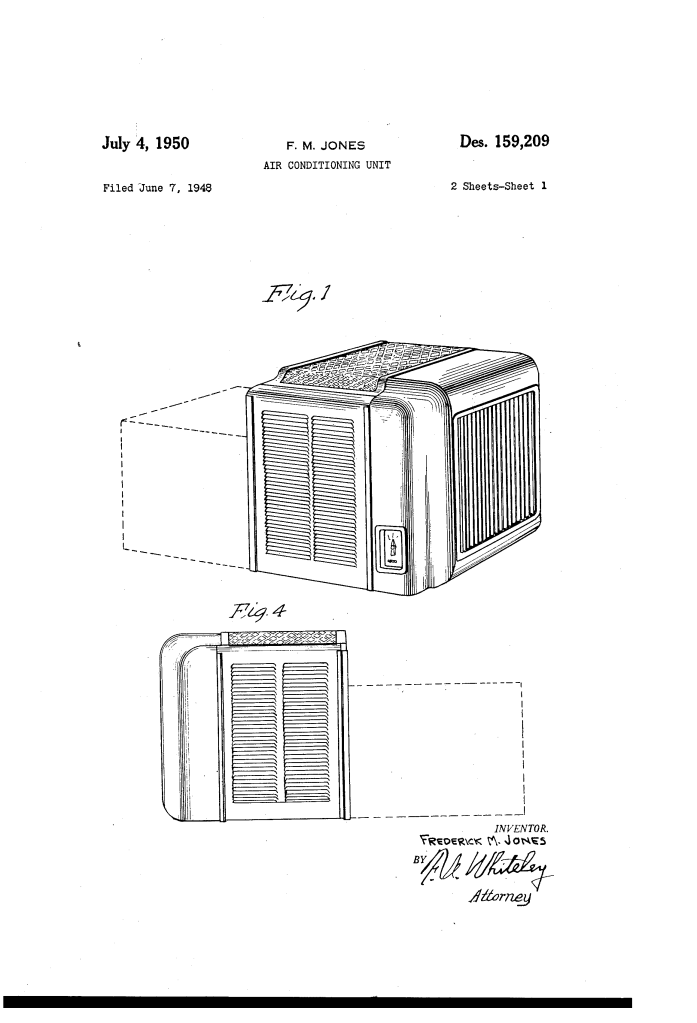
Patented on July 4, 1950, this design patent (U.S. Patent No. Des. 159,209) represents the aesthetic and structural maturation of Frederick M. Jones’s world-changing refrigeration technology. While his previous patents focused on the “guts” of the machine—the compressors and control systems—this patent protects the unique industrial design of the unit itself.
This specific look became the “face” of Thermo King, the company Jones co-founded. It was designed to be mounted on the exterior of a truck or trailer, meaning it had to be aerodynamic, rugged, and visually distinct.
The “Why” of the Design
- Aerodynamics: Because these units were mounted on the front of trailers (the “nose”), they were subjected to intense wind resistance at highway speeds. The rounded corners and sloped top helped reduce drag.
- Serviceability: The design allowed for quick access to the internal engine and compressor. In the 1940s and 50s, downtime for a repair meant a load of food could spoil, so “form followed function.”
- Brand Identity: Before this, most refrigeration units were messy collections of exposed pipes and motors. Jones’s design “shrouded” the components in a professional, sleek housing that signaled reliability to fleet owners.
Key Design Features
1. The Louvered Front Grille
The most striking part of the design is the series of horizontal slats (louvers) on the front face.
- Function: These allowed maximum airflow into the radiator and condenser while protecting the internal components from road debris, rocks, and rain.
- Aesthetics: The repetitive horizontal lines gave the unit a “Streamline Moderne” look, which was the height of industrial fashion in the mid-20th century.
2. The Integrated Mounting Flange
The unit features a distinctive flanged edge where it meets the trailer wall.
- The “Nose-Mount” Legacy: Jones pioneered the “one-piece” unit. Instead of having a motor outside and a separate evaporator inside connected by long hoses, his design allowed the entire “package” to slide into a hole in the trailer wall.
- Weather Sealing: The design shows a clear, wide border that ensured a gas-tight, waterproof seal against the vehicle.
3. Asymmetric Portals
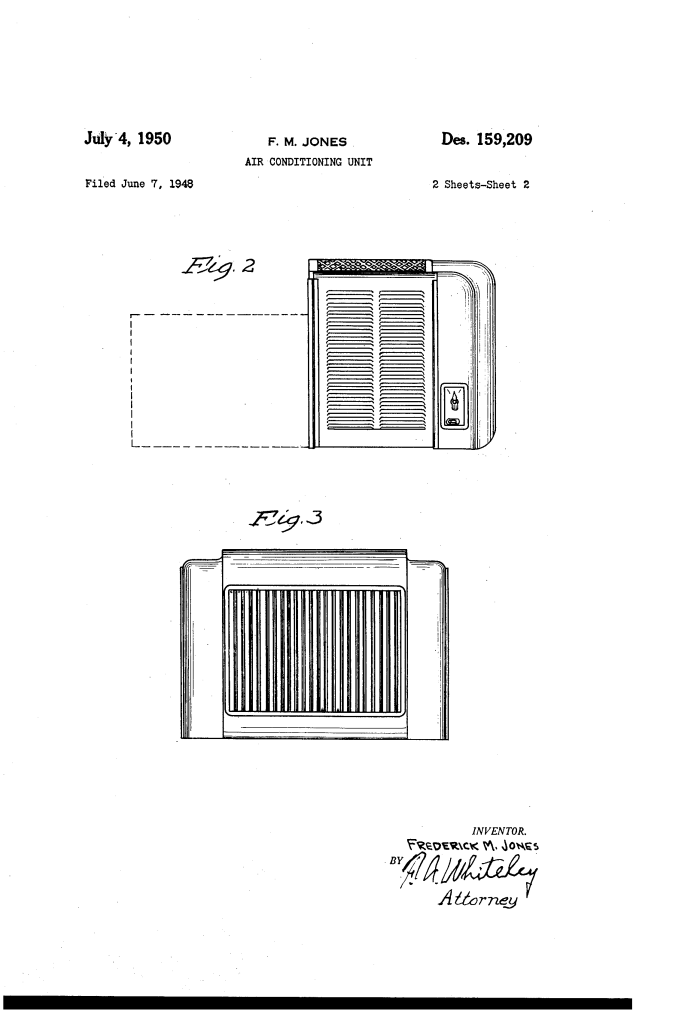
As seen in Fig. 1 and Fig. 2, the sides of the unit are not identical.
- The Exhaust and Intake: One side typically featured an opening for the engine’s exhaust, while the other provided access to the starter or fuel controls.
- Compact Curvature: The tight radius of the corners allowed the unit to fit within the “swing clearance” of a truck cab, preventing the trailer from hitting the truck during sharp turns.
Visual Breakdown of the Drawings
| Figure | Viewpoint | Key Detail |
| Fig. 1 | Perspective | Shows the three-dimensional “hump” shape that became iconic for Thermo King. |
| Fig. 2 | Side View | Highlights the sloped front profile, designed to shed water and wind. |
| Fig. 3 | Front View | Focuses on the symmetry of the cooling slats and the central mounting bolt locations. |
| Fig. 4 | Reverse Side | Shows the flat mounting surface that sits flush against the refrigerated cargo area. |
Significance
Frederick M. Jones was more than just a mechanical genius; he understood that for a product to revolutionize an industry, it had to be packaged correctly.
- Standardization: This design set the standard for how transport refrigeration looks even today. If you look at a modern semi-truck trailer, the “repro” units still follow this basic silhouette.
- The “Model C”: This specific design patent is closely associated with the Thermo King “Model C,” the unit that proved refrigeration could survive the vibration and harshness of the open road.
- Recognition: In 1991, decades after this design became a staple of the American highway, Jones was posthumously awarded the National Medal of Technology, the first African American to receive the honor.
Final Insight: Des. 159,209 isn’t just a drawing of a box; it’s the blueprint for the “Cold Chain.” By housing his complex inventions in this specific, rugged shell, Jones made it possible for fresh produce to travel from California to New York without ever breaking a sweat.
