
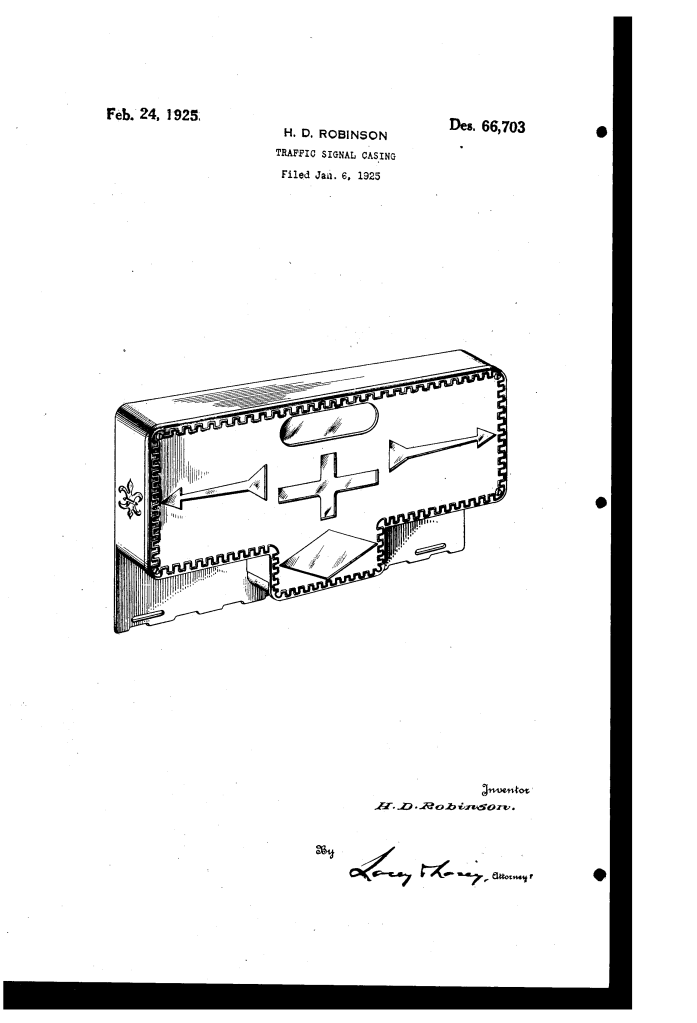
Design for a Traffic-Signal Casing (Hassel D. Robinson, Des. 66,703)
This patent, granted on February 24, 1925, represents a Design Patent created by Hassel D. Robinson of Washington, D.C. Unlike a utility patent, which focuses on how a device works, this design patent (Des. 66,703) protects the specific ornamental appearance and aesthetic form of a traffic-signal casing.
Inventor Background: Hassel D. Robinson
Hassel D. Robinson was an African American inventor living in the nation’s capital during a pivotal era for urban infrastructure. In the mid-1920s, cities were transitioning from manual traffic “semaphores” (like Garrett Morgan’s hand-cranked signal) to permanent, electrically housed units. Robinson’s design contributed to the professionalization and standardization of the “traffic tower” look that defined the streetscapes of early 20th-century America.
Key Design Features
Robinson’s design is characterized by its balanced, architectural silhouette, moving away from purely utilitarian “boxes” toward a more stylized, decorative housing.
- Symmetrical Tiered Structure: The casing features a vertical, rectangular body with a distinct tiered or “stepped” top and bottom. This reflects the Art Deco influence of the 1920s, giving the signal a monumental, pillar-like appearance.
- Three-Lens Configuration: The design clearly displays three circular apertures on each face. This was intended to house the Red, Yellow (Caution), and Green lenses that were becoming the national standard following the 1923 innovations in traffic logic.
- Hooded Visors: Each signal lens aperture is shielded by a prominent visor or “cowl.” This design element was both aesthetic and functional, reducing sun glare to ensure the lights remained visible to drivers even in direct sunlight.
- Multi-Directional Capability: The perspective view in the patent shows a four-way housing, designed to be suspended over the center of an intersection or mounted on a central pedestal, providing clear instructions to traffic approaching from all four cardinal directions.
Design vs. Utility: The 7-Year Term
The patent specifies a term of 7 years. In the 1920s, design patents were often issued for shorter terms (3.5, 7, or 14 years) compared to the standard 17-year utility patent. This reflects the fast-moving nature of industrial design; as car heights and speeds changed, signal casings had to be redesigned frequently to maintain optimal visibility and urban aesthetics.
Significance to Urban History
While Garrett Morgan is often credited with the logic of the three-position signal, inventors like Hassel D. Robinson were responsible for the industrial identity of these machines.
- Civic Architecture: Robinson’s design treated the traffic signal as a piece of civic furniture. The ornamental detailing allowed these new mechanical “policemen” to blend into the sophisticated architecture of cities like Washington, D.C.
- Evolution of Safety: By standardizing the visor-shaded, three-light housing, Robinson helped solidify the visual language of the road. His design ensured that drivers knew exactly where to look and could clearly distinguish the colors regardless of the weather or time of day.
