
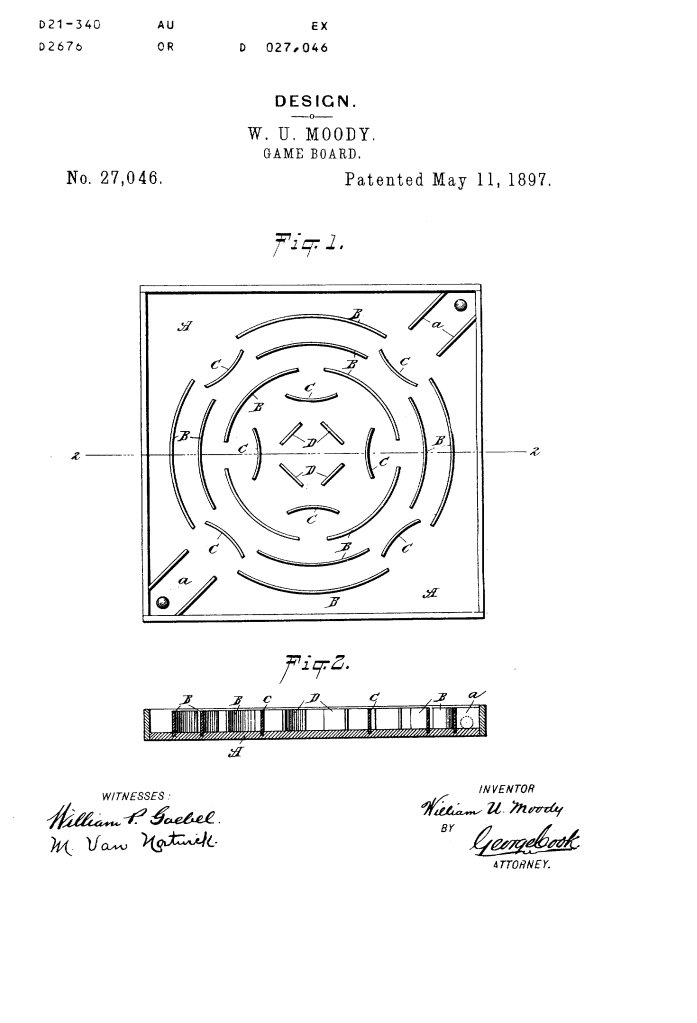
Design for a Game-Board (1897)
U.S. Design Patent No. 27,046, granted on May 11, 1897, to William U. Moody, describes an ornamental design for a tabletop game board featuring an intricate, labyrinthine partition layout. William U. Moody, a resident of Pottsville, Pennsylvania, filed the design application on March 13, 1897, securing protection for a term of three and a half years.
The design established a distinct visual configuration intended to guide playpieces, marbles, or balls through concentric, curved defensive barriers toward or away from a central goal area.
The Core Design: Concentric Curved Partitions
The leading visual feature of Moody’s design is a structured rectangular playing field divided by specialized wall segments shaped into circular arcs and straight barriers.
- The Rectangular Base (A): The main flat surface supporting all elevated game barriers.
- Opposed Radial Corner Partitions (a): Distinct partition sets located in diagonally opposite corners of the board, serving as entry zones, staging areas, or corner hazards.
- Primary Curved Partitions (b): Longer sectional partitions distributed symmetrically around the board’s center, bent in uniform circular arcs in one shared direction.
- Reverse-Curved Deflector Partitions: Shorter sectional partitions placed directly opposite the openings between the longer partitions, curved in the reverse direction to create challenging zig-zag pathways.
- Central Inner Partitions: Straight barrier segments positioned at the very center of the board, forming the interior goal or terminal pocket.
Key Design Elements
The board layout is organized into distinct functional zones to create visual rhythm and game flow:
| Component | Design Feature | Visual & Game Function |
| Base (A) | Rectangular foundation | Provides the playing field and boundary for all interior game elements. |
| Corner Partitions (a) | Diagonally opposed radial walls | Anchors the corners of the board, serving as starting or scoring pockets. |
| Outer Long Partitions (b) | Arcs of circles curving in one direction | Forms the main outer concentric track to guide pieces along curved paths. |
| Shorter Outer Partitions | Arcs curving in the opposite direction | Guards the openings in the long partitions, forcing deliberate navigation. |
| Central Partitions | Straight vertical/horizontal segments | Encloses the central bullseye or finishing zone of the board. |
Visual and Spatial Flow
Moody’s configuration uses alternating curves to dictate movement across the board surface:
- Staging: Pieces begin in the open channels or within the dedicated radial corner zones (a).
- Traversing the Outer Rings: Movement toward the center requires navigating through the alternating curved wall segments (b).
- Navigating the Baffles: The shorter, reverse-curved partitions prevent direct passage through perimeter gaps, acting as visual deflectors.
- Reaching the Core: Pieces finish by passing through the final narrow passages defined by the straight inner barriers.
About the Inventor: William U. Moody
William U. Moody was an American inventor based in Pottsville, Schuylkill County, Pennsylvania, during the late Victorian era.
- Era of Innovation: The late 1890s marked a major expansion in mass-produced parlor games and physical dexterity toys across the United States.
- Design Focus: Moody’s work captured the period’s growing demand for geometric parlor entertainment, combining visual symmetry with mechanical gameplay elements.
Summary of Claims
The patent explicitly claims:
- The ornamental design for a game-board featuring a rectangular base with curved sectional partitions, diagonally opposed corner radial walls, and straight central inner barriers, as shown and described.
