
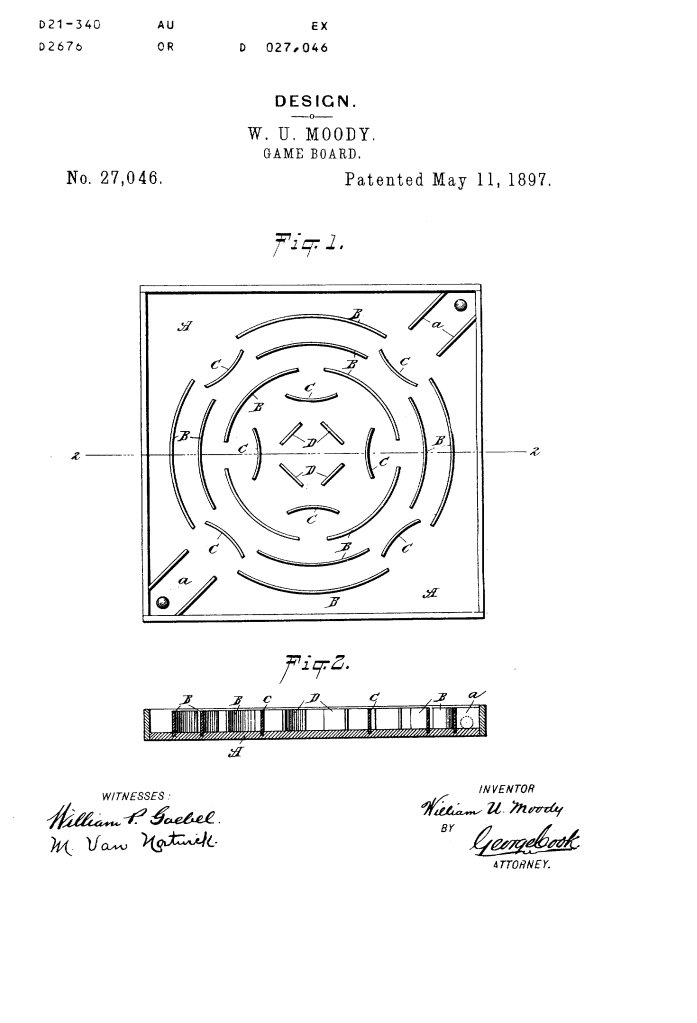
Design for a Game-Board (William U. Moody, No. 27,046)
The document is a Design Patent (No. 27,046) granted to William U. Moody of Pottsville, Pennsylvania, on May 11, 1897, for a new and original Design for a Game-Board. Design patents protect the ornamental appearance of an article.
Inventor Background: William U. Moody
William U. Moody was an inventor residing in Pottsville, Pennsylvania. His contribution, a design patent, focuses on the aesthetic and functional arrangement of partitions on a game board, indicating a contribution to the popular recreational and entertainment market of the late 19th century.
Design Description
The design consists of a unique arrangement of curved and straight sectional partitions on a rectangular base.
- Base (A): A simple rectangular base.
- Radial Partitions (): Located in diagonally opposite corners of the base.
- Sectional Partitions (): Distributed around the center of the base, these partitions form the leading feature of the design.
- Curvature: The longer sectional partitions are bent or curved in one direction (e.g., concave).
- Opposite Curvature: The shorter partitions, located opposite the openings between the longer partitions, are bent or curved in the opposite direction (e.g., convex).
- Central Partitions (): The innermost partitions are straight.
Visual Summary: The overall design is characterized by a concentric arrangement of partitions that alternate in curvature, creating an appearance of flowing or opposing arcs and directing the viewer’s eye toward the center.
Concepts Influenced by This Invention
As a design patent, its influence is primarily aesthetic and functional in the layout of subsequent game boards, particularly those involving marbles, balls, or projectiles.
- Partitioned Maze Geometry: The use of curved and opposing partitions (arcs of circles) to define pathways, pockets, and obstacles influenced the design of various mechanical board games, pinball-like devices, and coin-operated amusement games. The specific geometry guides rolling pieces and controls their path unpredictably.
- Aesthetic Functionality: The design demonstrates the principle of using ornamental geometry (the alternating arcs) to directly serve a mechanical function (guiding and separating game pieces), which is standard in game design.
- Layout of Target Games: The arrangement of partitions to create centralized, straight pockets (partitions
) surrounded by curved barriers (partitions
) is a layout frequently used in bagatelle, billiards, and target games where the objective is to land a piece in the center after navigating a complex, deflected perimeter.
