
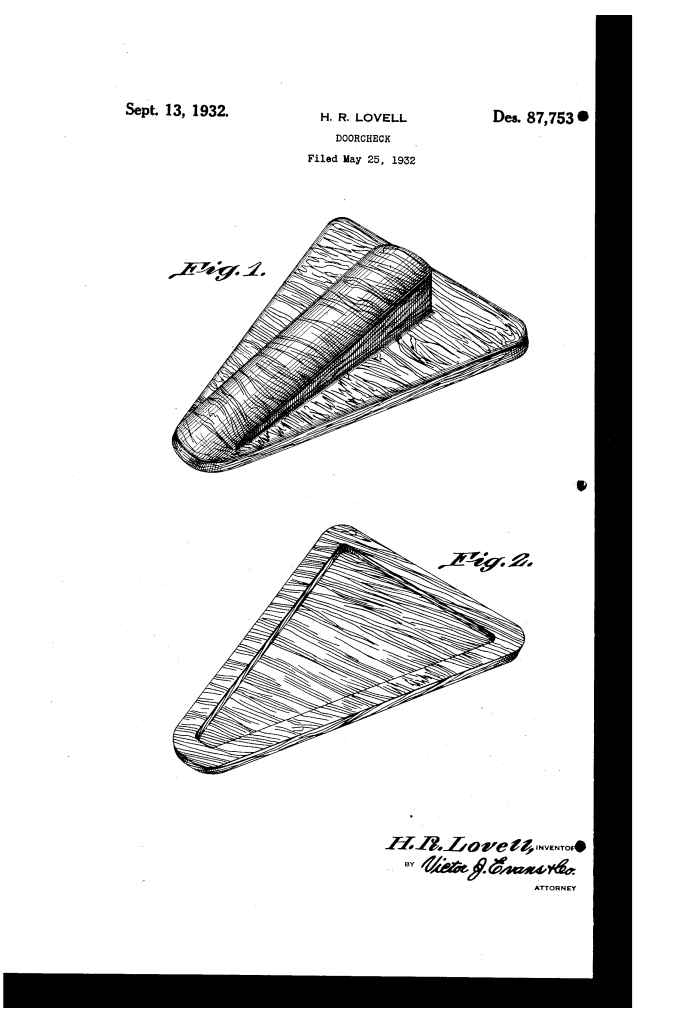
Ornamental Design for a Door Check (Henry R. Lovell, Des. 87,753)
Patented on September 13, 1932, by Henry R. Lovell of Greenville, Pennsylvania, this document represents a Design Patent. Unlike the previous utility patents which focus on how a machine works, a design patent protects the unique visual appearance and ornamental shape of an object.
The object in question is a Door Check (often referred to today as a door stop or door closer component). In the early 1930s, as architecture and interior design shifted toward Art Deco and industrial styles, even functional hardware like door checks were redesigned to be more aesthetically pleasing.
1. Visual Characteristics
The design is characterized by a streamlined, geometric form. Based on the patent drawings (Figures 1 and 2), the door check features:
- A Tapered, Curved Body: The main housing has a smooth, rounded top that tapers down toward the base, reflecting the “streamline” aesthetic popular in the 1930s.
- Integrated Mounting Flanges: The base of the device includes flat, protruding ears or flanges with holes, designed to be screwed flush against a door or floor.
- Dual-Face Symmetry: Figure 1 shows the “presentation” face, while Figure 2 illustrates the reverse face, showing how the design maintains a cohesive look from all visible angles.
2. Purpose of a Design Patent
In the context of the U.S. Patent Office in 1932, Henry Lovell was seeking protection for the “ornamental design” rather than the internal mechanics (such as springs or hydraulic fluid).
- Term of Patent: As noted in the header, this patent was granted for a term of 14 years.
- Scope: This protection prevented competitors from manufacturing a door check that looked substantially similar to Lovell’s, even if the internal machinery was different.
3. Comparison of Patent Types
| Feature | Utility Patent (e.g., Crosthwait’s Valve) | Design Patent (Lovell’s Door Check) |
| Protects | How an invention works and is used. | How an invention looks (shape/surface). |
| Requirements | Must be functional, novel, and non-obvious. | Must be ornamental, novel, and non-obvious. |
| Duration | Usually 17–20 years. | Usually 14–15 years. |
| Claim | Detailed technical descriptions and steps. | “The ornamental design… as shown.” |
Historical Context
Greenville, Pennsylvania, where Lovell resided, was a hub for manufacturing and steel-related industries in the early 20th century. Designers like Lovell worked to ensure that everyday hardware matched the evolving “Machine Age” look of modern offices and homes. This design patent is a snapshot of the era’s transition from purely utilitarian hardware to decor-conscious engineering.
