
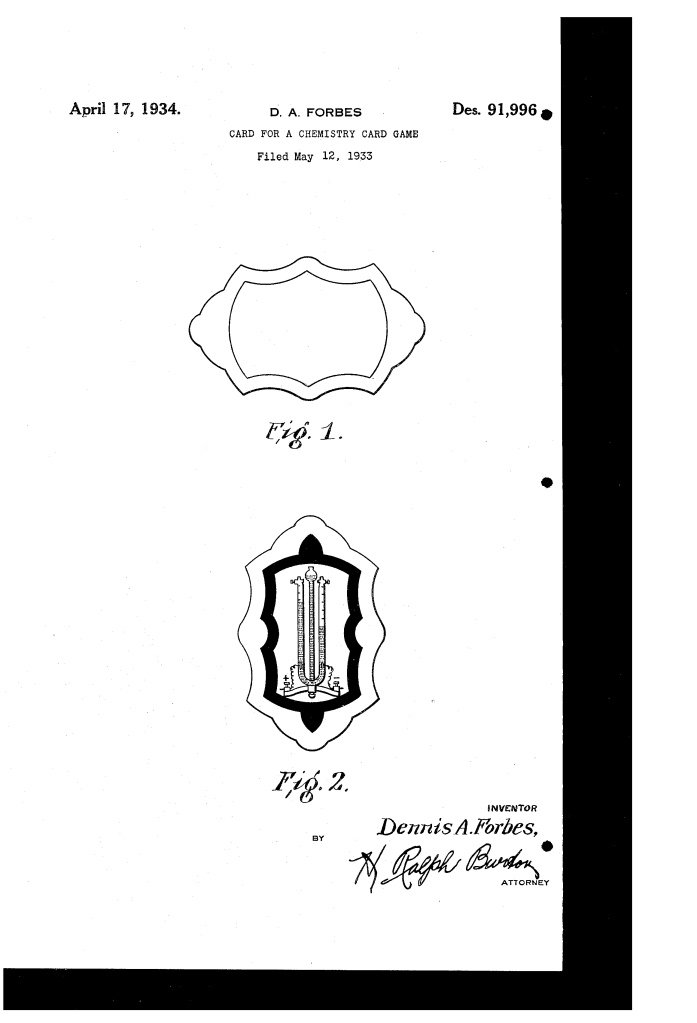
Card for a Chemistry Card Game; Dennis A. Forbes; Des. 91,996
The patent by Dennis A. Forbes of Nashville, Tennessee, describes a Design for a Card for a Chemistry Card Game (Patent No. Des. 91,996). This invention is an ornamental design for a specialized playing card intended to facilitate the learning of chemical elements and compounds through gamified interaction.
The “Why”
In the early 1930s, science education—particularly chemistry—was often inaccessible and rote. For students in segregated or underfunded institutions, complex concepts like atomic symbols and valence required creative pedagogical tools. Forbes identified a pain point in the lack of engaging, tactile educational aids that could bridge the gap between abstract chemical formulas and student comprehension.
The Inventor: Dennis A. Forbes
Dennis A. Forbes was an educator and innovator deeply rooted in the intellectual community of Nashville, home to prestigious Black institutions like Fisk University. His engineering philosophy centered on systemic simplification: the idea that the most complex scientific data could be decoded if presented within a logical, interactive framework. Operating during the height of the Great Depression and the Jim Crow era, Forbes’s work represents a defiant commitment to Black excellence in STEM and the democratization of scientific knowledge.
Key Systems Section
Graphical Data Interface
- Symbolic Centering: The design utilizes a central focal point for the chemical symbol (e.g., “H” for Hydrogen or “O” for Oxygen), ensuring immediate visual recognition.
- Quantified Borders: Information is distributed to the card periphery, allowing players to “fan” the cards and see vital data—such as atomic weights or valency—without revealing the full card face.
Universal Card Geometry
- Standardized Form Factor: By adhering to the dimensions of a traditional playing card, Forbes ensured the game was portable and familiar to the user, lowering the barrier to entry for learning.
- Reversible Orientation: The layout allows the card to be read from multiple angles, essential for a multi-player “tabletop” educational environment.
Comparison: Traditional Pedagogy vs. The Forbes Design
| Feature | Standard Methods (1930s) | The Forbes Innovation |
| Medium | Heavy textbooks / Chalkboards | Portable, tactile playing cards |
| Engagement | Passive memorization | Active, competitive gameplay |
| Data Visualization | Dense tables (Mendeleev style) | Modular, isolated data points per card |
| Accessibility | Limited to laboratory settings | Usable in homes, schools, and social clubs |
Significance
- Pioneer of EdTech: This patent is an early precursor to modern “gamified” learning and educational flashcard systems used in STEM today.
- Cognitive Science: The design utilizes “chunking,” a psychological method of breaking down complex information into small, manageable units.
- Cultural Bridge: Forbes leveraged the social popularity of card games to introduce rigorous scientific literacy into the Black community’s social spaces.
