
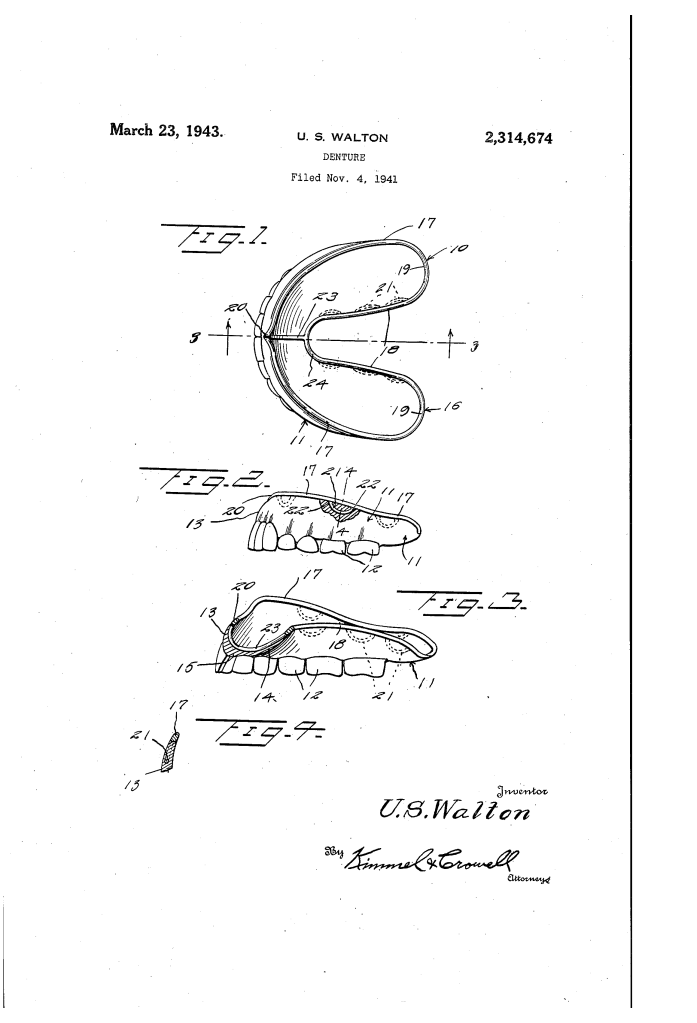
Reinforced Denture, Ulysses S. Walton, Patent No. 2,314,641
The patent by Ulysses S. Walton of Memphis, Tennessee, describes an improved Denture (Patent No. 2,314,641), filed in 1941 and granted in 1943. This invention introduces a moldable metallic reinforcing rim designed to strengthen the marginal edges of dental plates. By integrating a “skeletal” metal frame into the plastic body of the denture, Walton allowed for the use of thinner, lighter materials (such as phenol resins or rubber compounds) without sacrificing the structural integrity or fit of the device.
The “Why”
In the early 1940s, dentures were often bulky and heavy because the plastic materials of the time (like Bakelite or early acrylics) were brittle. If made too thin, they would crack under the pressure of chewing or “spread” (warp) over time, losing their suction and causing discomfort. The pain point for patients was the trade-off between a lightweight, comfortable plate and a durable one. Walton sought to create a “rib-cage” for the denture that would maintain its shape while allowing the walls to be cast much thinner than previously possible.
Inventor Section: Engineering Philosophy
Ulysses S. Walton’s approach was rooted in Integrated Reinforcement. Rather than simply plating a finished denture in metal, he designed a system where the metal and plastic become a single composite unit during the molding process. His philosophy emphasized laboratory accessibility; he insisted that this reinforcement be something a dental technician could form using standard plaster casts and existing tools, ensuring that the innovation didn’t drive up the cost of dental care through expensive specialized equipment.
Key Systems Section
1. The Continuous Metallic Rim (16)
The reinforcement consists of a U-shaped outer member (17) and an inner member (18) connected at the ends to form a complete circuit.
- Mechanical Principle: This creates a peripheral brace. By reinforcing the “marginal edges” (the very top and bottom ridges), the metal absorbs the tensile stress that usually causes plastic plates to snap in half.
- Design Detail: The “V-shaped forward portion” (20) is specifically designed to follow the complex curve of the front of the jaw, providing maximum rigidity at the point of highest impact.
2. Embedded Anchoring Loops (21)
To ensure the metal rim doesn’t peel away from the plastic body, Walton utilized a series of “open loops.”
- Mechanical Principle: These loops (22) are thinner than the main rim and are designed to be entirely submerged within the initially plastic material.
- Modern Term: This is a Mechanical Interlock. As the resin or rubber hardens around these loops, it “locks” the metal frame into the body, preventing any lateral movement or separation between the two materials.
3. The Transverse Tie Element (23)
A combined connecting and reinforcing member (23) runs across the bight (the curve) of the denture.
- Function: This acts as a cross-brace or “tie-bar.” It prevents the U-shaped denture from “spreading” (opening up) or “contracting” (tightening) under thermal changes or mechanical stress.
- Clinical Benefit: This ensures the denture maintains an exact fit to the patient’s gums over years of use, reducing the need for frequent relining or adjustments.
4. Material Synergy
The frame was designed to be cast from “dental metal”—typically gold, silver, or specialized alloys.
- Engineering Insight: By using metals that have a degree of “moldability,” the technician can burnish or shape the frame directly onto a plaster cast of the patient’s mouth. This ensures that the reinforcement is as unique as the patient’s anatomy, providing a custom-fit skeleton.
Comparison Table: Standard Plastic Plate vs. Walton’s Reinforced Plate
| Feature | Standard 1940s Denture | Walton Reinforced Denture |
| Wall Thickness | Must be thick/bulky to prevent snapping. | Thinner and lighter construction. |
| Structural Logic | Monolithic plastic (brittle). | Composite (Metal skeleton + Plastic body). |
| Shape Retention | Prone to “spreading” or warping. | Braced against expansion/contraction. |
| Durability | High risk of midline fractures. | Reinforced margins prevent cracking. |
| Technician Effort | Standard molding. | Integrated molding using existing tools. |
Significance
Ulysses Walton’s patent was an early contributor to the field of Prosthodontic Biomechanics:
- Composite Materials: It anticipated the modern use of cobalt-chrome frameworks in partial and full dentures, proving that combining materials could overcome the weaknesses of each.
- Patient Comfort: By reducing the “bulk” in the mouth, Walton’s design improved speech and taste (by leaving more of the palate exposed or thinner) and reduced the weight-bearing load on the gums.
- Mid-Century Innovation: This patent reflects the transition from heavy vulcanized rubber (Vulcanite) dentures to modern, lightweight resins, providing the necessary “bridge” of strength during that material shift.
