
Dentist Apparatus: William B. Jones (Patent No. 2,096,375)
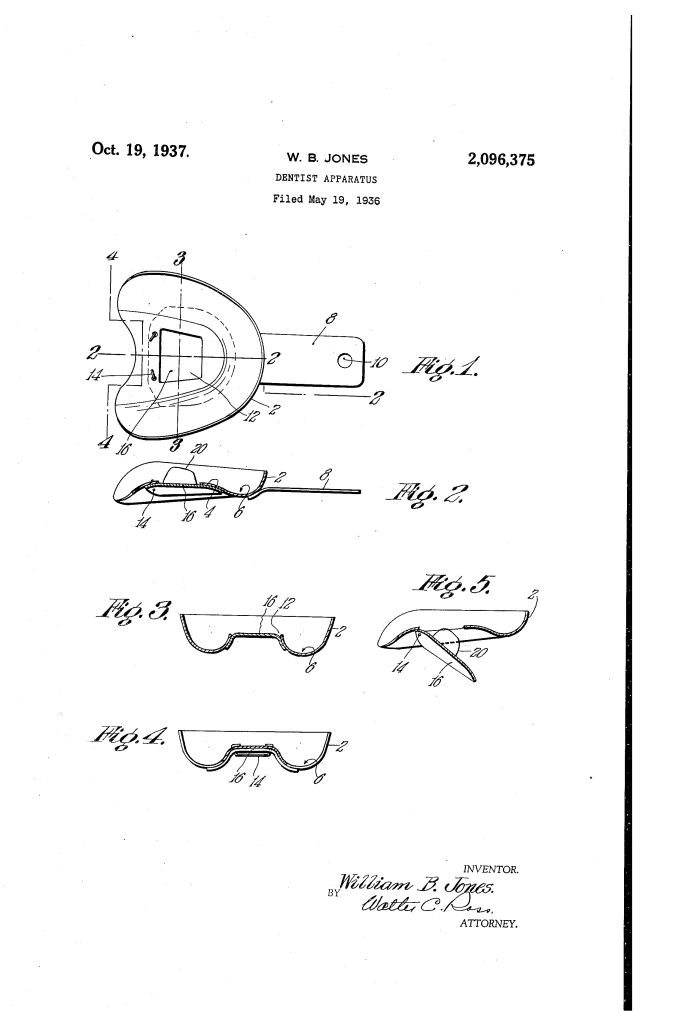
The patent by William B. Jones of Springfield, Massachusetts, describes a Dentist Apparatus (Patent No. 2,096,375), granted on October 19, 1937. This invention is a specialized dental impression tray specifically engineered for the manufacture of false teeth and upper plates. By introducing a hinged plate and a central relief opening, Jones transformed the traditionally messy and distressing process of jaw-modeling into a precise, “gag-free” clinical procedure.
The “Why”
In the 1930s, taking an upper jaw impression was a notorious “pain point” for both dentist and patient. Standard trays were solid, meaning that when the dentist pressed a tray full of Plaster of Paris or wax against the jaw, the excess material had nowhere to go but the back of the throat. This caused uncontrollable gagging, choking, and extreme discomfort. Furthermore, dentists often struggled to guess the correct amount of material, leading to either overflowing trays or incomplete molds that required the process to be repeated.
Inventor Section: William B. Jones
William B. Jones was an inventor focused on medical ergonomics and patient psychology. His engineering philosophy centered on controlled displacement. He understood that the primary flaw in dental tools was a lack of “exhaust” for displaced matter. By applying mechanical principles—specifically the use of a relief valve and a measurement gauge—to a biological context, Jones sought to professionalize and humanize the dental experience.
Key Systems Section
1. The Central Relief Aperture (12)
Unlike a solid tray, Jones’ design features a substantial opening in the “roof” of the tray.
- Modern Term: Overflow Port / Stress-Relief Vent.
- As the tray is pressed upward, any excess plastic material is forced through this hole rather than being squeezed toward the patient’s soft palate or throat.
2. The Hinged Secondary Plate (16)
Mounted beneath the main tray via a hinge (14) is a movable plate that fits snugly against the underside of the opening.
- Modern Term: Catch-Basin Assembly.
- This plate acts as a safety reservoir, catching the excess material that passes through the aperture and preventing it from falling into the patient’s mouth.
3. Pre-Measurement Logic (The Compressible Wad)
The apparatus includes a unique method for “pre-fitting” the mold.
- Modern Term: Volumetric Calibration.
- Before using the permanent mold material, a dentist places a compressible wad (20) on the hinged plate. By closing the plate against the patient’s palate, the wad is flattened to the exact height of the mouth, allowing the dentist to measure the exact volume of plaster needed before the final step.
4. The Anatomical Trough (6)
The tray is shaped with a deep horseshoe-shaped trough designed to sit specifically over the alveolar process (where the teeth or sockets are located).
- Modern Term: Alveolar Ridge Channel.
- This isolates the tooth-bearing area from the palatal area, ensuring the most detailed impression is taken where the plate will actually sit.
Comparison Table
| Feature | Standard 1930s Trays | Jones’ Precision Tray |
| Excess Material | Overflows into the throat (Gagging). | Redirected through a central vent. |
| Material Estimation | Trial and error (Guesswork). | Pre-measured via compressible wad. |
| Patient Comfort | High distress/pressure on the palate. | Low pressure; avoids the soft palate. |
| Accuracy | Prone to air bubbles and shifting. | Highly accurate due to “overflow” relief. |
Significance Section
- Ergonomic Dentistry: Jones’ invention was a major step toward modern restorative dentistry, emphasizing that a tool’s success depends on the patient’s physiological response.
- Reduction of Medical Waste: By allowing for exact pre-measurement of plaster and wax, the device significantly reduced the waste of dental materials.
- Precursor to Custom Trays: The logic of measuring palatal depth before taking an impression is a fundamental step in modern prosthodontics.
- Safety Engineering: The “catch-basin” plate is an early example of using secondary containment to prevent a medical choking hazard.
