
Curtain Rod (1892)
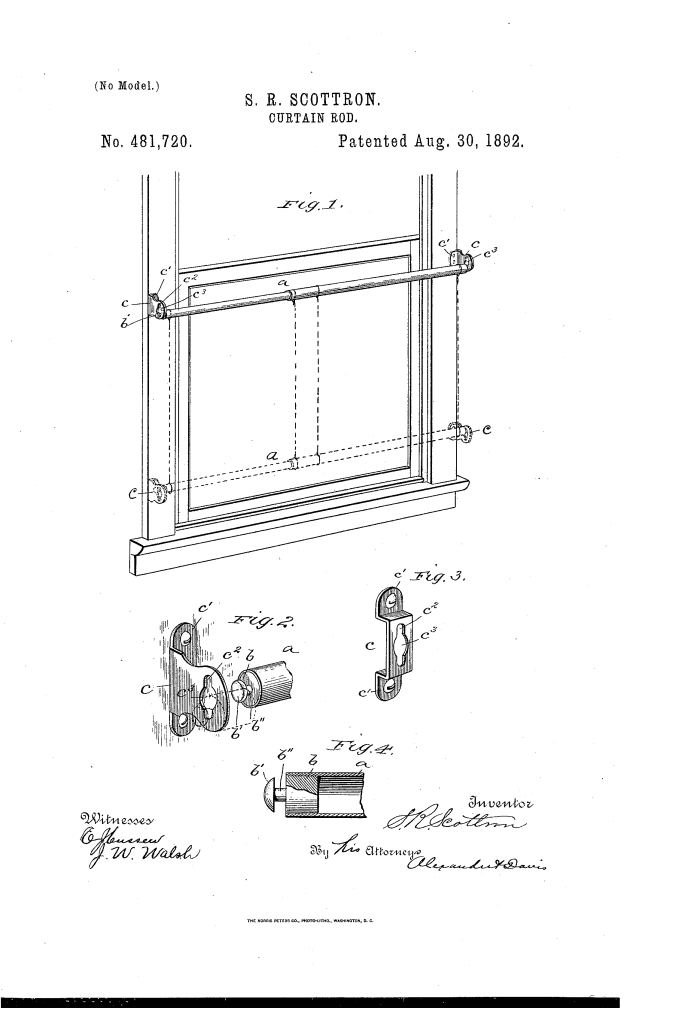
U.S. Patent No. 481,720, granted on August 30, 1892, to Samuel R. Scottron, describes an adjustable, telescoping metallic curtain rod featuring an innovative bracket system designed for easy installation and removal without the use of screws, caps, or complex fasteners.
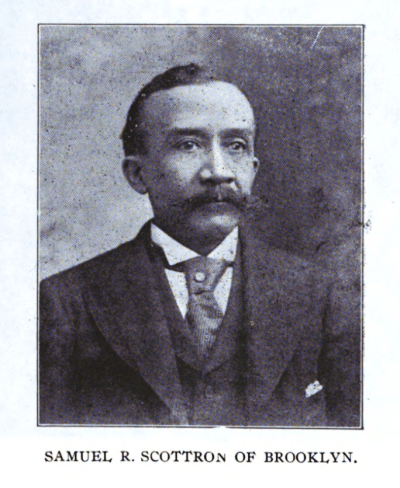
Samuel Scottron, based in Brooklyn, New York, was an ingenious inventor and businessman who focused heavily on improving everyday household items, making them more functional, affordable, and accessible for the modern home.
This specific invention solved a persistent problem in late 19th-century households: the reliance on troublesome screw caps and fixed-length rods that quickly wore out, damaged window frames, and made removing curtains for washing an exhausting, precise, and frustrating chore.
The Innovation: The “Button-and-Slot” Locking System
Standard curtain rods of the era required tools or precise alignment of loose screws to secure them into position. If a homeowner frequently removed the rods to wash or change curtains, the screw threads would strip and the brackets would fail.
Scottron’s breakthrough replaced these high-friction components with a physical geometry solution: an integrated button head on the rod that locks smoothly into a specially engineered vertical slot on the bracket.
Why This Design?
- Toolless Operation: It entirely eliminates the need for screws, caps, or specialized tools to attach or detach the rod.
- Accidental Displacement Protection: The rod cannot fall out on its own. To remove it, the user must explicitly align the rod to a precise midpoint and compress the telescoping tubes.
- Reversible Universal Design: The brackets are manufactured symmetrically. Either edge can be the top, and either side can face inward, completely preventing user errors during installation.
Key Mechanical Components
The system relies on a seamless mechanical interaction between the adjustable rod ends and the wall-mounted plates:
| Component | Function |
| Telescoping Tubes (a) | Two interlocking metallic sections that slide into each other to allow the rod to fit various window widths. |
| Metal Plug (12) | Fitted flush inside the outer ends of the tubes to provide structural stability. |
| Narrow Neck (b) | A thin extension projecting from the plug that rides freely within the narrow vertical channels of the bracket. |
| Circular Button Head (b) | A rounded or slightly pointed head that acts as the primary locking anchor when passed through the bracket plate. |
| Bracket Plate (c) | The wall anchor featuring perforated ears ($c’$) for securing it directly to the window frame. |
| Vertical Closed Slot (c2) | The vertical track that holds the neck of the rod, preventing it from pulling away from the wall. |
| Circular Open Enlargement (c3) | An opening positioned exactly midway along the vertical slot, matching the diameter of the button head for insertion/removal. |
How the Apparatus Functions
The process of hanging or removing the curtains follows a quick, tool-free sequence:
Step-by-Step Operation:
- Shortening: The user slides the telescoping tubes together to shorten the overall length of the rod.
- Alignment: The rounded button heads (b) are brought to the exact midpoint of the brackets and pushed through the circular enlargements (c3).
- Locking: The user releases the rod, allowing it to expand. The narrow neck ($b’$) drops naturally into the bottom of the slot ($c^2$). Because the button head is larger than the narrow slot, the rod is locked securely in place.
- Removal: To take the curtains down, the user simply lifts the rod back to the middle enlargement, compresses the telescoping tubes inward, and pulls the rod free.
Multi-Rod Tension Advantage
These rods were frequently deployed in pairs (an upper and lower rod) to hold sliding window curtains taut. Scottron smartly engineered the slots so that the upper rod rests at the bottom of its bracket slot, while the lower rod is pulled to the top of its bracket slot. This dual-direction capability counteracts structural tension perfectly from both above and below.
About the Inventor: Samuel R. Scottron
Samuel Raymond Scottron was a prominent African American inventor, scholar, and community leader in New York during the late 19th and early 20th centuries.
- Patents: Beyond his adjustable curtain rods, Scottron held several vital patents for household improvements, including the Scottron Combo-Mirror (a hand-mirror system allowing users to see the back of their own heads), adjustable window cornices, and extension rods.
- Manufacturing & Business: He successfully manufactured and marketed his inventions through the Scottron Manufacturing Company, maintaining a showroom in New York and achieving widespread commercial distribution.
- Civic Legacy: Deeply invested in education and civil rights, Scottron was the first African American appointed to the Brooklyn Board of Education, serving for several years, and wrote extensively on racial equity, economics, and history.
Summary of Claims
The patent explicitly claims:
- The combination of bracket plates provided with closed vertical slots (c2) that are uniquely enlarged between their ends (c3).
- An extensible, telescoping curtain rod outfitted with an integral button on each end connected by a narrow neck.
- The specific mechanical behavior allowing the narrow necks to rest securely in either the upper or lower limits of the slots, completely out of line with the center enlargement, preventing accidental detachment.
