
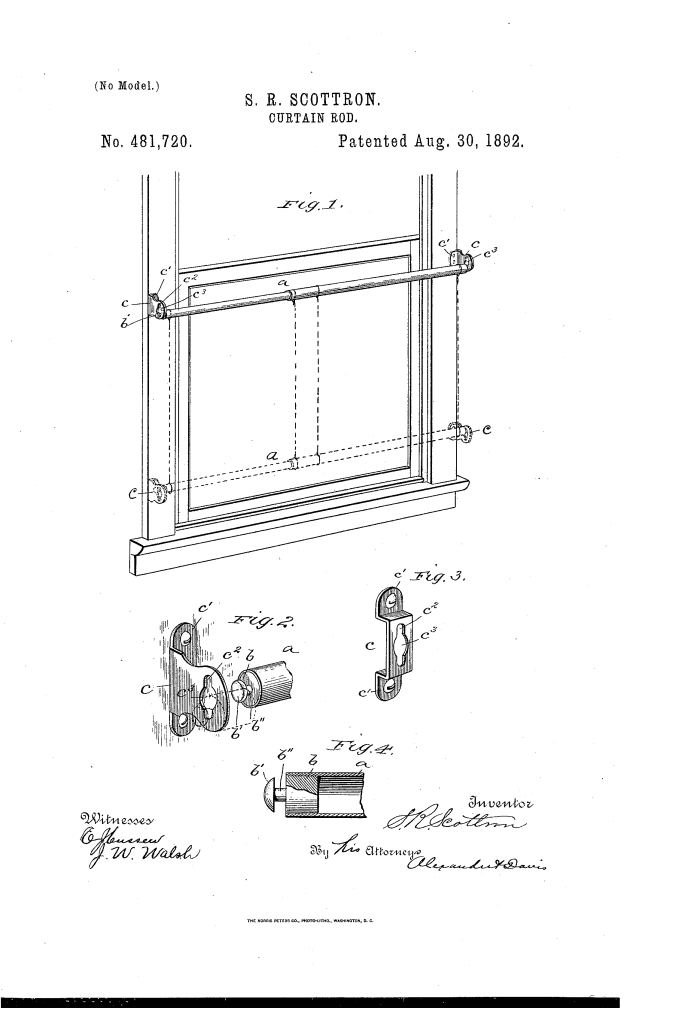
Samuel R. Scottron’s patent for a Curtain Rod, No. 481,720, describes a telescoping curtain rod with a unique mounting system. Patented on August 30, 1892, the invention was designed to make a curtain rod easy to install and remove without screws, while ensuring it was secure against accidental displacement.
Key Features
- Telescoping Design: The curtain rod was made of two metallic tubes that fit into each other, allowing the length to be adjusted for different-sized windows.
- Button and Neck Fastening: The end of each rod had a metal plug with an integrated “circular button” or head connected to it by a narrow neck.
- Closed Vertical Slot Brackets: The brackets were plates with a closed vertical slot in them. The slot was approximately the width of the neck, but it had a circular enlargement in the middle. The buttons on the rod could be passed through this enlarged opening, and the rod could then be raised or lowered to a secure position.
The design allowed the rod to be quickly removed by raising it back to the enlarged part of the slot and pulling it free. When in the upper or lower part of the slot, the rod was securely held and could not be accidentally dislodged.
Societal Impact
Scottron’s invention was a practical improvement on a common household item, reflecting the late 19th-century trend of making domestic life more convenient.
- Domestic Convenience: Before this invention, curtain rods were often secured with screws and caps, which could be cumbersome to install or remove, especially for cleaning or changing curtains. Scottron’s design simplified this process, saving time and effort.
- Improved Product Durability: The screwless design also addressed a common problem of screws becoming loose and stripped over time from frequent removal. The new system was more durable and reliable.
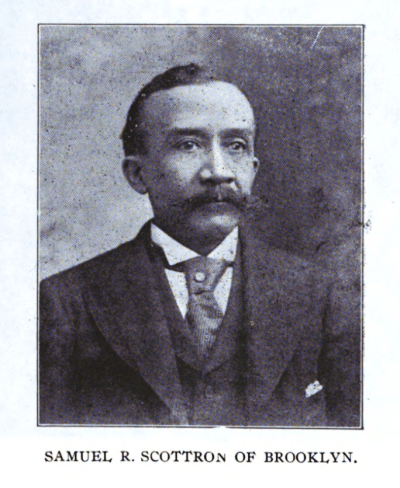
- The Inventor’s Legacy: Samuel R. Scottron was a Black inventor and entrepreneur from Brooklyn, New York. His work, which included a patent for an illuminating apparatus, is a testament to the ingenuity of Black innovators in developing products for the consumer market. Scottron was also a prominent figure in the Black community, an activist, and a business owner, and his work is part of the broader story of how Black inventors contributed to American technology and culture despite facing significant racial discrimination.
