
Cultivator and Marker (1894)
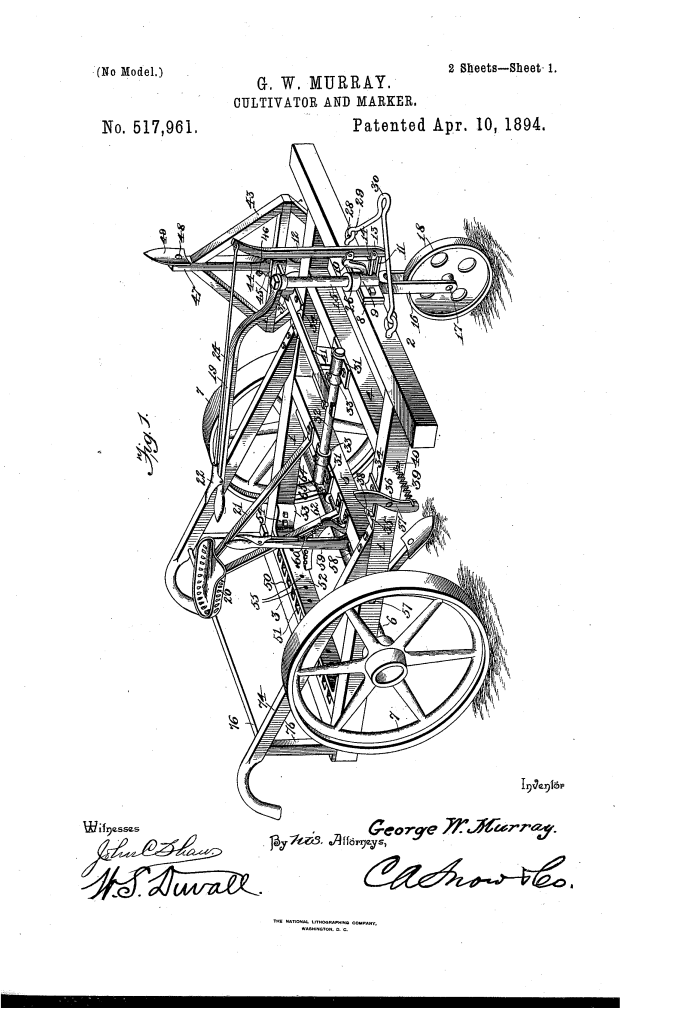
U.S. Patent No. 517,961, granted on April 10, 1894, to George W. Murray, describes an adjustable agricultural machine designed to efficiently open furrows for seeds while simultaneously marking parallel guidelines for the next row. George W. Murray, an inventor from Rembert, South Carolina, designed this lightweight implement to be easily managed by a single operator, solving common issues of alignment and heavy draft in late 19th-century farming.
This specific invention addressed a persistent problem for farmers: the physical strain and mathematical difficulty of laying straight, evenly spaced rows across a field without needing multiple passes, extra layout lines, or additional field hands.
The Innovation: The Reversible, Auto-Locking Marker Bar
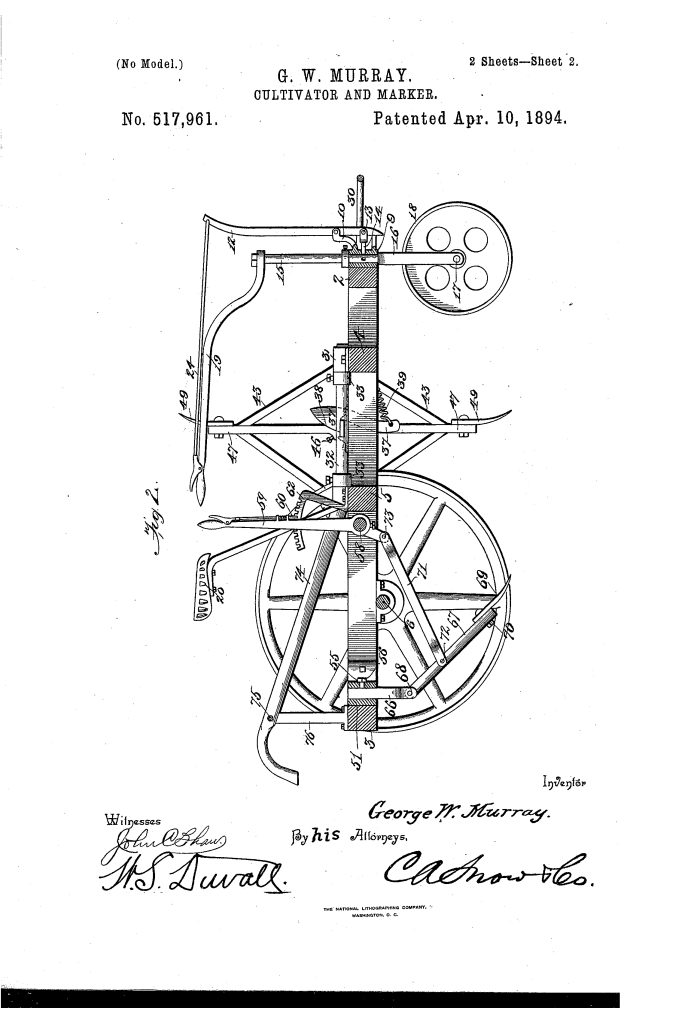
A primary challenge in row-crop cultivation of this era was ensuring that consecutive rows remained perfectly parallel. Murray’s breakthrough was a central longitudinal rock-shaft that allowed a single marking bar to swing effortlessly to either side of the machine, locking automatically into place depending on which direction the team of animals was driving.
Why the Reversible Marker?
- Single-Operator Efficiency: The operator can flip the marker to the opposite side at the end of a row without leaving their seat or stopping the draft animals.
- Automatic Locking: Spring-loaded, beveled latches catch the bar as it drops onto the side frame, securing it against rough terrain without requiring manual pinning.
- Precision Adjustability: The diamond-shaped marking frame can slide closer or further along the lateral bar to adapt perfectly to different crop spacing needs.
Key Mechanical Components
The apparatus relies on a rugged, interconnected framework where steering, furrowing, and marking are handled by separate, adjustable subsystems:
| Component | Function |
| Rock-Shaft (32) | A short, central longitudinal axle that allows the marking bar to flip 180 degrees from the left side to the right side of the machine. |
| L-Shaped Plates & Latches (34, 37) | Heavy iron rests equipped with spring-loaded, beveled latches that automatically capture and lock the marking bar when it is swung down. |
| Caster Wheel & Guide Handle (18, 19) | A swiveling front wheel connected to a long rear handle, allowing the operator to steer the machine precisely from behind or from the driver’s seat. |
| Recessed Clamping Bar (50, 52) | A rear bracket featuring a series of notched slots, allowing the main furrow-opening shovel to be adjusted laterally. |
| Lift Lever & Rock-Shaft (58, 59) | A hand lever and toothed segment that allows the operator to lift the furrow shovel completely out of the dirt for easy turning and transport. |
How the Apparatus Functions
The process follows a strict sequence to ensure uniform row spacing and minimal operator fatigue during a turn:
| Step | Action | Purpose |
| 1. Track Setup | The operator adjusts the diamond-shaped marking frame (43) along the lateral bar and tightens the binding bolt (46). | Sets the exact distance and spacing for the next parallel seed furrow. |
| 2. Steer Release | The operator compresses the handle lever (22), pulling an internal wire to release a locking bolt (14) from the front caster spindle (15). | Allows the front caster wheel to swivel freely for sharp, immediate turns at row ends. |
| 3. Shovel Engagement | The operator pulls the hand-lever (59) next to the seat, locking it into the teeth of the segmental standard (62). | Lowers the main furrow shovel (69) to the exact desired digging depth into the soil. |
| 4. Row Reversal | Upon reaching the end of the field, the operator lifts the marking bar and swings it over the top to the opposite side of the frame. | The bar automatically depresses the opposite side’s latch and snaps shut, ready for the return trip. |
About the Inventor: George W. Murray
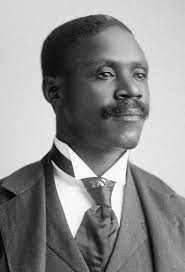
George Washington Murray was an extraordinary African American inventor, educator, and politician during the Reconstruction and post-Reconstruction eras.
- Political Legacy: Born into slavery, Murray rose to become a U.S. Congressman representing South Carolina’s 7th congressional district in the 53rd and 54th Congresses (1893–1897). He was the only Black member of the 53rd Congress.
- Patents: Murray held at least eight patents for agricultural machinery, including a cotton chopper, a fertilizer distributor, a planter, and this cultivator and marker. He frequently utilized his political platform to highlight the creative and intellectual achievements of African American inventors.
- Impact: His inventions focused on reducing the brutal physical labor of Southern farming, allowing smallholders and sharecroppers to increase productivity with fewer draft animals and less hired help.
Summary of Claims
The patent explicitly claims:
- In an agricultural machine, the combination with the framework of a marking bar carrying opposite marking devices, resting on side-mounted flanged plates, and secured by spring-loaded, beveled latches.
- A laterally adjustable furrow-opening shovel assembly mounted via a recessed rear clamping bar and controlled by an independent lifting rock-shaft.
- A front-end guidance system consisting of a locking caster spindle operated remotely from the rear handle via a wire-and-lever mechanism.
