
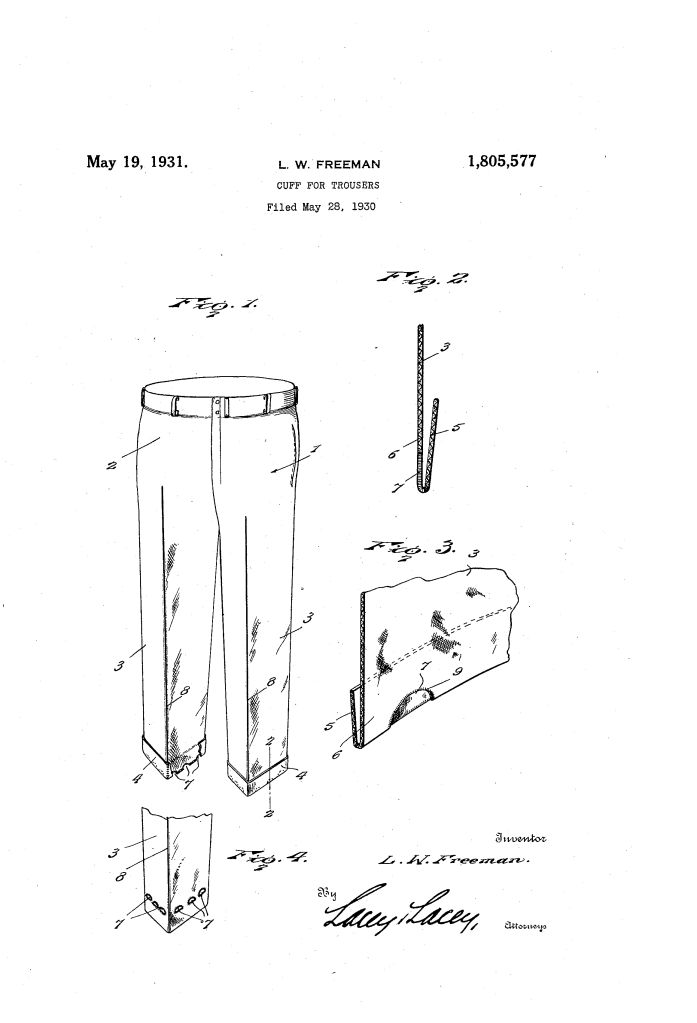
Trousers with Dust-Evacuating Cuffs (Louis W. Freeman, No. 1,805,977)
This 1931 patent by Louis W. Freeman of Charleston, West Virginia, addresses a practical nuisance of early 20th-century menswear: the accumulation of dirt, sand, and debris inside trouser cuffs. At the time, wide, turned-up cuffs were the standard fashion, but they acted as “dust traps,” especially for people walking on unpaved roads or dry soil. Freeman’s invention provides a discreet way for debris to fall out of the cuff automatically.
1. The Problem: The “Cuff Trap”
Traditional trouser cuffs are created by folding the fabric of the leg outward and upward. This creates a deep pocket between the outer wall (5) and the inner wall (6).
- Debris Accumulation: Sand, lint, and fine dirt naturally settle at the very bottom of this fold.
- Cleaning Difficulty: Once dirt is inside, it is difficult to remove without physically turning the cuff down and brushing it out—a tedious task for the wearer.
- Fabric Wear: Trapped grit can act as an abrasive, eventually wearing through the fabric at the crease.
2. The Solution: Inner Wall Outlet Openings
Freeman’s design modifies the construction of the leg before the cuff is folded to create exit ports for dirt.
- Strategically Placed Cuts (7): Before the cuff is formed, the tailor makes several small cuts in the fabric. These are spaced circumferentially around the leg.
- Positioning: The cuts are located just above the “fold line” (the line that becomes the bottom edge of the trousers).
- The “Flush” Edge: When the fabric is folded up to form the cuff, these openings end up on the inner wall of the cuff. Crucially, the straight lower edge of each opening is perfectly aligned (coincident) with the bottom crease of the cuff.
3. Discreet Aesthetics and Durability
Because the openings are on the inner wall (the side facing the wearer’s leg or shoe), they are invisible to an observer.
- Buttonhole Stitching (9): To prevent the edges of the openings from fraying or looking “ragged,” Freeman specifies that the margins should be finished with buttonhole stitching. This reinforces the holes, ensuring they stay open and durable through many washings and wearings.
- Tapered Shape: The openings are often tapered upward. This shape encourages gravity to pull dirt toward the bottom edge, where it can fall out through the “straight cut” at the crease.
4. Technical Summary of Claims
The patent focuses on the geometry and placement of these “dust vents”:
| Feature | Engineering Purpose |
| Inner Wall Placement | Keeps the outlets hidden from view to maintain a formal appearance. |
| Coincident Lower Edge | Ensures there is no “lip” inside the cuff for dirt to get stuck behind. |
| Crease Alignment | Openings are often placed on either side of the front and rear creases to catch debris where the cuff pocket is deepest. |
Fashion and Practicality in 1930
In the 1930s, trousers were typically made of heavy wools and flannels which held onto dust and lint more aggressively than modern synthetic blends. Freeman’s invention was a “lifestyle” improvement for the working man or the outdoorsman, allowing the trousers to effectively “self-clean” as the wearer walked.
