
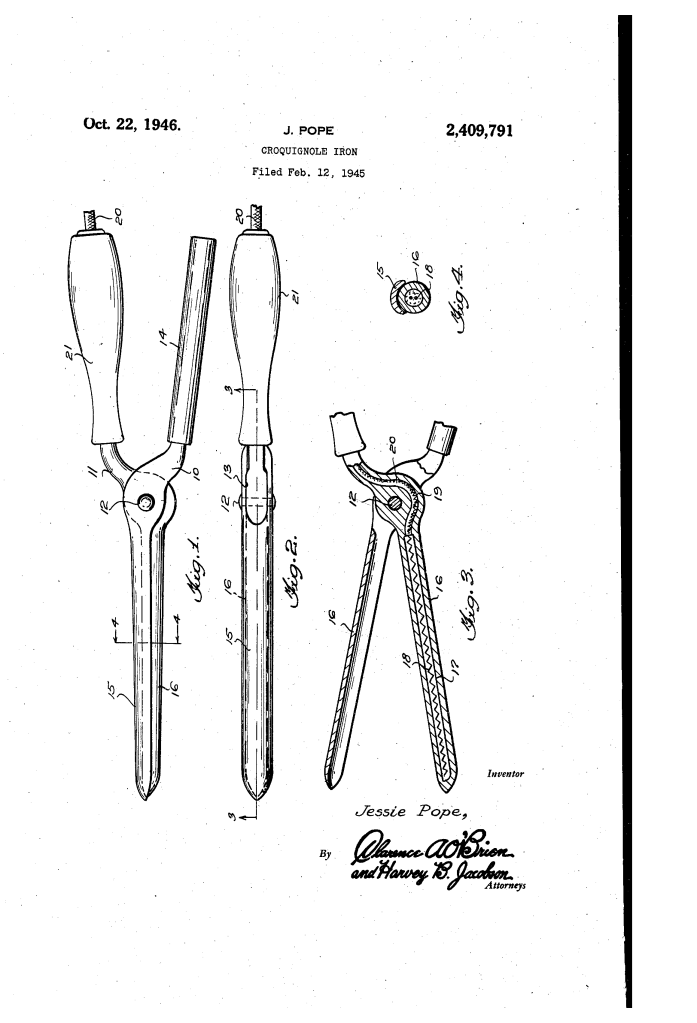
Electric Croquignole Iron, Jessie Pope (1946)
Patented in October 1946, this invention by Jessie Pope of Ecorse, Michigan (U.S. Patent No. 2,409,952) modernized a staple of the beauty industry. During the mid-20th century, the “Croquignole” style—where hair is wound from the ends toward the scalp in a flat, overlapping spiral—was the height of fashion.
Before Pope’s invention, beauticians had to use “stove-heated” irons. These were heavy metal rods heated on a gas burner; they lost heat quickly and carried a high risk of scorching the hair or the scalp if the temperature wasn’t guessed perfectly. Pope’s Electric Croquignole Iron introduced internal heating and ergonomic design, transforming a stressful, manual process into a consistent, “self-heating” professional treatment.
The “Why”
The traditional beauty treatment was a race against time. An iron would start too hot (risking damage) and end too cold (failing to set the curl). Jessie Pope wanted to provide thermal stability. By incorporating an internal electric coil, she ensured the iron stayed at a constant, safe temperature indefinitely. This allowed the beautician to focus on the artistry of the wave rather than constantly running back to a heating stove.
Inventor Section: Engineering Philosophy
Jessie Pope’s philosophy was Asymmetric Synergy. She realized that the two halves of a curling iron shouldn’t be identical. One side needs to be a thermal reservoir (holding the heat), while the other needs to be a pressure plate (clamping the hair). Her design uses a hollow cylindrical core for the heat and a segmental, “arcuate” (curved) outer shell to provide the compression, ensuring that heat is transferred evenly through the entire “curl of average size.”
Key Systems Section
1. The Internal Heating Core
Unlike older irons that were solid metal, Pope’s device features a specialized “power rod.”
- The Longitudinal Bore (17): The lower jaw (16) is drilled out to create a hollow chamber.
- The Electrical Coil (18): A heating element is inserted directly into the tip.
- The Plug: Once the coil is installed, the tip is plugged and reformed into a point. This “internalizes” the heat source, making the outer surface the only part that touches the hair.
2. The Tapered Parallelism
This is the “secret” to a perfect Croquignole wave.
- The Spacing Logic: In many irons, the jaws are parallel when empty but “V-shaped” when clamped on hair, leading to uneven curls.
- Pope’s Solution: The jaws are designed with a specific taper. When they are closed upon a strand of hair, the pressure forces them into perfect parallelism. This ensures that the hair at the base of the iron receives the same heat and pressure as the hair at the tip.
3. The Dual-Ergonomic Handles
Pope recognized that beauticians hold irons for hours, leading to hand fatigue. She designed two distinct handle shapes:
- The Pear-Shaped Handle (21): The lower handle is enlarged and rounded to fit comfortably into the palm of the hand.
- The Straight Insulating Handle (14): The upper handle is a uniform diameter, designed to be easily manipulated by the fingers.
- Integrated Cord (19): The electrical cord is routed through the pivot pin (12) to prevent it from tangling or getting in the way while the operator rotates the iron.
4. Heavy-Duty Segmental Construction
The iron was built for “material force.”
- Segmental Cross-Section (15): The upper jaw isn’t just a flat piece of metal; it is curved to partially surround the heating cylinder.
- Thermal Mass: Pope specified “exceptionally heavy construction.” This extra weight helps maintain heat and provides the physical “squeeze” necessary to set a long-lasting wave without needing a mechanical lock.
Comparison Table: Stove Iron vs. Pope’s Electric Iron
| Feature | Conventional Stove-Heated Iron | Pope’s Electric Croquignole Iron |
| Heat Source | External Gas Flame / Stove. | Internal Electric Coil. |
| Heat Retention | Rapidly cooling. | Constant & Continuous. |
| Handle Design | Thin metal (hot). | Insulated Pear/Straight handles. |
| Safety | High risk of scorching/burns. | Thermostatic control capability. |
| Efficiency | Requires frequent pre-heating. | Ready for immediate, back-to-back use. |
Significance
Jessie Pope’s patent is a perfect example of the professionalization of the beauty industry in the post-war era:
- Time Efficiency: By eliminating the “heating cycle,” beauticians could serve more clients in a single day.
- Technique Refinement: The tapered jaws allowed for the precise, flat spirals required for the “Croquignole” look, which defined the glamour of the 1940s.
- Durability: Her focus on a “sturdy and durable” construction meant this was an industrial-grade tool meant for the rigors of a busy salon, not just a home novelty.
Final Insight: While we take electric curling irons for granted today, Pope’s focus on the palm-fit handle and parallel jaw spacing shows a deep understanding of the physical labor involved in 1940s hairstyling.
