
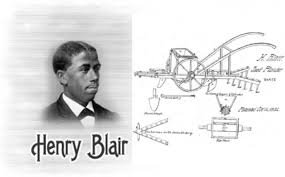
Cotton Planter (1836)
U.S. Patent No. 15, granted on August 31, 1836, to Henry Blair, was a sophisticated evolution of his earlier agricultural designs. While his 1834 patent revolutionized corn planting, this invention focused on the unique mechanical challenges posed by cotton seeds, which are notoriously difficult to plant due to their light weight and the clingy fibers (linters) that cause them to clump together.
By automating the sowing of cotton, Blair provided a solution that allowed for much faster cultivation of the South’s most dominant cash crop during the mid-19th century.
The Innovation: The “Harrow-Planter” Hybrid
The 1836 Cotton Planter was not merely a seed dropper; it was a comprehensive soil-management machine. Blair’s breakthrough was a design that performed three distinct agricultural tasks simultaneously: tilling the soil, dropping the seed, and covering the row.
1. The Agitated Hopper
Cotton seeds do not flow as easily as smooth corn kernels. Blair’s 1836 design featured a hopper equipped with an internal mechanism to keep the seeds in motion. This prevented the seeds from “bridging” (getting stuck in an arch over the exit hole), ensuring a steady, uninterrupted flow.
2. The Built-in Harrow
Unlike his corn planter, the cotton planter featured a split-frame design with two rows of “harrow teeth” (plow-like spikes).
- The Front Teeth: These broke up clods of earth and cleared debris just inches before the seed was dropped.
- The Rear Teeth: Positioned at an angle, these teeth acted as a mechanical rake to cover the seeds with loose, aerated soil.
3. High-Clearance Wheels
The machine utilized very large, thin wheels. This design served two purposes: it provided the necessary torque to drive the internal seeding gears and ensured the machine could pass over uneven, freshly plowed ground without getting mired in the dirt.
Key Mechanical Components
Blair’s cotton planter was a masterclass in early 19th-century wooden and iron engineering:
| Component | Function |
| Cylindrical Hopper | A specialized container that used gravity and internal agitation to feed cotton seeds into the discharge chute. |
| Harrow Teeth (Front) | Preceded the seed drop to ensure the “bed” was soft enough for the seed to take root. |
| Seed Roller | A rotating component linked to the axle that “measured” the seeds, ensuring they weren’t wasted through over-planting. |
| Adjustable Handles | Allowed the operator to steer the horse-drawn unit and tilt the machine to control the depth of the furrow. |
Performance: Solving the “Clumping” Problem
The primary measure of success for Blair’s machine was its ability to handle “un-ginned” or fuzzy cotton seeds without clogging—a problem that had defeated many previous inventors.
- Consistency: The machine ensured that cotton plants grew in a straight line, which was essential for the later use of horse-drawn cultivators to remove weeds between rows.
- Seed Conservation: By using a mechanical roller to drop specific amounts of seed, Blair saved farmers significant money on seed stock that would otherwise be wasted by hand-scattering (broadcasting).
About the Inventor: Henry Blair
Henry Blair remains a standout figure in the history of American innovation, specifically within the African American community.
- A Rare Record: Because the Great Patent Office Fire of 1836 destroyed thousands of records, Blair’s Cotton Planter is one of the few from that era with a low, “modern” patent number (No. 15), as it was granted just after the patent system was reorganized.
- Entrepreneurial Spirit: Blair was a “free man of color” and a successful independent farmer. His patents show he wasn’t just an armchair inventor; he was solving problems he encountered personally in the fields of Maryland.
- Historical Significance: Blair is the only person in United States history to be identified in Patent Office records as a “black man” (or “colored man”) during the era of slavery, providing an undeniable legal record of Black intellectual achievement in the 1830s.
Summary of Claims
The 1836 patent explicitly protected:
- The arrangement of harrow teeth in combination with a seeding hopper on a single frame.
- A rotating cylinder at the base of the hopper that utilized the movement of the cart to meter out seeds.
- The self-covering mechanism that used the rear teeth of the machine to finish the planting process without a second pass.
