
Cotton-Chopper (1894)
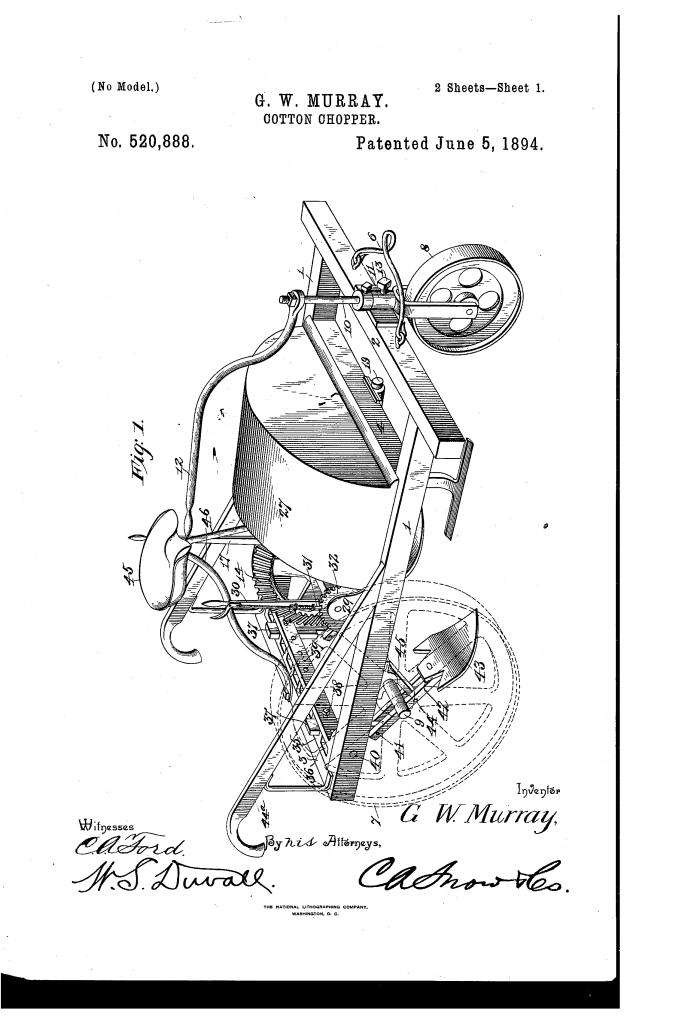
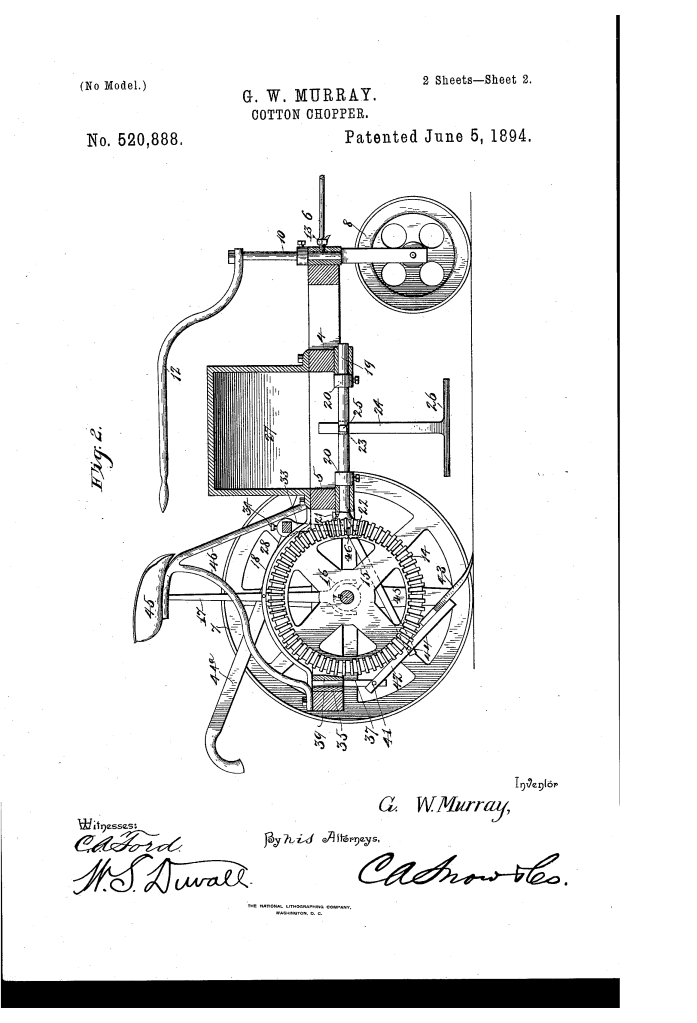
U.S. Patent No. 520,888, granted on June 5, 1894, to George W. Murray, describes an automated agricultural machine designed to streamline the labor-intensive process of thinning cotton fields. Murray, a schoolteacher, farmer, and landmark political figure from South Carolina, engineered this device to combine multiple field preparation steps into a single horse-drawn operation.
This invention solved a persistent problem in late 19th-century agriculture: the slow, backbreaking hand-labor required to “chop” cotton—thinning out excess seedlings so the remaining plants (called “stands”) could grow to full maturity, while simultaneously clearing weeds and shaping the rows.
The Innovation: The “Intermittent Rotary Hoe” System
Traditional cotton chopping relied on laborers walking fields with hand hoes. Murray’s breakthrough was a mechanical, axle-driven system that automatically struck the ground at regular, calculated intervals.
By utilizing a synchronized gear system tied directly to the rotation of the machine’s wheels, the cotton-chopper could automatically alternate between cutting away unnecessary crop growth and leaving targeted plants untouched. Furthermore, Murray built the machine with interchangeable parts, allowing farmers to customize the distance between their cotton plants depending on soil conditions.
How the Apparatus Functions
The machine combines mechanical chopping and traditional plowing in a synchronized, four-step sequence:
| Step | Action | Mechanical Purpose |
| 1. Engagement | The operator uses a clutch-lever (17) to slide the master-gear (14) into mesh with the drive pinion (22). | Locks the chopping mechanism to the rotation of the main wheels. |
| 2. Rotational Chopping | As the horses pull the frame, the rotating main axle spins a longitudinal shaft (19), revolving the chopping arm (24) and hoe (26). | Strikes the ground at fixed intervals to cut away a swath of excess cotton and weeds. |
| 3. Row Preservation | When the revolving hoe rotates upward, it clears the ground completely. | Leaves a uniform “stand” of cotton untouched to grow. |
| 4. Furrow Cleaning | Adjustable sweep-plows (43) follow immediately behind the rotating hoe. | Cleans out the furrows on either side of the row, shaping the bed in the same pass. |
Key Mechanical Components
The cotton-chopper is built on a durable, adjustable framework where every element interacts mechanically without requiring external power:
- Master-Gear (14) & Pinion (22): The primary gear assembly. The pinion is completely removable; substituting a larger or smaller pinion directly changes the timing of the rotation, allowing farmers to adjust the physical length of the remaining crop stands.
- Adjustable Chopping Arm (24): Held in place by a binding screw within a shaft mortise, allowing the operator to adjust the depth and angle at which the hoe strikes the earth.
- Sweep-Plows (43): Positioned at the rear of the unit to shape the soil beds immediately after the plants are thinned.
- Rock-Shaft (29) & Lever Assembly: Allows the driver, sitting atop the integrated seat (45), to lift, lower, or adjust the width of the rear plows on the fly using a series of connected link-bars.
Historical and Agricultural Impact
George W. Murray’s cotton-chopper was part of a broader wave of post-Reconstruction industrialization aimed at making Southern farming more efficient and less reliant on massive, manual labor forces.
- Labor Efficiency: By combining thinning, weeding, and furrowing into a single operation, the machine significantly reduced the hours a farmer had to spend managing a single acre of cotton.
- Customization: The ability to swap out the driving pinions meant the machine was versatile enough to be used across different regions with varying agricultural standards for plant spacing.
- Operational Simplicity: Designed to be “cheap and simple,” the machine utilized standard mechanical linkages that could be easily maintained or repaired by local blacksmiths.
About the Inventor: George W. Murray
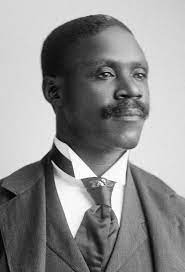
George Washington Murray was one of the most remarkable figures of the late 19th-century American South. Born into slavery in Rembert, South Carolina, in 1853, he rose to become an educator, a successful farmer, and a highly influential politician.
- Political Legacy: Murray was elected to the U.S. House of Representatives, serving from 1893 to 1897. Notably, he was the only Black member of the 53rd and 54th Congresses, where he fought aggressively to protect voting rights and highlight African American achievements.
- Prolific Inventor: Frustrated by the historical erasure of Black technological achievement, Congressman Murray famously read a list of 92 patents by African American inventors into the Congressional Record in 1894. He practiced what he preached, securing eight U.S. patents of his own between 1891 and 1903 for various agricultural labor-saving devices, including planters, cultivators, and this cotton-chopper.
Summary of Claims
The patent explicitly claims:
- The specific combination of a rectangular wheeled framework featuring a revoluble, axle-driven hoe shaft with an integrated engagement mechanism.
- A specialized notched bar and clamping system at the rear of the frame designed for the modular removal and adjustment of individual plow standards.
- The use of a rock-shaft linked directly to the plow feet, giving the operator centralized lever-control over the depth and tracking width of the following furrow-sweeps.
