
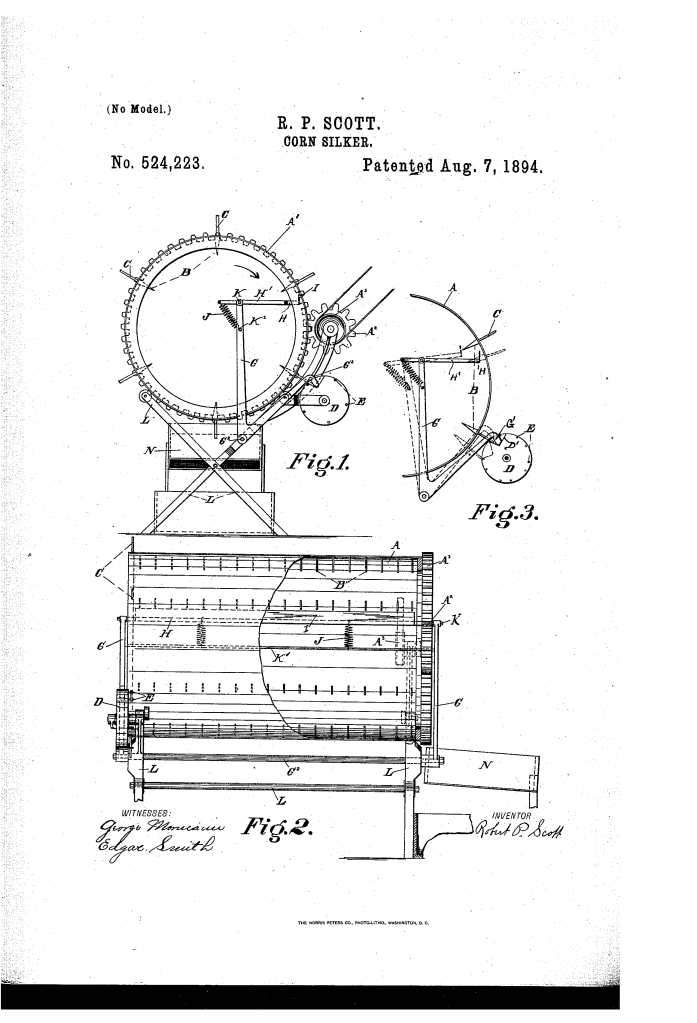
Corn-Silker (1894)
U.S. Patent No. 524,223, granted on August 7, 1894, to Robert P. Scott of Cadiz, Ohio, describes an automated mechanical system designed to remove silky fibers from green corn after it has been cut from the cob. Scott, an inventive mind in agricultural mechanics, sought to solve a major bottleneck in the late 19th-century canning industry.
This specific invention solved a persistent problem in food processing: when green corn is cut from the cob, it forms a thick, pasty mass. Traditional gathering devices would quickly clog with the sticky corn paste, rendering machinery useless and wasting a significant amount of food. Scott’s machine successfully separated the silk from the corn automatically, without clogging.
The Innovation: The Rotating Tooth and Intermittent Scraper
The brilliance of Scott’s corn-silker lay in its ability to separate materials based on texture and gravity using an inclined, open-ended rotating cylinder.
Instead of a continuous brushing mechanism that would mash the corn, Scott utilized rows of thin, wedge-shaped plates (or cylindrical pins) acting as gathering teeth along the inner walls of the cylinder. As the corn mass traveled down the inclined drum, the fibrous silk naturally caught on these teeth, while the heavy, pasty corn slid safely along the bottom toward the discharge end.
Why the Mechanical Design Succeeded
- Selective Adhesion: The wedge shape of the teeth allowed the fibrous silk to wrap around and adhere to them, while the wet corn kernels simply slipped past.
- Gravity Separation: By rotating the cylinder, the silk-laden teeth were carried to the upper side of the drum, cleanly lifting the debris away from the corn mixture below.
- The “Hunting Tooth” Timing Gear: To prevent the cleaning mechanism from wearing down or missing rows, Scott engineered a mismatched pin ratio. The cylinder featured six pins, while the driving pin wheel featured only five. This fractional difference meant that a different row of teeth was scraped on every rotation, ensuring even cleaning across the whole machine.
Key Mechanical Components
The apparatus relies on a purely mechanical, synchronized sequence of levers and gears:
| Component | Function |
| Rotary Cylinder (A) | The main open-ended drum that receives the cut corn and tumbles it via rotation. |
| Gathering Teeth (B) | Thin, wedge-shaped plates distributed inside the cylinder that selectively catch silk fibers. |
| Rubber Scraper (I) | A yieldingly supported rubber strip that periodically wipes the teeth from base to apex to remove collected silk. |
| Bell Crank Levers (G) | Weighted levers that automatically throw the scraper into the path of the teeth at precise intervals. |
| Grooved Pin Wheel (D) | The timing hub that drops the levers into a groove, triggering the cleaning cycle once every five cylinder revolutions. |
| Shaking Sieve (N) | Located at the discharge end to remove any remaining large particles of husk or cob from the clean corn. |
How the Apparatus Functions
The processing sequence continuously cleans the corn while keeping the machinery free of residue:
- Feeding: Cut green corn and intermixed silk are fed into the left, open end of the rotating cylinder.
- Separation: The mass slides along the bottom. The teeth pass through the mixture, catching the silk and carrying it upward, while any accidentally lifted corn drops back down by gravity.
- Triggering: As the cylinder hits its fifth revolution, the weighted bell crank drops into the groove of the pin wheel.
- Scraping: The spring-loaded rubber scraper is thrown directly into the path of the elevated teeth, wiping the accumulated silk off onto a collection bar.
- Discharge: The clean corn exits the right side of the cylinder onto a shaking sieve for a final filtering of husks and cobs.
Industrial Impact
Before Robert P. Scott’s invention, “silking” corn was a tedious, manual chore that required large amounts of hand labor in canning factories, severely limiting production speeds.
- Mass Production: By automating the separation of silk from pasty cut corn, this machine allowed canning factories to significantly scale up operations.
- Waste Reduction: Because the machine selectively caught fibers without dragging the corn paste with it, it dramatically increased the yield of usable product per bushel.
- Self-Cleaning Longevity: The automated scraper meant the machine did not have to be shut down periodically for manual cleaning, enabling continuous factory operation.
About the Inventor: Robert P. Scott
Robert P. Scott was a prominent inventor from Cadiz, Ohio, who left an indelible mark on industrial food processing. He is best known historically as a pioneer in canning machinery, later partnering in the Sinclair-Scott Company, which became famous for manufacturing revolutionary pea hullers, apple parers, and corn processing equipment. His focus on solving the mechanical challenges of processing delicate fruits and vegetables helped lay the groundwork for modern automated food packaging.
Summary of Claims
The patent explicitly claims:
- A cut green corn silking machine combining a rotary cylinder with internal gathering teeth and an automatic scraping device.
- The use of an imperforate rotary cylinder working in tandem with automatic cleaning devices.
- A yieldingly mounted scraper within the cylinder that utilizes periodically acting devices to throw the scraper into the path of the teeth.
- The specific mechanical configuration of a grooved pin wheel and shifting levers to actuate the cleaning cycle safely and rhythmically.
