
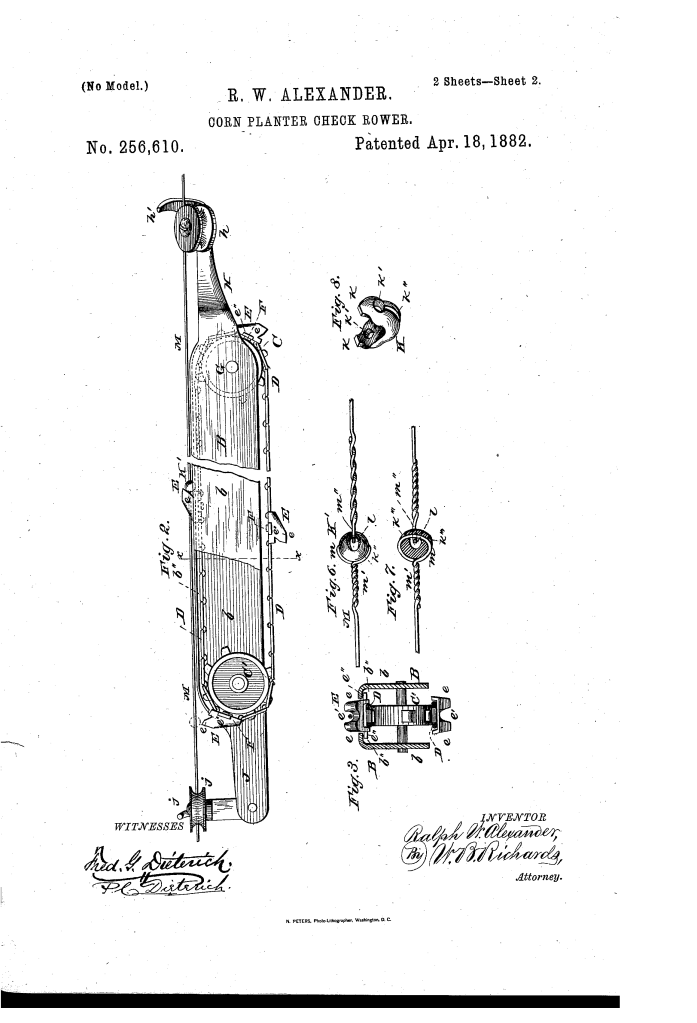
Ralph W. Alexander’s patent for a Corn-Planter Check-Rower, No. 256,610, describes a device for a horse-drawn corn planter that ensured corn seeds were planted in straight, evenly spaced rows. Patented on April 18, 1882, the invention was an improvement on previous check-rowers that often jammed.
Key Features
- Endless Belt System: The invention’s main feature was a pair of endless chain belts with forked heads. These belts were mounted on sprocket-wheels at the front of the corn planter.
- Tappet-Wire: A long wire with strategically placed knots, or “tappets,” was stretched across the field to be planted. As the planter was pulled along, the tappets would catch in the forked heads of the belt.
- Intermittent Rotation: When a tappet engaged a forked head, it would push the belt, causing it to rotate the sprocket-wheel. This in turn imparted an intermittent rotary motion to a shaft.
- Seed Slide Activation: The motion of this shaft would then trigger the seed slides of the planter, causing a charge of corn seed to be dropped at a precise, repeatable interval.
Alexander also included an improved design for the tappet itself, which was made from a single blank of metal that was bent around the wire, providing a strong and reliable knot.
Societal Impact
Alexander’s check-rower was a significant innovation in agricultural technology that had a large impact on farming in the late 19th century.
- Agricultural Efficiency: Planting corn in straight, evenly-spaced rows was critical for efficient cultivation. It allowed farmers to use horse-drawn cultivators to plow between the rows without damaging the young corn plants. This invention made that process automatic and precise, saving immense amounts of time and labor.
- Economic Benefits: By ensuring the seed was planted correctly, the invention led to more uniform and higher crop yields. For farmers in the Midwest, where corn was a staple crop, this was a major economic advantage.
- The Inventor’s Legacy: The patent record for Ralph W. Alexander does not contain information about his life beyond his residence in Galesburg, Illinois. However, his work stands as an example of the thousands of inventors who created devices that, while not world-changing, made a direct and tangible improvement to the lives and livelihoods of working people.
