
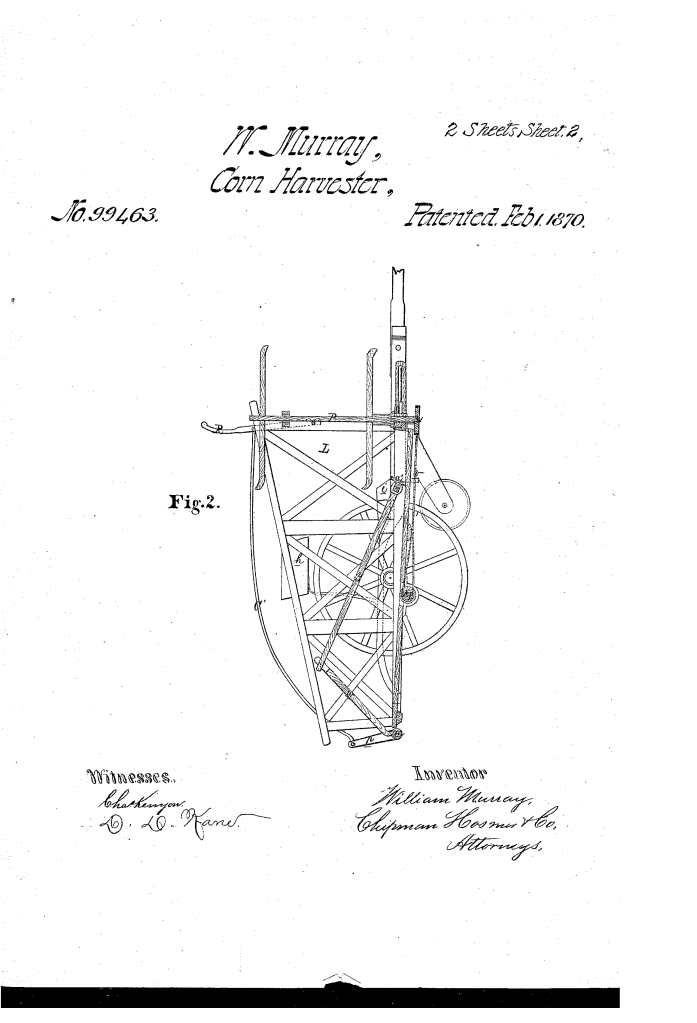
William Murray was granted patent 99,463 for a Corn-Harvester on February 1, 1870. This invention was an early form of a mechanical harvester designed to cut standing corn stalks and group them into bundles for binding. The machine was a carriage with three wheels and two main sections that were pulled by a team of animals.
Key Features
- Vibrating Cutting Bar: The wheels of the machine were connected to a system of gears and a crank that caused a cutting bar to vibrate back and forth. This bar, with diamond-shaped knives, would cut the corn stalks.
- Gathering Reel: A rotating gathering reel with curved arms would press the cut stalks firmly against the cutting fingers and then sweep them back onto a platform.
- Unloading Rake: Once enough stalks were collected on the platform for a bundle, the operator could pull a lever to activate a rake. This rake would then push the bundle of stalks off the platform and onto the ground, ready for a worker to bind.
Societal Impact
Murray’s corn harvester was a significant step in the mechanization of agriculture in the late 19th century.
- Agricultural Efficiency: Prior to this invention, cutting and gathering corn stalks was a manual, laborious task. Murray’s machine automated a significant portion of this work, saving immense amounts of time and labor for farmers. It allowed them to harvest more corn in less time, which was crucial for increasing farm productivity.
- The Inventor’s Legacy: The patent record for William Murray, who signed with an “X” mark, identifies him as an African American inventor. While details of his life are limited, his invention stands as a powerful example of the ingenuity of Black innovators in an era when they faced immense racial discrimination. His work contributed to the technological advancements that transformed American agriculture and laid the groundwork for modern farming equipment.
