
Inventor: Leonard C. Bailey
Patent Number: 285,545 (US-0285545-A)
Date of Patent: September 25, 1883
Invention: Combined Truss and Bandage
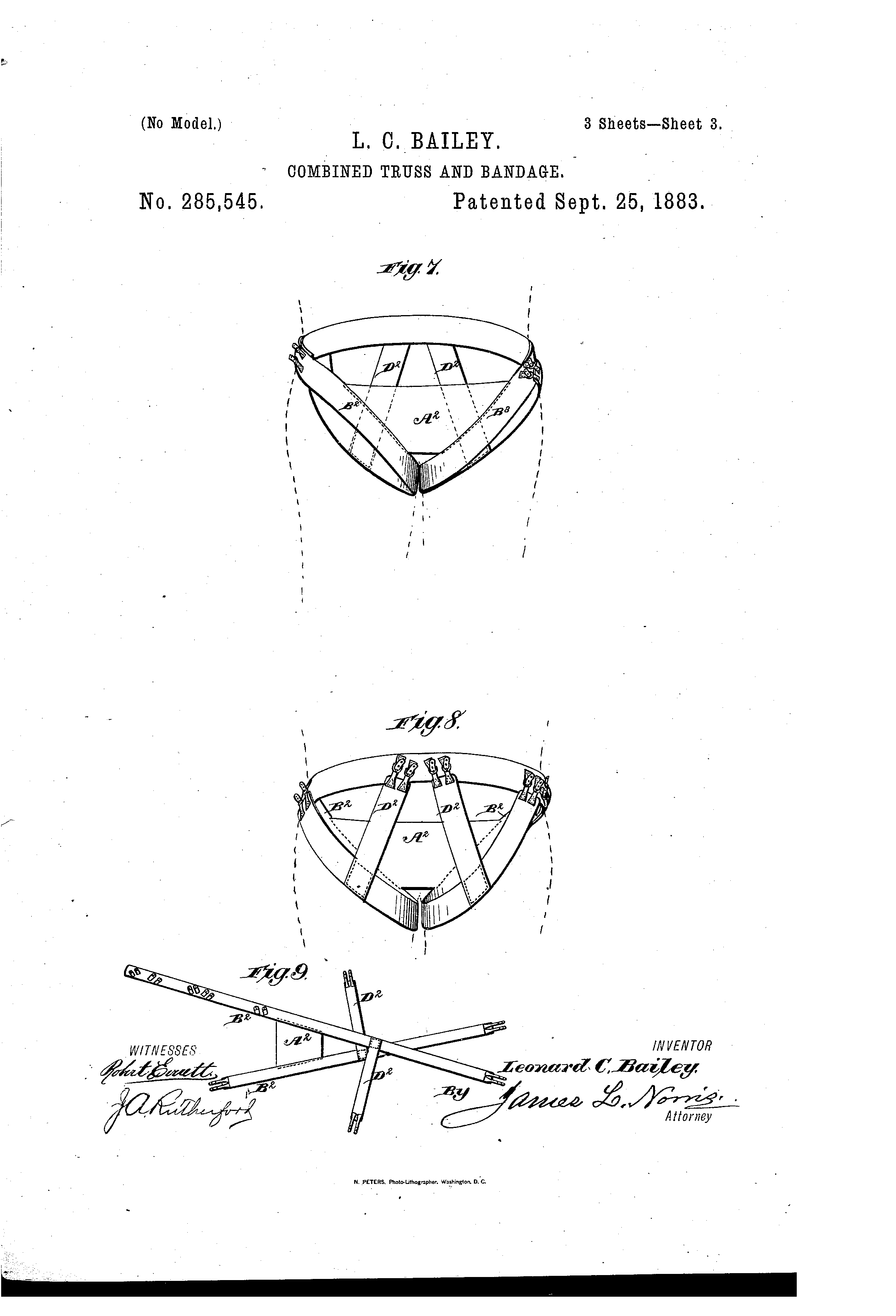
Description of the Invention (from the Patent Document): Leonard C. Bailey’s 1883 patent for a “Combined Truss and Bandage” was designed to provide a more effective, comfortable, and versatile support device for individuals suffering from hernias, particularly inguinal hernias. Trusses were common medical devices in the 19th century used to provide external pressure to keep a reducible hernia in place. Bailey’s invention aimed to improve upon existing designs.
Key features and components of his design:
- Pads (A): The device features one or more pads (A) made of suitable material, designed to be placed directly over the affected area of the hernia.
- Connecting Bar or Spring (B): These pads are connected by a flexible bar or spring (B) that extends across the pubic region (or around the body depending on the type of hernia). This spring provides the necessary tension to hold the pads in place and apply pressure.
- Body-Band (C): A flexible body-band (C), made of webbing or similar material, extends from one end of the connecting bar/spring (B) around the wearer’s body to the other end.
- Thigh-Strap (D): To further secure the device and prevent displacement, a thigh-strap (D) extends from the connecting-bar (B) and passes under the thigh, attaching back to the body-band (C). This strap is designed to keep the pads firmly in position.
- Adjustability: The patent emphasizes the adjustability of the various parts to ensure a snug and comfortable fit for different body types and to provide the correct amount of pressure. This often involved buckles, loops, and clasps.
- Ventilation and Comfort: The material for the body-band and potentially the pads would be chosen for comfort and breathability.
Purpose of the Invention: The main objective was to create a truss that provided constant, gentle, yet firm support to a reducible hernia, preventing it from protruding, while also being comfortable and unobtrusive for the wearer. The “combined” aspect likely refers to integrating the truss’s supportive pads and springs with a secure bandage-like body band and thigh strap.
Personal Significance (Leonard C. Bailey): Leonard C. Bailey was an African American inventor from Washington, D.C. His “Combined Truss and Bandage” patent showcases his inventive ability in the field of medical devices. This invention highlights his concern for practical solutions to health challenges, a common theme among inventors who observed unmet needs in society.
Bailey was a prolific inventor with a diverse range of patents beyond this medical device. He is perhaps most widely known for his 1899 patent for a “Folding Bed” (Patent No. 636,873), which addressed space-saving needs in urban dwellings. Other inventions include a “Lacing-Stud” for shoes in 1886 and a “Cotton-Picker” in 1898. As an African American inventor in the late 19th century, Bailey navigated a landscape of significant racial discrimination and limited opportunities. His success in securing multiple patents across different fields underscores his remarkable ingenuity, perseverance, and dedication to innovation. His contributions are part of the important, yet often under-recognized, history of Black American innovation.
Historical Significance: Leonard C. Bailey’s “Combined Truss and Bandage” holds historical importance within the context of 19th-century medical technology, public health, and African American contributions to science and industry:
- Addressing Common Medical Conditions: Hernias were a prevalent and often debilitating condition in the 19th century, especially among laborers. Before modern surgical techniques became widespread, trusses were the primary non-surgical method for managing hernias. Improvements like Bailey’s were crucial for providing better palliative care and allowing individuals to continue their work with greater comfort.
- Evolution of Medical Devices: The invention reflects the ongoing efforts to refine and improve medical support devices. Inventors sought to make trusses more effective, less cumbersome, and more comfortable for long-term wear.
- African American Contribution to Healthcare Technology: Bailey’s patent in the medical field is a significant example of an African American inventor directly contributing to healthcare solutions. It demonstrates that Black ingenuity extended to improving instruments and devices critical for public health and individual well-being, despite the systemic barriers of the era.
- Practical Impact on Daily Life: For those suffering from hernias, a well-designed truss could mean the difference between being able to work and being incapacitated. Bailey’s improvement had a direct, positive impact on the daily lives and livelihoods of many individuals.
His patent is a testament to the practical application of inventive thought to address real-world health challenges.

Generate Audio Overview
