
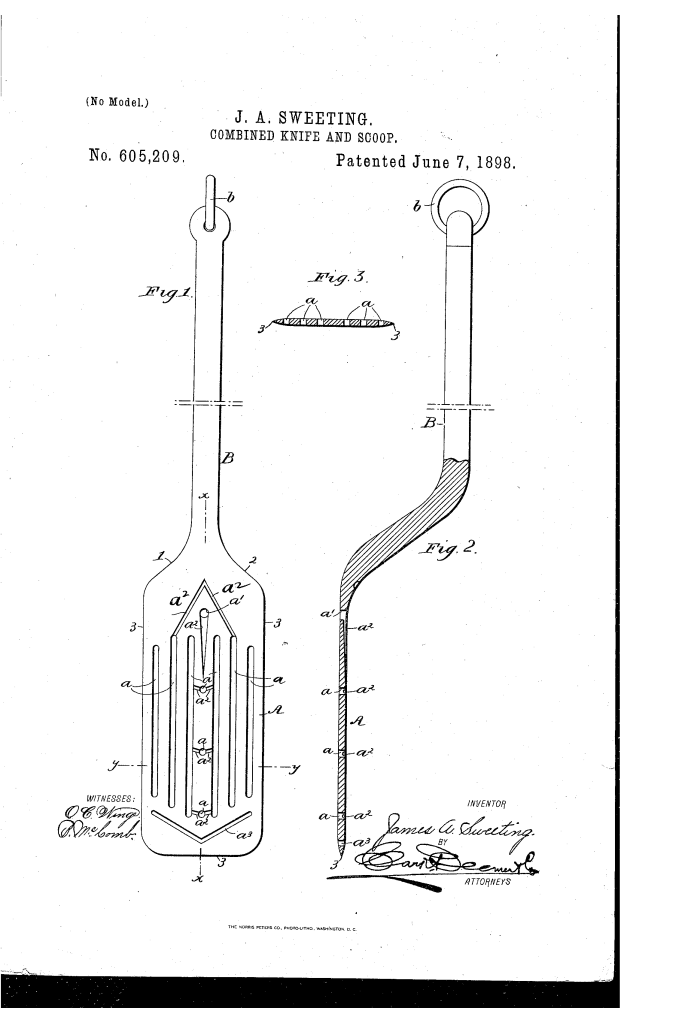
Combined Knife and Scoop (1898)
U.S. Patent No. 605,209, granted on June 7, 1898, to James A. Sweeting, describes a multifunctional culinary implement engineered specifically for frying, lifting, and serving hot meats and fish. Sweeting, a resident of New York City who assigned half of his patent rights to James A. Cambridge, designed a tool that bridged the gap between a slotted spatula and a prep knife.
The invention directly solved a common kitchen bottleneck: the clumsy, multi-step process of lifting delicate, grease-soaked foods out of a hot pan with one utensil and switching to a knife to trim or portion them beforeCombined Knife and Scoop (1898)
U.S. Patent No. 605,209, granted on June 7, 1898, to James A. Sweeting, details an innovative multi-purpose culinary tool designed for frying, draining, and preparing meats. Sweeting, an inventor based in New York City, assigned half of the patent rights to James A. Cambridge, also of New York.
The invention directly addressed an everyday inefficiency in residential and commercial kitchens: the cumbersome process of lifting delicate, piping-hot fried meats from searing fat, draining off the excess grease, and having to switch to a separate utensil to cut and portion the food before serving.
The Innovation: The Dual-Function Perforated Blade
Cooking delicate proteins—particularly fried fish—presents two distinct challenges. First, excess oil clings to the surface, creating soggy food if not adequately drained. Second, transferring fragile fried cutlets between a separate spatula, a draining rack, and a carving knife frequently tears the meat apart.
Sweeting solved this by designing a unified, thin metallic implement that acts as a structural spatula, a rapid fat drainer, and a cutting instrument all in one hand tool.
Why the Combined System?
Efficient Drainage: Strategic perforations and feeding channels allow grease and drippings to escape instantaneously back into the pan.
Integrity of Food: Eliminates the need to puncture or drop hot meats while juggling multiple tools.
Dual Utility: The surrounding sharpened perimeter turns the spatula plate into an effective slicing knife the moment the meat touches the cutting board or serving platter.
Key Mechanical Features
The device integrates specialized geometry across a flat, rectangular plate:
| Component | Function |
| Plate (A) | A thin, flat metallic blade with rounded corners that serves as both the lifting scoop and the primary cutting surface. |
| Perforated Slots (a) | Vertical, parallel slots extending through the central body of the plate to permit immediate grease run-off. |
| Drainage Grooves (a’) | Surface channels scored into the upper face of the plate that actively route hot drippings directly into the center slots. |
| Terminal Aperture (d) | An additional angular opening located at the outer tip of the plate to ensure fluid escape from the leading edge. |
| Sharpened Knife Edge (3) | A continuous cutting edge extending around the plate’s perimeter (points 1 to 2) for trimming and dividing portions. |
| Handle & Hanging Ring (B, b) | An integrated or welded handle anchored to the plate, terminating in a ring for secure storage. |
How the Implement Functions
The operation follows a direct, streamlined sequence designed to save time and reduce labor at the stove:
| Step | Action | Functional Purpose |
| 1. Lifting | The operator slides the thin plate A under hot fried fish or meat in the frying pan. | Easily separates fragile crusts and meat from the cooking surface without breaking the food. |
| 2. Draining | Meat rests on the plate above the hot pan while oil flows through slots a and channels a’. | Quickly channels drippings back into the cooking vessel, preventing greasy food. |
| 3. Transfer | The food is carried on the scoop plate directly to a platter or preparation board. | Minimizes the handling of burning hot meats. |
| 4. Slicing | The cook uses the peripheral knife edge 3 to portion the food immediately. | Facilitates prompt carving and serving without reaching for a separate carving knife. |
Historical and Practical Impact
James A. Sweeting’s combined knife and scoop was an early and practical entry into modern kitchen ergonomics at the close of the 19th century.
Workflow Efficiency: In fast-paced cooking environments, combining the lifting spatula, drainage mechanism, and portioning blade reduced kitchen clutter and halved the utensil cycle required for handling fried foods.
Versatility: While Sweeting specifically highlighted its value for fragile fried fish, the balanced design made it equally suited for steaks, cutlets, chops, and pan-fried poultry.
Durability: By avoiding complex hinges or moving mechanical assemblies, the tool was durable, easy to clean, and inexpensive to manufacture from stamped or cut sheet metal.
About the Inventor: James A. Sweeting
James A. Sweeting was an inventor residing and working in New York City during the late 19th century. His work reflects the era’s growing focus on household utility, mechanical optimization, and practical domestic labor-saving devices. Collaborating with his partner James A. Cambridge, Sweeting demonstrated how subtle design adjustments—like integrating surface guide grooves with perforated drainage slots—could convert an ordinary kitchen knife into a high-utility culinary implement.
Summary of Claims
The patent explicitly claims:
A kitchen implement made of a thin, flat metal plate configured as a cutter, featuring parallel longitudinal apertures in the center, an angular aperture at the outer end, and surface grooves leading fluid into the central slots.
A continuous knife-edge surrounding the perimeter of the perforated plate with a projecting handle attached to one end.
The combination of lateral, longitudinal, and central drainage apertures communicating with surface grooves on one face to evacuate hot drippings.
