
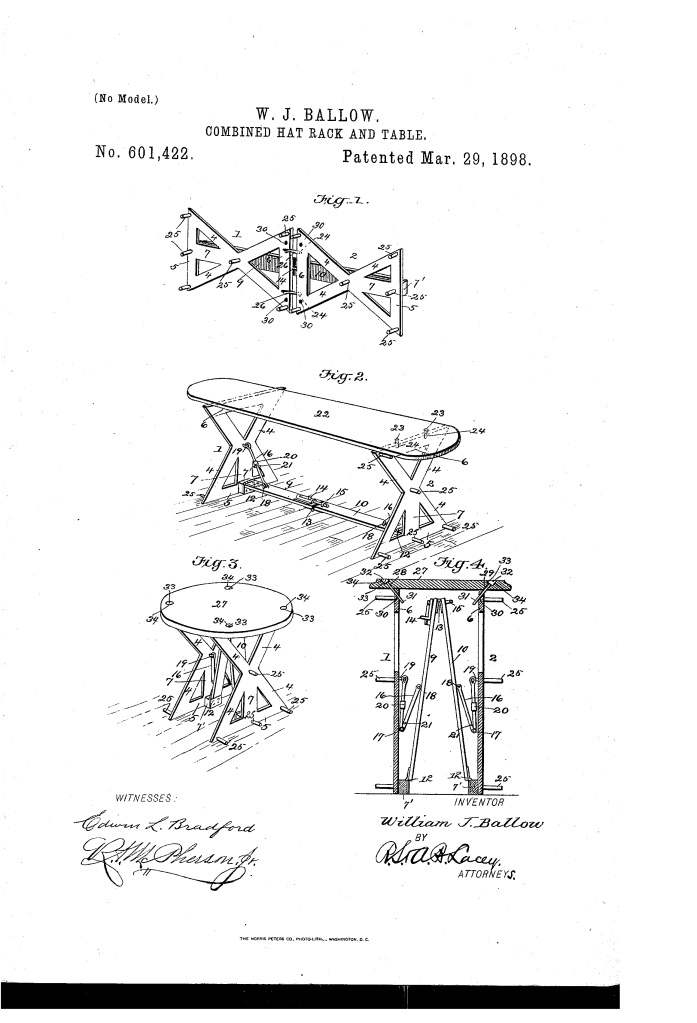
The patent by William J. Ballow of Riddleton, Tennessee, describes a Combined Hat-Rack and Table (Patent No. 601,422, 1898).1 The object is to provide a simple, cheap, and convenient article of furniture that can be converted into a hat-rack, an ironing-table, or a lamp/candle stand as required.
Inventor Background: William J. Ballow
William J. Ballow was an inventor focused on domestic utility and space-saving furniture. His invention addresses the need for multi-functional furniture in small or modest homes by designing a single unit that performs three distinct household tasks, which was a practical necessity in the late 19th century.
Invention and Mechanism
The device is a system of folding, jointed legs and collapsible braces that stabilize the unit in different configurations.
1. Frame and Stabilization (Key Innovation: The Sliding Sleeve Lock)
- Legs/Standards (1, 2): Two main legs, each comprising cross-braces (4, 5, 6) and a vertical standard (7).
- Folding Diagonal Rods (16): Diagonal rods run between the leg braces and the central longitudinal brace (9, 10). These rods are the key to the multi-functionality, as they have a hinged joint (17) about midway through their length.2
- Sliding Sleeve Lock (20): A sleeve (20) snugly encompasses each rod (16) and is adapted to slide over the hinged joint (17).3 A pin (21) holds the sleeve in place over the joint.
- Function: When the sleeve (20) is placed over the joint (17), it locks the rod rigidly, stabilizing the frame for use as a table. When the sleeve is removed, the rod folds, allowing the legs to collapse.
2. Conversion Modes
- Hat-Rack (Fig. 1): The sleeves (20) are slipped up to release the joints (17), allowing the diagonal rods (16) to fold inwardly.4 The legs (1, 2) are then turned inward and closed down on the central brace. In this compact, folded position, pegs or studs (25) secured to the braces project horizontally to form supports for hats and coats.
- Ironing-Table (Fig. 2): The legs are unfolded, and the sleeves (20) are slid down over the joint (17) to lock the diagonal rods rigidly. The two halves of the central longitudinal brace (9, 10) are locked flat by a bolt (14). A longitudinal ironing-board (22) is placed on the top cross-braces (6, 6) and secured by dowel-pins (23).
- Function: The board’s front end is hinged (by the dowel-pins), allowing the rear end to be raised to insert a skirt or shirt for ironing convenience.5
- Lamp/Candle Stand (Fig. 3): The bolt (14) on the longitudinal brace is withdrawn, allowing the brace to fold upwardly in the center (like the letter A). This draws the parallel legs closer together. A detachable circular top (27) is placed horizontally on the cross-braces (6, 6) and secured by pins (31) that pass through aligning orifices.
Concepts Influenced by This Invention
Ballow’s furniture influenced subsequent utility and camping gear by pioneering the sliding sleeve lock for rapid, rigid structure conversion.
- Sliding Sleeve/Collar Lock: The most direct influence is the mechanism using a sliding sleeve (20) that covers a hinged or articulated joint (17) to achieve rigid structural integrity. This concept is widely used in:
- Folding Camp Furniture: Mechanisms in camping chairs, cots, and tables where a sleeve is manually slid over a knuckle joint to lock the frame member open.
- Telescoping Poles and Rods: Various forms of push-pull locks and external sleeves that rigidize telescoping members.
- Integrated Multi-Functionality: The philosophy of designing a single, space-saving article that can be safely converted into three distinct utility pieces (storage rack, specialized work table, display stand) influenced the design of modern convertible apartment furniture and modular living systems.
- Pin/Hinge Engagement for Work Surfaces: The use of dowel-pins (23) in the board engaging simple orifices (24) for a toolless, hinged connection influenced the design of quick-attach/detach work surfaces in portable utility stands.
