
Combined Furrow-Opener and Stalk-Knocker (1894)
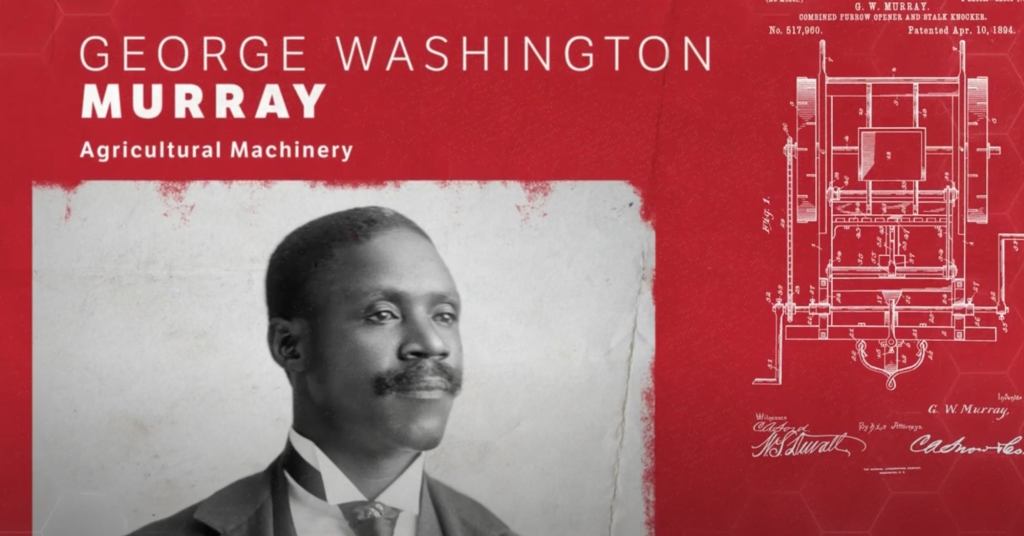
U.S. Patent No. 517,960, granted on April 10, 1894, to George W. Murray, describes an innovative agricultural implement designed to streamline field preparation by simultaneously opening center furrows and clearing old crop stalks. George W. Murray, an inventor from Sumter, South Carolina, was a pioneering figure in agricultural mechanics and one of the few Black members of Congress during the Reconstruction era.
This specific invention solved a labor-intensive and persistent problem for farmers: the necessity of breaking down old stalks by hand before a field could be plowed. Murray’s machine integrated these two distinct field preparation tasks into a single horse-drawn implement, allowing agricultural residue to be processed efficiently so it could decompose and enrich the soil.
The Innovation: Synchronized Soil and Stalk Management
Traditionally, farmers had to clear or smash stalks from the previous harvest before breaking new ground to prevent equipment from clogging. Murray’s breakthrough was a mechanical, axle-driven system that mechanized this process right at the front of the plow frame.
By utilizing the mechanical rotation of the main wheels, the machine powered a forward-mounted assembly that actively broke down standing vegetation just fractions of a second before the plow shovel engaged the earth.
How the Dual-Action System Functions
The machine coordinates two actions simultaneously as it is drawn down the row:
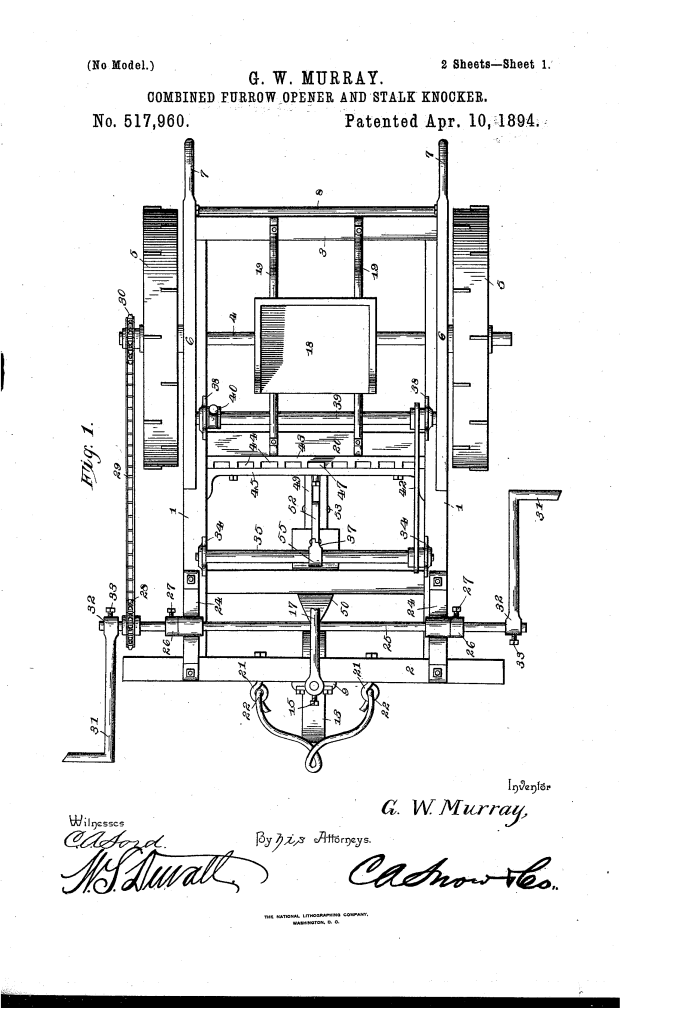
- Mechanical Stalk-Knocking: As the machine moves forward, the ground wheels turn the main axle. This axle transfers rotational power via a sprocket-and-chain drive to a front-mounted transverse shaft. This shaft features heavy, rotating crank-shaped arms that strike and snap standing stalks on either side of the row.
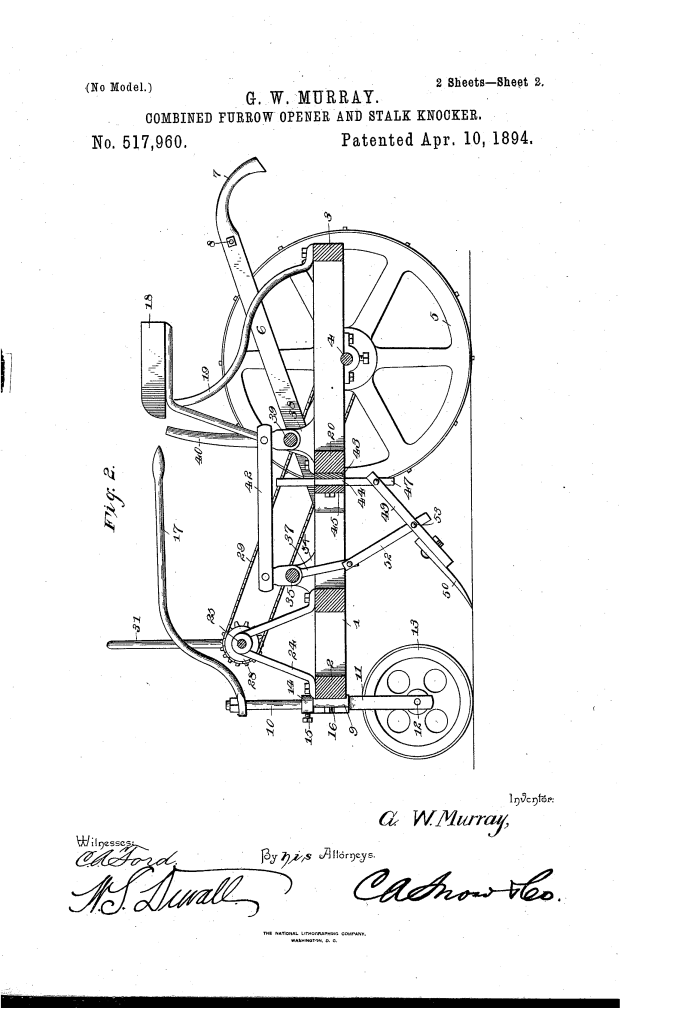
- Precision Furrow-Opening: Positioned safely behind the rotating arms, an adjustable plow shovel opens a clean center furrow. Because the stalks are broken down ahead of it, the shovel can cut smoothly through the soil without snagging on upright debris.
Key Mechanical Components
The apparatus is built on a heavy rectangular timber frame where the drive mechanics and soil tools work in harmony:
| Component | Function |
| Main Axle & Ground Wheels (4, 5) | The primary mobility system that generates mechanical power from the team’s forward pull. |
| Sprocket & Chain Drive (28, 29, 30) | Transfers rotational energy from the turning axle directly up to the forward clearing shaft. |
| Crank-Shaped Knocking Arms (31) | Adjustable, rotating iron clubs that strike and fracture tough stalks, dropping them flat to the earth. |
| Adjustable Shovel Standard (47, 49) | A modular, vertical plate-and-mortise clamping system that sets the depth of the furrow. |
| Hand-Lever Assembly (40) | A manual lever system allowing the operator to raise the plow completely for transport or drop it to engage the soil. |
Performance: Operational Advantages
Murray’s design offered significant economic and labor advantages over traditional mid-19th-century farming practices:
- Labor Elimination: It entirely obviated the need to clear stalks manually by hand or run a separate stalk-cutter across the field prior to plowing.
- Soil Enrichment: Rather than burning crop residue (which strips nutrients), the machine broke and left the stalks flat on the ground to decay naturally, serving as organic fertilizer.
- Versatility: The knocking mechanism could be decoupled or adjusted via binding screws, allowing the machine to function purely as a multi-shovel gang plow when clearing wasn’t required.
About the Inventor: George W. Murray
George Washington Murray was one of the most remarkable inventors and political figures of the late 19th century.
- Patents: Born into slavery in South Carolina, Murray became a teacher, farmer, and prolific inventor, securing eight patents in the early 1890s for agricultural advancements, including cotton choppers, fertilizer distributors, and planters.
- Political Legacy: Murray was elected to the 53rd and 54th U.S. Houses of Representatives, serving as South Carolina’s only Black congressman during that time. On the House floor in 1894, he famously read his own patents into the Congressional Record to explicitly prove the intellectual and creative capacities of African Americans.
- Impact: His mechanical innovations sought to increase the operational autonomy and financial viability of small-scale farmers and sharecroppers across the post-bellum American South.
Summary of Claims
The patent explicitly claims:
- The combination of a rectangular frame and ground-wheel axle with a forward transverse shaft carrying rotating knocking-arms powered by a sprocket chain.
- The use of adjustable bearing-collars and eyes with binding screws to alter the alignment and sweep of the crank-shaped clearing arms.
- A plow-standard mounting system utilizing a recessed mortise plate and clamping bar to adjust the vertical depth of the plow shovel.
- A pivot link mechanism connected to a dual rock-shaft assembly for manual leverage control over the shovel’s pitch and elevation.
