
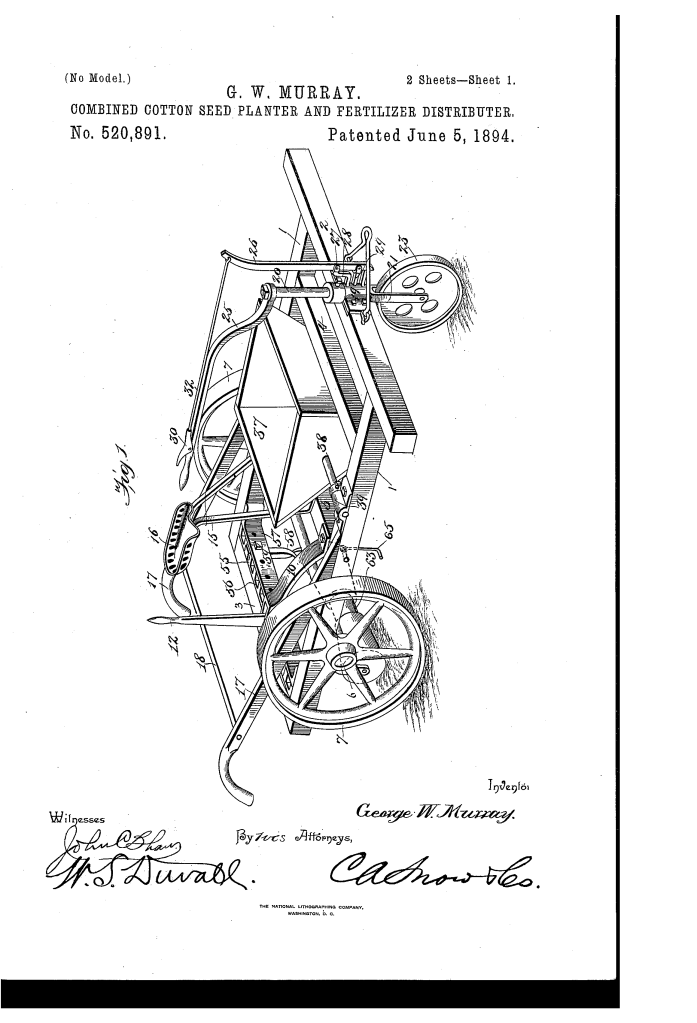
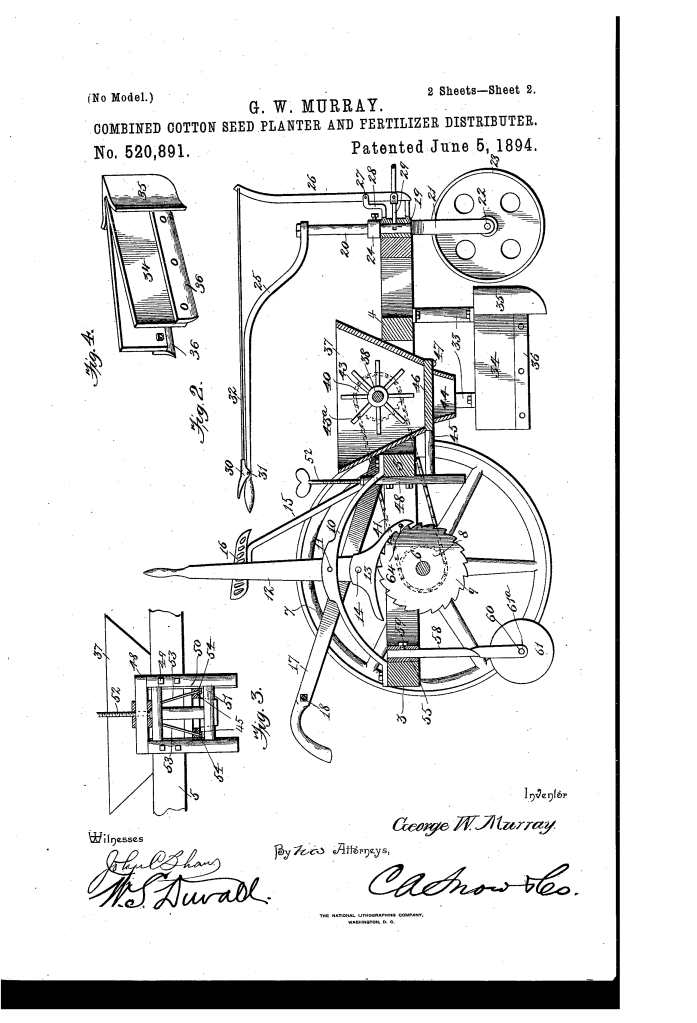
Combined Cotton-Seed Planter and Fertilizer-Distributer (1894)
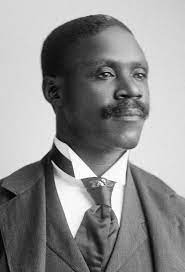
U.S. Patent No. 520,891, granted on June 5, 1894, to George W. Murray, describes an innovative agricultural machine designed to automate and perfect the planting of cotton seed—either for crop growth or for use as a natural fertilizer. Murray, an influential farmer, inventor, and statesman from Rembert, South Carolina, designed this system to drastically reduce the manual labor required to prepare, plant, and bed Southern fields.
This invention solved a notorious problem in late 19th-century farming: cotton seeds are notoriously “fuzzy” and prone to clumping, which regularly clogged mechanical planters. Murray’s machine ensured a continuous, un-clogged flow of seeds while simultaneously opening the furrow, distributing the seeds evenly, packing the soil, and marking the crop row in a single pass.
The Innovation: The “Agitating Hopper and H-Frame Cut-Off”
To prevent seed clumping and control the exact amount of seed dropped into the soil, Murray engineered a dual-action system driven mechanically by the rotation of the wagon’s main wheels.
Instead of relying on gravity alone, a chain-driven agitating shaft lined with radiating “stirring fingers” constantly churned the seeds inside the hopper. To regulate the flow, Murray created a highly precise cut-off mechanism using a vertical, adjustable H-shaped frame. By turning a single top-mounted set screw, a pair of inclined guide rods would spread or contract the internal feed levers, allowing the farmer to calibrate the seed discharge perfectly depending on whether they were planting a crop or heavily distributing seed to rot as fertilizer.
How the Apparatus Functions
The planter operates in a continuous, automated sequence as it is pulled through the field:
| Step | Action | Purpose |
| 1. Furrowing | The V-shaped front shoe and flared shear-blades slice into the earth. | Opens a clean, uniform trench and clears debris ahead of the seed drop. |
| 2. Agitation | Ground wheels turn the axle, spinning the internal sprocket-driven fingers. | Keeps the sticky, fibrous cotton seeds fluid and prevents bridging or clogging. |
| 3. Metered Drop | Seeds fall through the space regulated by the H-frame cut-off into the furrow. | Ensures accurate spacing and prevents wasting expensive seed. |
| 4. Bedding & Drilling | The heavy, concave rear roller passes over the newly dropped seed. | Presses the soil inward to cover the seed, leaving a distinct, raised drill line. |
Technical Components
- Agitating Hopper (37): The central reservoir featuring an internal hub with radiating arms that constantly break up seed clusters.
- H-Shaped Regulating Frame (51): An adjustable metal framework equipped with converging guide rods that precisely controls the opening and closing of the feed gates.
- V-Shaped Furrow Shoe (35) & Shear-Blades (36): A multi-tiered ground-breaking tool that cuts the soil and flares outward to mold the trench.
- Concave Packing Roller (61): A specialized rear wheel that tapers inward toward an annular center groove, packing the dirt efficiently over the furrow and leaving a highly visible guide path for future farming.
- Lockable Caster Wheel (23): A front guide wheel operated by an upper handle and locking lever, allowing the driver to fix the steering angle or easily turn at the end of a row.
Historical and Agricultural Impact
George W. Murray’s invention arrived during a critical era of Southern agricultural modernization.
- Resource Efficiency: At the time, raw cotton seed was widely recognized as a highly effective, cheap fertilizer. Murray’s machine allowed farmers to rapidly distribute large quantities of seed to rot and enrich the soil efficiently.
- Labor Reduction: By combining four distinct tasks—trenching, clearing, metered seeding, and soil packing—into one horse-drawn implement, the machine significantly cut down the manpower required during the planting season.
- Precision Farming: The distinct “drill line” left by the unique rear roller allowed farmers to immediately see where rows were planted, protecting the buried seeds from accidental trampling during subsequent field work.
About the Inventor: George W. Murray
George Washington Murray was one of the most remarkable figures of the post-Reconstruction American South.
- From Slavery to Congress: Born into structural bondage in South Carolina, Murray educated himself, attended South Carolina College, and went on to become a teacher, farmer, and eventually a U.S. Congressman, serving as the only Black member of the 53rd Congress.
- A Prolific Innovator: Murray was a passionate champion of Black ingenuity. While in Congress, he frequently read lists of patents secured by African American inventors into the Congressional Record. He himself held at least eight agricultural patents, including heavily utilized designs for continuous soil cultivators, reapers, and cotton choppers.
Summary of Claims
The patent explicitly claims:
- A rear packing roller featuring a concaved periphery and a central annular cylindrical recess, mounted on adjustable vertical standards utilizing a notched clamping plate.
- A specialized rear axle drive system featuring a ratchet wheel and a weighted pawl mechanism that allows the machine to be backed up or paused without damaging the drive gears.
- The combination of forwardly converged gage-bars, a V-shaped furrow shoe, and horizontally flared shear-blades extending below the gage-bars.
- A seed-distribution control system combining a hopper agitator with a pair of pivoted gate-bars operated by an adjustable sliding H-frame and inclined rods.
