
Combined Cot, Hammock, and Stretcher (1898)
U.S. Patent No. 615,907, granted on December 13, 1898, to Charles V. Richey (assignor of three-fifths to Leonard C. Bailey), details a multi-functional field bed designed for military and outdoor utility. The invention combines three separate pieces of camp equipment—a raised camp bed, a suspended hammock, and a medical litter—into a single, compact roll that can be folded directly into a soldier’s standard blanket roll without adding burdensome weight.
The Core Design: The Modular Tension Frame
The mechanical core of Richey’s design relies on a flexible canvas body laced with continuous load-bearing ropes and rigid cross-members. Instead of heavy iron hinges or complex side rails, tension across the textile provides the necessary structural rigidity.
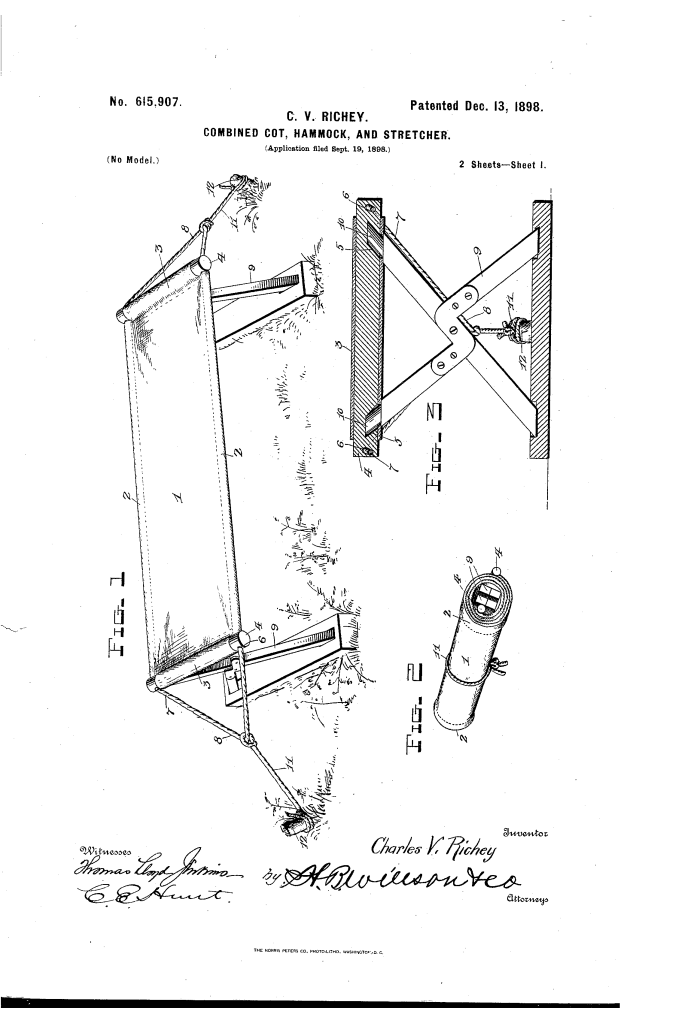
- The Flexible Body and Hem System (1, 2, 3)The foundation consists of a strong textile body (1), preferably canvas.
- Longitudinal hems (2) run continuously down the entire outer length of both sides.
- Transverse end hems (3) are shorter than the width of the main canvas bed, leaving the outer wooden edges of the stretcher-bars exposed.
- Endless Rope and Suspending-Bails (7, 8)A heavy endless rope (7) runs inside the side hems (2). It passes out of the canvas ends and threads directly through bored apertures (6) in the exposed ends of the stretcher-bars (4), forming exterior loops termed suspending-bails (8).
- Detachable Uprights (9, 10)Two pairs of folding legs (9) feature turned tenons (10) at their upper tips. These tenons seat firmly into matching blind sockets (5) bored into the underside of the stretcher-bars (4).
Operational Modes and Deployment
The apparatus quickly converts between three distinct tactical configurations depending on field requirements:
| Mode | Mechanical Setup | Functional Purpose |
| 1. Camp Cot | Legs (9) seated in sockets (5); lanyards (11) anchored to ground stakes (12); legs levered upright. | Creates a raised, rigid sleeping surface isolated from cold or damp ground. Levering the legs inward pulls the canvas drum-tight. |
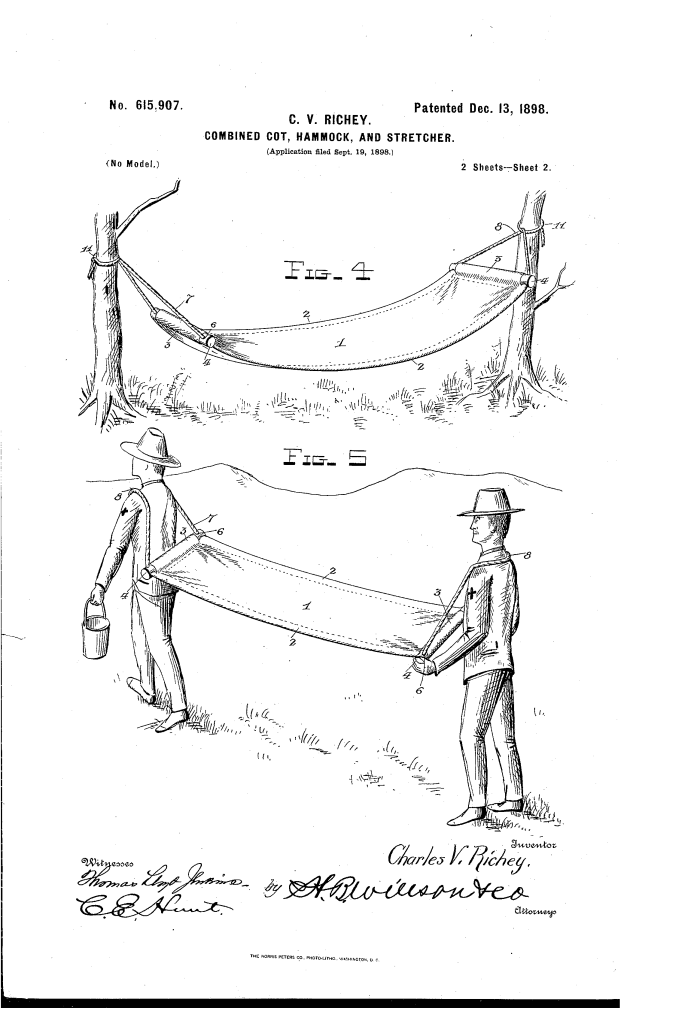
| 2. Hammock | Folding legs (9) removed entirely; lanyards (11) secured directly between trees or support posts. | Provides an elevated, free-swinging suspended bed for rough, sloped, or wet terrain. |
| 3. Field Stretcher | Lanyards secured or stowed; suspending-bails (8) looped over the shoulders of two bearers. | Hands-free casualty evacuation, allowing field medics or soldiers to carry wounded while holding gear or supporting the patient. |
Key Technical Components
- Main Textile Body (1): Heavy canvas sheet forming the primary weight-bearing surface.
- Stretcher-Bars (4): Rigid wooden cross-members fitted through end hems (3) to prevent lateral collapse.
- Sockets & Tenons (5, 10): Modular mortise-and-tenon interface holding the removable vertical legs stable under downward load.
- Continuous Rope Core (7): Internal tension line transferring tensile load along the bed perimeter to eliminate tearing at stitch lines.
- Suspending-Bails (8) & Lanyards (11): External rigging points handling anchoring, suspension, and over-the-shoulder hauling.
Military and Tactical Impact
Richey’s combined design directly targeted logistics and field mobility during late 19th-century military campaigns:
- Pack Efficiency: Eliminated the logistical deadweight of soldiers carrying separate litter canvas, folding cots, and hammocks on long marches.
- Rapid Evacuation: Allowed combat units to convert standard bedding into an emergency medical stretcher instantly without specialized tools.
- Field Ergonomics: Shoulder-slung carry loops (8) distributed patient weight across the torso of the bearers, greatly reducing fatigue during casualty transport over rough ground.
About the Assignee: Leonard C. Bailey
Charles V. Richey assigned a majority three-fifths stake in this patent to Leonard C. Bailey of Washington, D.C. Bailey was a prominent Black inventor, entrepreneur, and civil rights leader who notably patented his own folding military bed design (U.S. Patent No. 629,286) the following year. Bailey was a co-founder and director of the Capital Savings Bank—one of the earliest Black-owned banks in the United States—and actively financed and partnered on mechanical innovations designed to support everyday civil and military needs.
Summary of Claims
The patent explicitly claims:
- A flexible textile body having continuous longitudinal side hems, shorter end hems, and transverse stretcher-bars with bored apertures and bottom leg-sockets.
- An endless rope threaded through the longitudinal side hems and through the stretcher-bar apertures to form load-bearing loops.
- Detachable folding legs engineered with tenons to seat within the stretcher-bar sockets for quick assembly and breakdown.
