
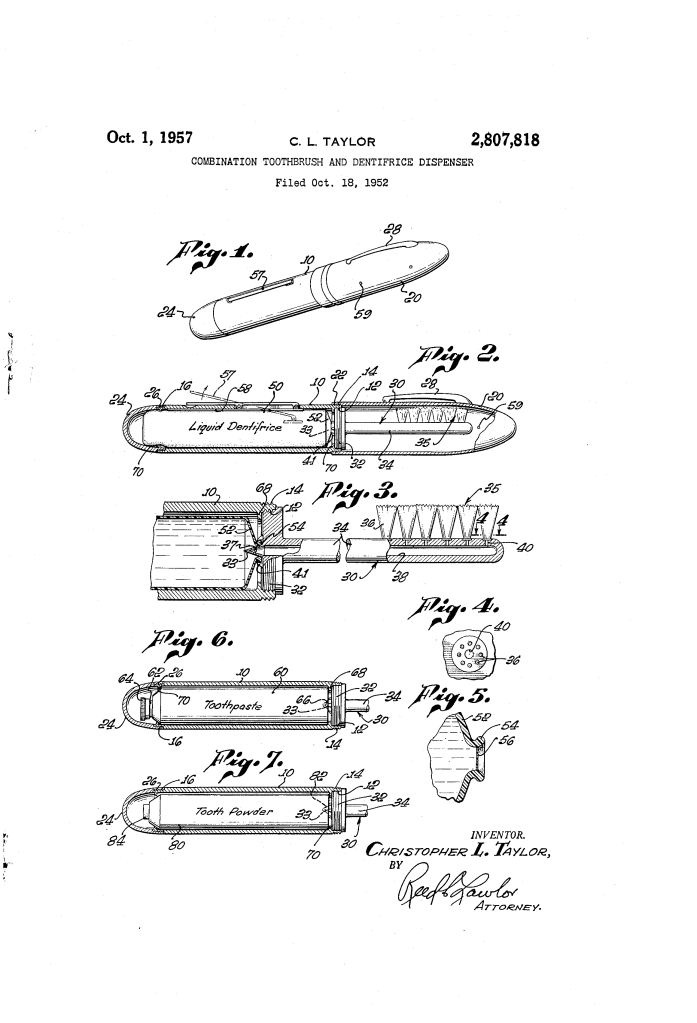
Combination Toothbrush and Dentifrice Dispenser (1957)
U.S. Patent No. 2,807,818, granted on October 1, 1957, to Christopher L. Taylor, introduces a versatile, portable oral hygiene device designed for the modern traveler. Taylor, an inventor based in Los Angeles, California, sought to eliminate the bulk of separate brushes and tubes by creating a single, fountain-pen-shaped unit that could store and dispense any type of dental cleaner.
This specific invention solved a common frustration for mid-century commuters and travelers: the lack of a compact, leak-proof way to carry a toothbrush and various types of “dentifrice” (liquid, paste, or powder) in a pocket or purse without making a mess.
The Innovation: The “Universal Reservoir” System
Unlike previous “fountain” toothbrushes that only worked with specific pastes, Taylor’s design featured a tubular body (10) that acted as a universal dock for different container types. The brilliance of the system lies in its ability to adapt to whatever the user has on hand.
1. The Membrane-Piercing Needle (33)
For liquid users, the inner end of the brush head features a hollow needle. When a flexible liquid capsule (50) is pushed into the tube, the needle pierces a thin membrane, instantly connecting the reservoir to the bristles.
2. The External Dispensing Lever (57)
To apply the cleaner, Taylor installed a mechanical lever on the outside of the pen-like body.
- Pressure Plate (58): When the lever is pressed, it pushes a curved plate against the internal flexible tube.
- Controlled Flow: This “squeezing” action forces liquid through a flow channel (38) and out of tiny orifices (40) hidden in the center of the bristle bunches.
How the Apparatus Functions
The device is designed for a seamless transition from storage to active brushing:
| Step | Action | Purpose |
| 1. Uncapping | The long top cap (20) is removed to reveal the bristles. | Protects the brush from pocket lint and keeps it sanitary. |
| 2. Dispensing | The user tilts the brush down and presses the external lever (57). | Forces liquid dentifrice directly onto the bristles from the internal capsule. |
| 3. Reversing | After wetting, the brush is tilted up. | Allows excess liquid to flow back into the capsule to prevent drips. |
| 4. Ventilation | The cap is replaced; air flows through small perforations (59). | Allows the damp bristles to dry, preventing mold and odors. |
Technical Components
- Bristle Bunches (36): Arranged transversely with outlet orifices of approximately 0.010 inch in diameter—small enough to prevent leaks unless the lever is pressed.
- Retaining Fingers (41): Small, inward-directed metal or plastic tabs that “lock” the mouth of a liquid capsule in place over the needle.
- Multi-Purpose Caps: The top cap features a pocket clip (28) for carry, while the bottom cap (24) holds the dentifrice container firmly against the internal needle.
- Recessed Containers: For paste or powder users, the containers (60 or 80) feature a special recess (66) at the inner end to prevent the needle from accidentally puncturing them.
Versatility: Liquid, Paste, or Powder
Taylor’s patent emphasizes “market universality.” The dispenser is compatible with:
- Liquid Capsules: Direct flow through the needle and bristle orifices.
- Toothpaste Tubes: The user can detach the brush head and squeeze paste directly onto the bristles, or squeeze paste onto a finger to be transferred.
- Toothpowder Containers: Features a rubber stopper (84); the powder is poured into the palm of the hand and the moistened brush is dipped into it.
About the Inventor: Christopher L. Taylor
Christopher L. Taylor was an innovator working in the post-war Los Angeles industrial scene. His design reflected the era’s obsession with “all-in-one” gadgets and the increasing mobility of the American workforce. By modeling the device after a fountain pen, he tapped into a familiar aesthetic of professional utility. Taylor’s work was a precursor to modern travel toothbrushes, but with a level of mechanical sophistication—specifically the integrated internal pump—that is rarely seen in disposable modern equivalents.
Summary of Claims
The patent explicitly claims:
- An elongated tubular body with a pocket clip and ventilation holes.
- A membrane-piercing member (needle) that establishes communication with a dentifrice capsule.
- A pivoted dispensing lever and internal pressure plate for squeezing flexible containers.
- Outlet orifices located specifically within the centers of the bristle bunches for direct-to-bristle application.
- A modular design where the brush member (30) can be removed to accommodate paste or powder containers.
