
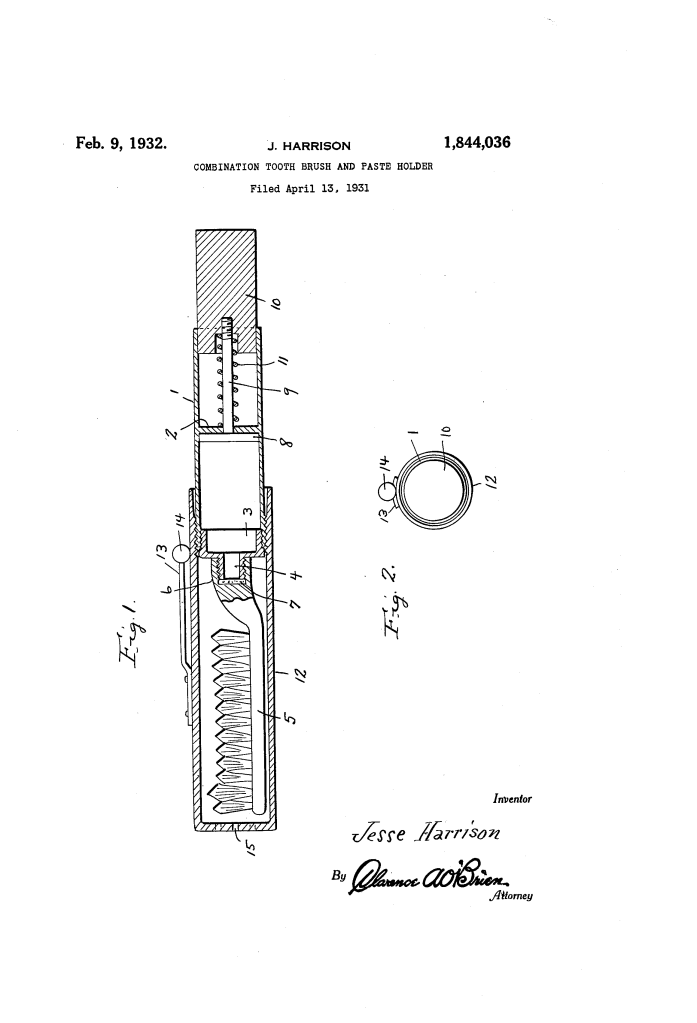
Combination Toothbrush and Paste Holder (Jesse Harrison, No. 1,844,036)
Patented in 1932 by Jesse Harrison of Waco, Texas, this invention is an early ancestor of the modern travel toothbrush. Designed for portability and convenience, it integrates a refillable toothpaste reservoir, a dispensing mechanism, and a detachable toothbrush into a single unit about the size of a fountain pen.
1. The Container and Reservoir
The device is built around a cylindrical container (1) that serves three distinct purposes: a storage tank for toothpaste, a housing for the pump mechanism, and the handle for the toothbrush during use.
- Internal Partition (2): The cylinder is divided by a wall with a small central hole. This creates two distinct sections: the paste reservoir at the front and the mechanical spring chamber at the rear.
- The Removable Cap (3): To fill the device, the front cap is unscrewed, paste is loaded into the chamber, and the cap is replaced. This cap features a threaded discharge neck (4) where the paste exits.
2. The Piston Dispensing Mechanism
Unlike modern collapsible tubes, Harrison used a rigid mechanical pump to dispense the paste.
- Piston and Rod (8, 9): A piston sits inside the paste chamber. It is connected to a rod that passes through the partition into the rear of the device.
- The Push Member (10): The end of the rod is attached to a sliding button or “member” at the very back of the cylinder.
- Spring Action (11): A coil spring encircles the rod. It pushes against the partition and the rear member, normally keeping the piston retracted.
- Operation: The user removes the brush, holds the container, and presses the rear member with their thumb. This forces the piston forward, squeezing a controlled amount of paste out through the neck.
3. The Modular Brush and Cap
The toothbrush component is designed to be both protected and functional.
- Socket Attachment (6): The toothbrush (5) has a very short handle with a threaded socket. It screws directly onto the discharge neck of the paste container. A gasket (7) ensures that no paste leaks out of the joint while brushing.
- Ventilated Protective Cap (12): A long cylindrical cap covers the brush when not in use. Importantly, Harrison included perforations (15) at the end of the cap. These air holes allow the bristles to dry and stay ventilated, preventing the growth of bacteria in a closed environment.
- Pocket Clip (13, 14): Similar to a high-end pen of the 1930s, the cap features a spring clip with a spherical tip, allowing the user to secure the device to a shirt or coat pocket.
4. Technical Component Summary
| Component | Function |
| Cylindrical Container (1) | Serves as the paste reservoir and the brush handle. |
| Piston (8) | Mechanically displaces paste toward the outlet. |
| Coil Spring (11) | Resets the plunger after the user finishes dispensing paste. |
| Threaded Neck (4) | The outlet for paste and the mounting point for the brush. |
| Perforations (15) | Allow the wet bristles to breathe and dry while capped. |
Utility and Design Significance
Harrison’s invention targeted the “on-the-go” professional of the early 1930s. By making the container the handle, he eliminated the need for a full-sized toothbrush handle, saving significant space. The use of a mechanical piston instead of a squeeze tube reflected the era’s focus on “everlasting” mechanical tools that could be refilled rather than disposed of.
