
Combination Cotton Thinning and Cultivating Machine (James King, No. 1,661,122)
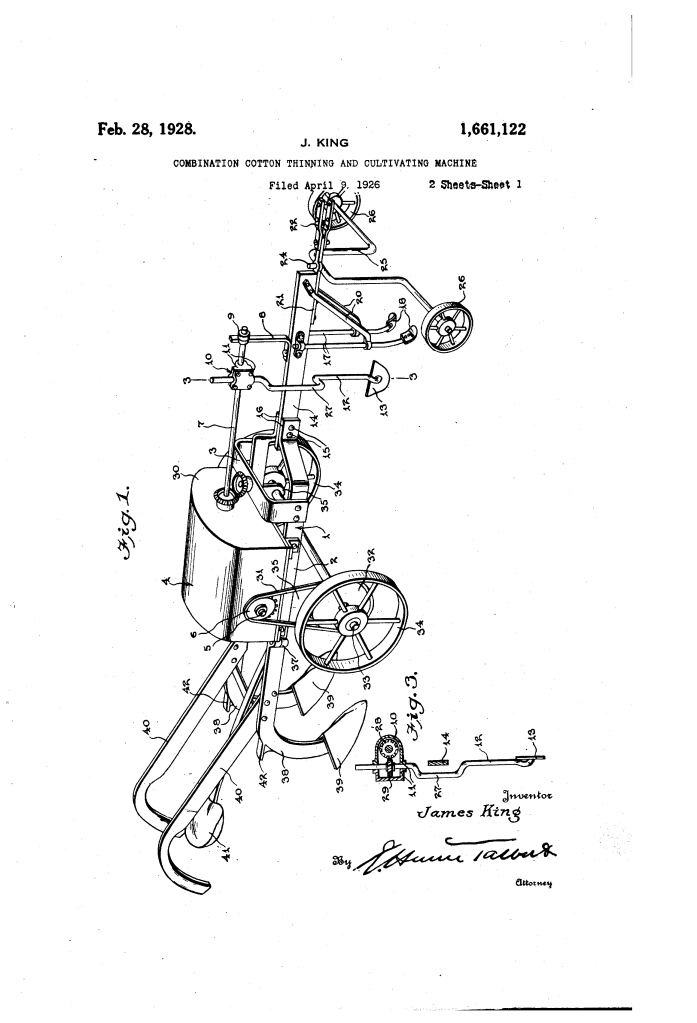
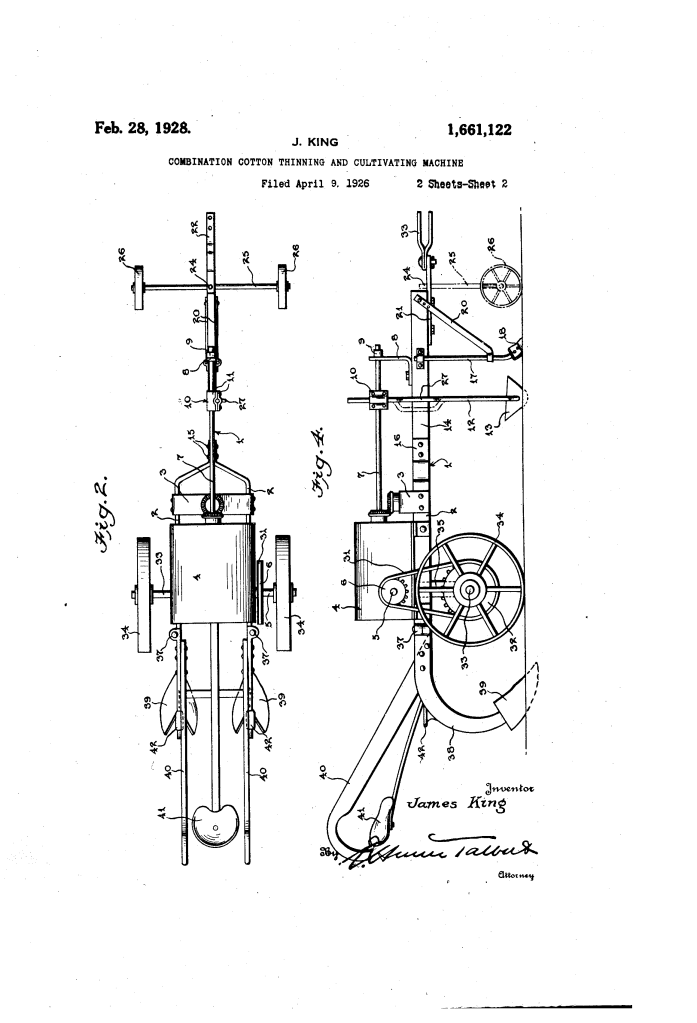
The patent by James King of Kansas City, Missouri, describes a Combination Cotton Thinning and Cultivating Machine (Patent No. 1,661,122, 1928). This invention is a multi-purpose agricultural implement designed to streamline the maintenance of cotton crops. King’s primary objective was to combine two essential labor-intensive tasks—”thinning” (removing excess plants to allow the strongest to grow) and “cultivating” (breaking up soil and removing weeds)—into a single pass. His innovation features a unique crank-driven rotating blade that produces a specialized shearing action to “top” or thin the plants.
Inventor Background: James King
James King was an African American inventor based in Kansas City during the late 1920s. His patent addressed the specific needs of Southern cotton farmers during the transition from animal-drawn plows to mechanized tractors. In the 1920s, “chopping cotton” was a grueling hand-labor task; King’s machine was designed to be modular, capable of being pulled by draft animals or powered by an internal combustion engine. His work represents a sophisticated understanding of mechanical synchronization, translating the rotational power of an engine into the complex lateral and circular movements required for delicate crop maintenance.
Key Mechanical & Agricultural Systems
The machine utilizes a sequence of tools to treat the soil and the plants simultaneously.
1. The Pre-Cultivation Shovels (17, 18)
- Initial Pass: Mounted on an extension tongue (14) at the front of the machine are two shovels (18).
- Function: These shovels operate on opposite sides of the row of cotton plants. They break up the soil before the thinning blade reaches the plants, preparing the earth for the deeper cultivation that follows.
2. The Rotating Thinning Blade (12, 13, 27) (Key Innovation)
This is the “heart” of the machine, converting simple rotation into a “shearing” path.
- The Shank (12) and Blade (13): A vertical shank carries the cutting blade.
- The Crank (27): The shank features an offset crank.
- Lateral Motion: As the motor rotates the shank via spiral gears (28, 29), the crank strikes the side of the machine frame.
- Action: This collision forces the rotating blade to swing laterally (side-to-side) while it spins. This creates a specialized “shearing” movement that chops through the excess cotton tops with high precision.
3. Universal-Joint Plows (37, 38, 39)
- Adjustable Standards: At the rear of the frame, two plows (39) are attached via universal joints (37).
- Manual Control: The operator sits in a seat (41) and uses handles (40) and foot elements (42) to guide the plows.
- Function: The universal joints allow the operator to move the plows toward or away from the row independently. This “fine-tuning” ensures the machine can adapt to uneven plant growth or varying soil conditions in real-time.
4. Dual Power Configuration (4, 21, 31)
- Motorized: A casing (4) can house an internal combustion engine to drive the sprocket chain (31) and the thinning blade.
- Animal-Drawn: Alternatively, a clevis (22) on the coupling plate (21) allows draft animals to pull the frame.
- Function: This flexibility allowed farmers to adopt the technology regardless of whether they had transitioned to mechanical tractors, a crucial bridge during the industrialization of the American farm.
Improvements Over Standard Cotton Choppers
| Feature | Standard Hand-Chopping | King’s Combination Machine |
| Efficiency | Required large crews of laborers. | Single-operator machine handles thinning and plowing. |
| Precision | Quality of work varied by worker fatigue. | Crank-driven shear provides consistent cutting action. |
| Versatility | Only performed one task. | Three-stage action: Shoveling, Thinning, and Plowing. |
| Maneuverability | Fixed plows were hard to adjust. | Universal joints allow for real-time adjustments on the fly. |
Significance to Agricultural Engineering
James King’s cotton machine influenced the development of integrated crop management tools and mechanical thinning technology.
- Complex Motion Translation: King’s use of a crank to turn a simple rotation into a “shearing swing” is a foundational principle in reciprocating cutting bars used in modern mowers and harvesters.
- Operator-Centric Design: By including universal joints and foot braces, King practiced early ergonomic engineering, recognizing that agricultural machinery requires high levels of human-directed “fine-tuning.”
- Hybrid Mechanization: His “dual-power” frame design was a precursor to the Power Take-Off (PTO) systems of modern tractors, which allow a single engine to power a variety of modular attachments.
- Crop Optimization: King’s design prioritized “efficiency” in soil turning, a cornerstone of soil science and conservation tillage that helps maintain soil health while increasing crop yields.
