
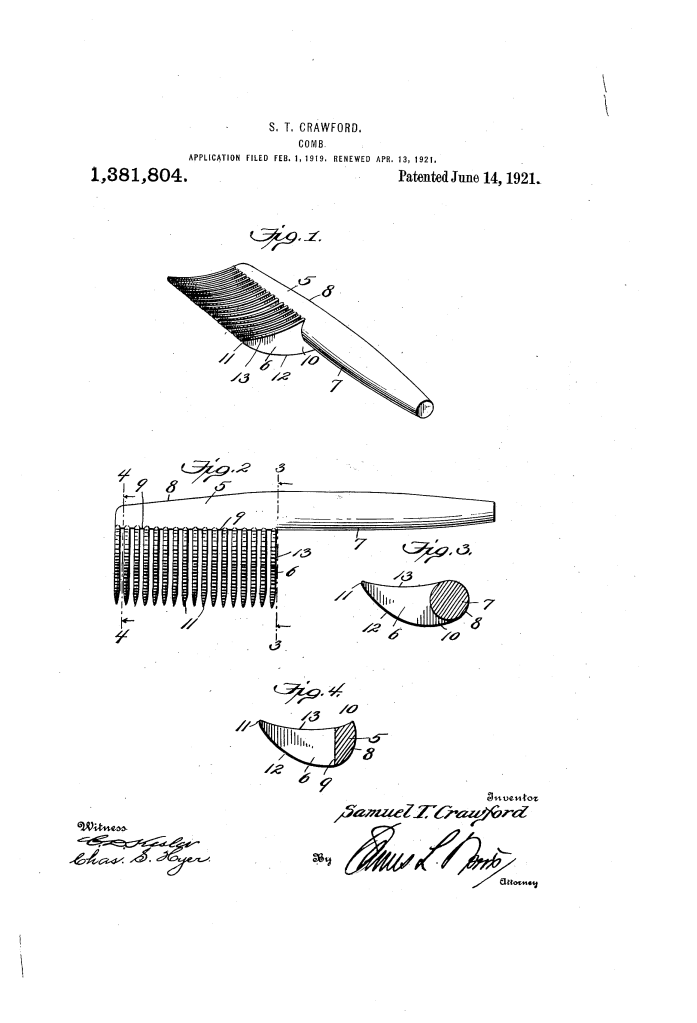
Barber’s Hair-Cutting Comb (Samuel T. Crawford, No. 1,381,281)
The patent by Samuel T. Crawford of Washington, D.C., describes an improved Comb (Patent No. 1,381,281, 1921). This invention is a specialized tool designed specifically for barbers to facilitate precision hair cutting and scalp treatment. Crawford’s primary innovation was the “concavo-convex” tooth structure, which allowed the comb to serve as a rolling fulcrum against the scalp. This design enabled barbers to gradually and evenly raise hair to the exact length desired for shearing while providing a dedicated “concave recess” to guide the scissors.
Inventor Background: Samuel T. Crawford
Samuel T. Crawford was an African American inventor based in the District of Columbia during the early 20th century. His 1921 patent addressed the ergonomic and technical challenges faced by professional barbers. Before this invention, standard flat combs required significant wrist strain to maintain a consistent angle for tapering hair. Crawford applied principles of leverage and balance to the grooming trade, creating a tool made of lightweight aluminum that could be manipulated with a “rolling” action, demonstrating a sophisticated understanding of tool-to-body mechanics.
Key Mechanical Components & Functions
The comb is characterized by its tapered handle and uniquely shaped teeth, all designed to optimize the “tapering” cut popular in barbering.
1. The Tapered Back and Handle (5, 7)
- Integral Construction: The back (5), teeth (6), and handle (7) are preferably cast as a single piece of aluminum.
- Balanced Taper: The handle and back are thickest at their point of juncture and taper toward their respective ends.
- Function: This creates a balanced organization. By tapering the back, Crawford reduced the weight at the tip, allowing the barber to “flick” or tilt the comb longitudinally with minimal effort. The thickest part near the handle serves as a sturdy fulcrum for tilting the comb to achieve different hair lengths.
2. Concavo-Convex Teeth (12, 13) (Key Innovation)
- Convex Back Edges (12): The lower edges of the teeth are curved outward.
- Function: This provides a smooth rolling surface. As the barber moves the comb through the hair, the convex edges allow the comb to pivot or “roll” easily against the scalp. This creates a natural gradient, lifting the hair more at the points of the teeth than at the base.
- Concave Inner Edges (13): The upper edges of the teeth are curved inward.
- Function: This creates a concave cutting recess along the entire length of the comb. When the comb is rolled to lift the hair, this recess provides a clear “track” for the shears to rest in, ensuring a positive and steady cutting application.
3. Reversible Scalp Massage Function
- Dandruff Removal: By flipping the comb over, the barber can use the free pointed ends (11) and the space between the teeth to massage the scalp.
- Function: In this reversed position, the concave clearance allows the comb to loosen dandruff and “fructify” the scalp without catching or pulling the hair. It also helps in clearing out loose hair clippings after a shampoo or moisture treatment.
Improvements Over Standard Barbers’ Combs
| Feature | Standard Flat Combs | Crawford’s Concavo-Convex Comb |
| Handling | Required rigid wrist angles for tapering. | Features a rolling fulcrum for easy, regular movement. |
| Shear Stability | Scissors could slip on flat comb surfaces. | Concave recess (13) provides a steady cutting track. |
| Weight | Often unbalanced or heavy (if metal). | Tapered aluminum design effects a balancing action. |
| Versatility | Used strictly for combing/lifting. | Reversible design for scalp massage and dandruff removal. |
Significance to Grooming and Engineering
Samuel T. Crawford’s comb influenced the development of ergonomic hand tools and specialized barbering equipment.
- Ergonomic Tooling: Crawford recognized that repetitive motion in barbering led to fatigue. His “rolling” comb is an early example of human-centered design, adapting the tool’s shape to the natural movement of the human wrist.
- Structural Reinforcement: By making the teeth widest at their base (10) where they meet the back, Crawford ensured that even thin, lightweight teeth were reinforced against the “fracture” or bending common in professional use.
- Multi-Functional Hygiene: The focus on “hygienic conditions” and scalp health (massaging and dandruff removal) integrated medical-cosmetic logic into a standard mechanical tool.
- Variable Fulcrum Logic: The ability to use different parts of the comb’s back as a fulcrum based on the “tilt” provided the barber with a mechanical variable-ratio lift, allowing for highly customized haircuts using a single tool.
