
Coin Changer Mechanism (1970)
U.S. Patent No. 3,490,571, granted on January 20, 1970, to James A. Bauer (assigned to Westinghouse Electric Corporation), describes an electro-optical vending control and automatic coin changer mechanism designed for fast, solid-state transactional response.
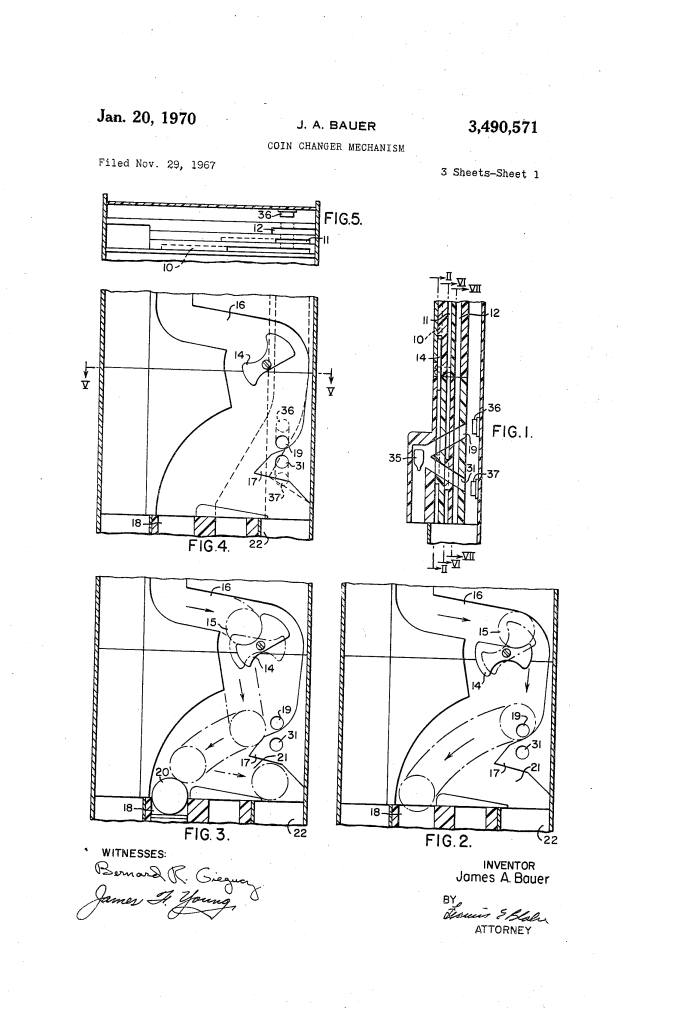
This invention solved a critical mechanical bottleneck in automated retail vending machines: the reliance on bulky, slow, and maintenance-heavy stepping switches and stepping relays to count incoming coins and compute change. Bauer developed a simplified solid-state architecture combining multi-plane physical coin sorting with dual photoelectric detection to eliminate received-coin counting circuits entirely.
The Innovation: The Dual-Photocell Logic System
Standard electro-mechanical coin changers in the late 1960s required elaborate stepping relays to track fractional deposits (e.g., counting two nickels to make a ten-cent vend) before calculating change for larger denominations like quarters. These mechanical counters were prone to contact wear, jamming, and slow cycle times.
Bauer bypassed electrical coin summation entirely by coordinating physical coin paths directly with optical interruption gates.
Why Two Photocells?
- Singulation of Vend Trigger: A single primary photocell initiates a vend command when broken by any deposit reaching the vend price: every second nickel, an individual dime, or a single quarter.
- Automatic Differential Detection: A secondary photocell is placed exclusively along the quarter’s path. Interruption of this beam triggers an immediate fifteen-cent change-making cycle.
- Elimination of Stepping Relays: By allowing mechanical track diverters and a two-beam optical arrangement to handle the logic, the control circuit requires zero tallying registers.
Key Design Components
The mechanism operates through coordinated coin paths and solid-state actuators:
| Component | Function |
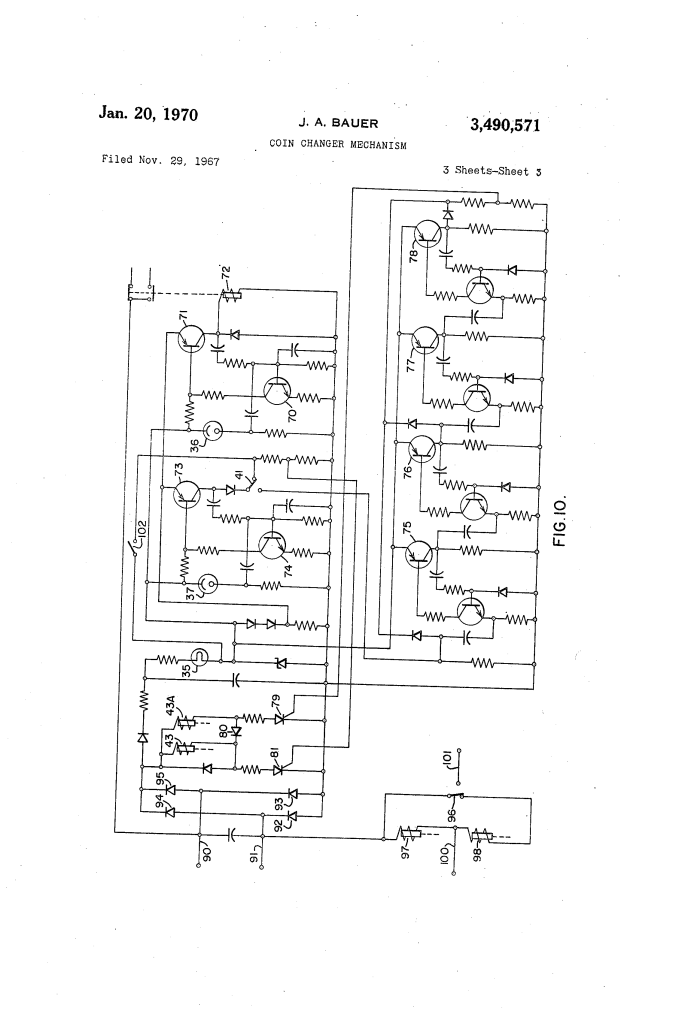
| Primary Photocell Aperture (19) & Cell (36) | Sensed by a common light source (35); registers deposits equal to or exceeding the vend threshold (ten cents) to fire vend relay 72. |
| Secondary Photocell Aperture (31) & Cell (37) | Positioned solely along the quarter trajectory (30); triggers the change payout circuitry. |
| Mechanical Flip-Flop (14) | Alternating mechanical rocker that diverts the first deposited nickel past sensor 19 and routes the second nickel directly through sensor 19. |
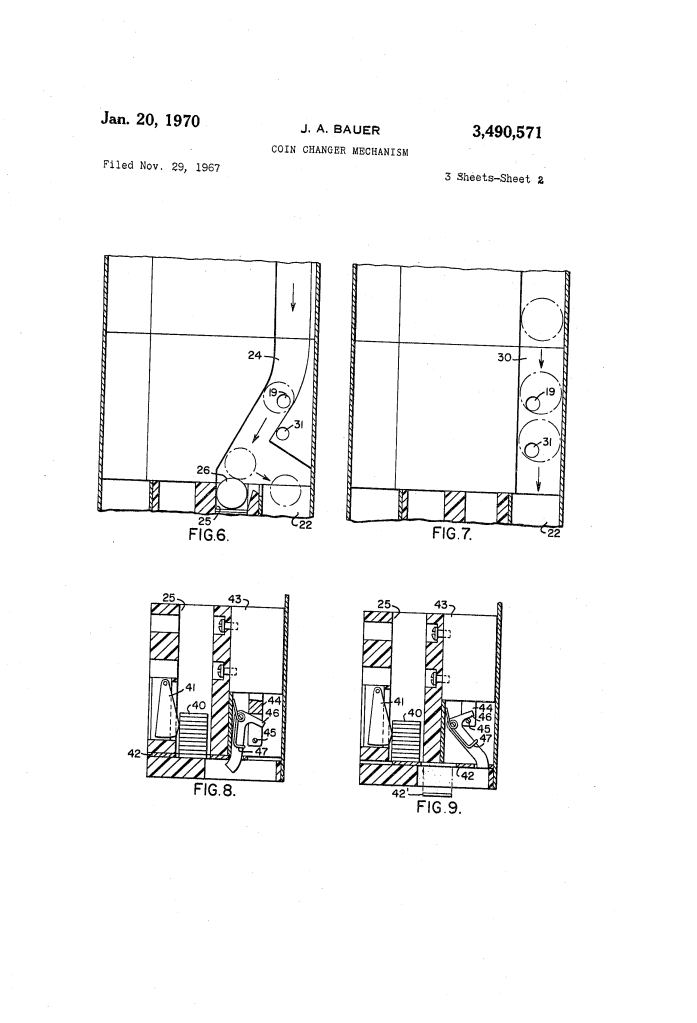
| Solenoid Payout Slides (42, 43, 44, 46) | Fast-acting bottom slides driven by a pulsed solenoid armature that strikes a toggle with high-speed hammer action to discharge change. |
| Storage Tube Sensing Switches (41, 96) | Spring-biased switches that monitor coin reserve levels inside the dime and nickel storage tubes to alter change payout logic. |
How the Apparatus Functions
The machine processes coins and dispenses change across a standardized sequence:
| Step | Action | Functional Purpose |
| 1. Insertion and Physical Sorting | Coins pass through an external slug rejector into distinct vertical planes: nickels (plane 10), dimes (plane 11), and quarters (plane 12). | Segregates authentic denominations into dedicated drop chutes. |
| 2. Nickel Alternation | The first nickel pivots flip-flop 14 into storage tube 18 without crossing aperture 19; the second nickel is deflected across aperture 19. | Fires vend relay 72 only upon receipt of the full ten-cent price. |
| 3. Dime Direct Vend | A single dime drops through channel 24 across aperture 19 directly into dime storage tube 25. | Trips photocell 36 to trigger vend relay 72 with zero change dispensed. |
| 4. Quarter Dual Sensing | A quarter falls through channel 30, momentarily interrupting both aperture 19 and aperture 31 before entering cash box 22. | Simultaneously activates the vend relay and triggers the fifteen-cent change payout sequence. |
| 5. Primary Change Mode | If dime tube 25 is sufficiently full, switch 41 directs a single pulse simultaneously to dime solenoid 43 and nickel solenoid 43A. | Instantly discharges one dime and one nickel (fifteen cents change). |
| 6. Contingency Change Mode | If dimes are depleted, switch 41 reroutes the pulse into a three-pulse solid-state oscillator (transistors 75 to 78). | Pulses nickel solenoid 43A three consecutive times to return three nickels (fifteen cents change). |
Technical Safeguards and Reserve Management
The changer includes built-in safeguards to protect both the operator and the customer:
- Hammer Action Solenoids: Solenoid armatures incorporate free-travel pins (45) that strike toggle levers (46) near the end of their stroke, imparting high-momentum hammer impacts that clear coin slides rapidly on minimal electrical wattage.
- Tube Overflow Routing: When nickel tube 18 or dime tube 25 fills to capacity, excess coins stack vertically to form an angled deflector shoulder, shunting subsequent deposits directly into cash box passage 22.
- Low-Reserve Lockout: If the nickel inventory drops below three coins, switch 96 de-energizes quarter coin-reject solenoid 98. Any deposited quarter is returned directly to the customer, and an “Exact Change Only” indicator illuminates while the machine continues accepting nickels and dimes.
About the Inventor: James A. Bauer
James A. Bauer developed control systems and electromechanical apparatuses for Westinghouse Electric Corporation in Monroeville and Pittsburgh, Pennsylvania. His designs in the late 1960s contributed to the transition of commercial automated vending from purely mechanical clockwork and relay logic to solid-state pulse electronics and electro-optical sensing.
Summary of Claims
The patent explicitly claims:
- A coin-responsive vending system utilizing only first and second coin detectors to initiate a vend at a base price and dispense change for higher-value coins.
- A channel routing system passing dimes past only the first detector, quarters past both detectors, and alternating nickels past only the first detector.
- A change-making apparatus configured to normally dispense one dime and one nickel upon quarter detection.
- A storage tube sensor switch that overrides normal change payout when dimes are depleted, triggering a pulse generator to fire the nickel release solenoid three times in rapid succession.
