
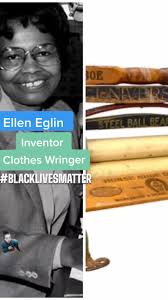
Ellen F. Eglin’s story and her invention of an improved clothes wringer are incredibly significant, though often overshadowed by the fact that she did not hold the patent in her own name. While we’ve listed “1880” as the year, research indicates her invention was in 1888, and the patent was later issued to someone else in 1891. This discrepancy highlights the profound challenges faced by Black women inventors in that era.
Here’s a breakdown of Ellen F. Eglin’s “Clothes Wringer” and its broader context:
The Invention: An Improved Clothes Wringer (circa 1888)
- Purpose: Clothes wringers were essential household appliances in the late 19th century. After clothes were washed and rinsed (often by hand or with a washboard), they were dripping wet. A wringer, typically consisting of two rollers mounted on a frame with a crank, would squeeze out the excess water, making the clothes much quicker to dry and significantly reducing the physical labor of hand-wringing.
- Eglin’s Improvement: While the exact details of Eglin’s specific “improvement” are not detailed in widely available records, it’s understood that she devised a more efficient or user-friendly design. One source mentions her improvement involved a “suitable system of spur-gearing” to increase or decrease the speed of the rollers, which would have allowed for better control and more effective wringing of different fabrics and heavier items.
- Impact of Wringers: Clothes wringers dramatically eased the burden of “laundry day,” which was an all-day, physically demanding chore for women. By reducing the time and effort required for drying, they were a significant step towards more modern laundry practices.
Personal Perspectives: Ellen F. Eglin (born c. 1836/1849 – after 1890/1916)
Ellen F. Eglin was an African American woman from Washington, D.C., who worked as a housekeeper and a government clerk. Her story is a poignant example of the systemic racism and sexism that prevented many talented inventors, particularly Black women, from receiving due credit and financial benefit for their innovations.
- The Decision Not to Patent: Eglin did not patent her invention in her own name. Instead, in 1888, she sold the rights to an agent for a mere $18 (which would be around $600-$700 in today’s money). When interviewed by Charlotte Smith for The Woman Inventor magazine in 1890, Eglin famously explained her reasoning: “You know I am black and if it was known that a Negro woman patented the invention, white ladies would not buy the wringer; I was afraid to be known because of my color in having it introduced in the market, that is the only reason.”
- Lost Credit and Profit: The wringer, based on her design, went on to be manufactured and sold very successfully, eventually by the American Wringer Company, which amassed considerable profits. Eglin, however, received no further financial gain or public recognition during her lifetime.
- A Desire for Future Recognition: Despite this setback, Eglin expressed a desire to invent again and this time patent her work in her own name, hoping “the invention will be known as a Black woman’s” to inspire future generations. Sadly, no further patents under her name are known.
Historical Perspectives: Innovation and Inequality in the 1880s
Eglin’s story is deeply intertwined with the social and technological landscape of late 19th-century America:
- Household Labor in the 1880s: Housework, especially laundry, was incredibly labor-intensive. Without electricity or modern plumbing, heating water, scrubbing clothes, and wringing them out by hand consumed vast amounts of time and physical energy. Inventions like the clothes wringer were genuine “labor-saving devices” that significantly improved the lives of women, particularly those in domestic service or managing their own homes.
- The Rise of Household Appliances: The 1880s was a period of burgeoning innovation in household technology, driven by the Industrial Revolution. While many of these inventions aimed to ease the burden of domestic work, the vast majority of patents were held by men, even for technologies directly used by women.
- Racial and Gender Barriers to Invention:
- Race: African Americans faced immense discrimination in all aspects of life, including access to education, capital, legal support, and the marketplace. The very act of seeking a patent could expose Black inventors to prejudice that might prevent their inventions from being manufactured or sold. Eglin’s statement perfectly illustrates this stark reality.
- Gender: Women, regardless of race, also faced significant hurdles in obtaining patents. Societal norms often limited their access to technical education, financial resources, and professional networks. The concept of “intellectual property” was still largely a male domain.
- “Hidden” Inventors: Eglin’s case is a prime example of how the contributions of women and people of color to innovation have often been “hidden” from the historical record, largely due to systemic biases and the reliance on formal patent documents as the sole measure of inventorship. If not for the interview in The Woman Inventor, her story might have been entirely lost.
Ellen F. Eglin’s improved clothes wringer represents not just a practical advancement in household technology but also a powerful and heartbreaking testament to the resilience and ingenuity of African American women, and the profound injustices they faced in the pursuit of recognition for their intellectual contributions.
