
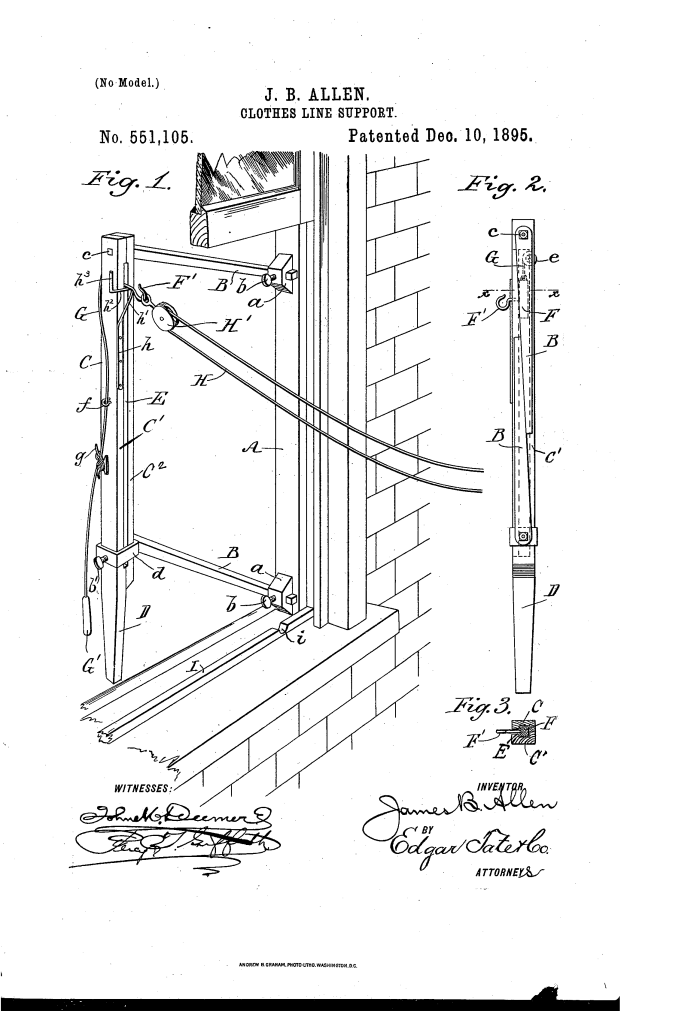
Clothes-Line Support (1895)
U.S. Patent No. 551,105, granted on December 10, 1895, to James B. Allen, addresses a common urban household dilemma of the late 19th century: hanging laundry out of apartment or house windows during freezing winter weather.
Traditionally, dealing with an outdoor clothesline meant leaving the window open, exposing the home to bitter drafts, or having wet laundry block out light and obscure the view. Allen, an inventor based in Orange, New Jersey, developed an adjustable, collapsible mechanical support system that allowed homeowners to comfortably pin up their laundry inside, raise it to full height, and then drop it safely below the window frame so the window sash could be shut completely.
The Innovation: The Drop-Down Pulley Post
The core mechanism relies on a dynamic vertical post system that rests on the floor outside the window but anchors directly to the external window casing. Instead of a fixed line, Allen introduced a sliding carriage system that could be locked at the top of the frame for loading and then lowered out of sight.
Additionally, the entire apparatus was engineered to be completely collapsible. When laundry day was over, the structural support arms could be unhooked and folded perfectly flat against the main post for compact storage.
How the Apparatus Functions
The support system operates through a clear mechanical sequence designed to optimize convenience and maintain home insulation:
| Step | Action | Functional Purpose |
| 1. Raising | The user pulls the hoist rope (G), lifting the sliding block (F) to the top of the post. | Automatically engages a built-in spring catch (h) to lock the line safely at working height. |
| 2. Loading | Clothes are pinned to the endless line (H) directly from the safety of the open window. | Keeps the line stable and accessible without requiring the user to lean out dangerously. |
| 3. Dropping | The user presses the release handle (h³) on the spring catch, letting the line slide down to sill level. | Moves the wet clothes below the window line, restoring natural light and clearing the outdoor view. |
| 4. Sealing | A specially notched wood strip (I) is placed on the sill, and the window sash is shut tightly over it. | Seals the room against cold winter air without pinching or damaging the clothesline rope. |
Technical Components
The elegance of Allen’s design lies in its adjustable, heavy-duty components:
- The Slotted U-Post (C): A two-piece vertical column that features a hollow interior channel and a front-facing guide slot. The base tapers into a heavy leg (D) that rests firmly on the ground or floor structure to absorb the weight of wet laundry.
- Tapered Folding Rods (B): Sectional, square bracing rods that lock into metal sockets (a) on the window frame using heavy thumb-screws. They are pivotally mounted so they can fold entirely flat against the post when stored.
- The Automatic Spring-Catch (h): A clever angled piece of spring metal positioned near the top of the post. As the line hook passes it, the metal flexes backward and then snaps firmly underneath the block, acting as an automatic gravity lock.
- The Safety Eye and Cleat (f, g): A guiding eyelet and tiedown cleat that ensures if the rope is accidentally dropped or unwound, an oversized handle (G’) jam-stops at the eyelet, preventing the laundry from falling into the dirt below.
Historical and Practical Impact
James B. Allen’s invention provided significant quality-of-life improvements for multi-story residential living at the turn of the century:
- Cold-Weather Comfort: By allowing the window to close tightly over the notched wooden sill strip (I), families could dry clothes mid-winter without turning their kitchens or rooms into freezing iceboxes.
- Universal Window Fit: Thanks to an adjustable lower sleeve (d) tightened by a thumb screw, the post could be extended or retracted to accommodate varying window heights across different architectural styles.
- Space Optimization: Because it was designed for urban environments where space was a premium, its ability to fold into a minimal footprint meant it could be stored easily behind doors or in narrow closets when not in use.
About the Inventor: James B. Allen
James B. Allen was a late-19th-century inventor from Orange, New Jersey (Essex County). Living and working during a golden age of mechanical innovation in northern New Jersey—not far from Thomas Edison’s West Orange laboratories—Allen focused his talents on solving practical, everyday domestic engineering problems to improve the comfort and efficiency of the Victorian-era home.
Summary of Claims
The patent explicitly claims:
- A clothes-line support featuring a two-section angular post, pivoting structural rods, and matching window-frame mounting sockets.
- A vertical sliding block and hook configuration controlled via an integrated top pulley and a securing tie-cleat.
- An automatic spring-catch mechanism equipped with a manual release handle to securely hold and drop the laundry carriage at will.
