
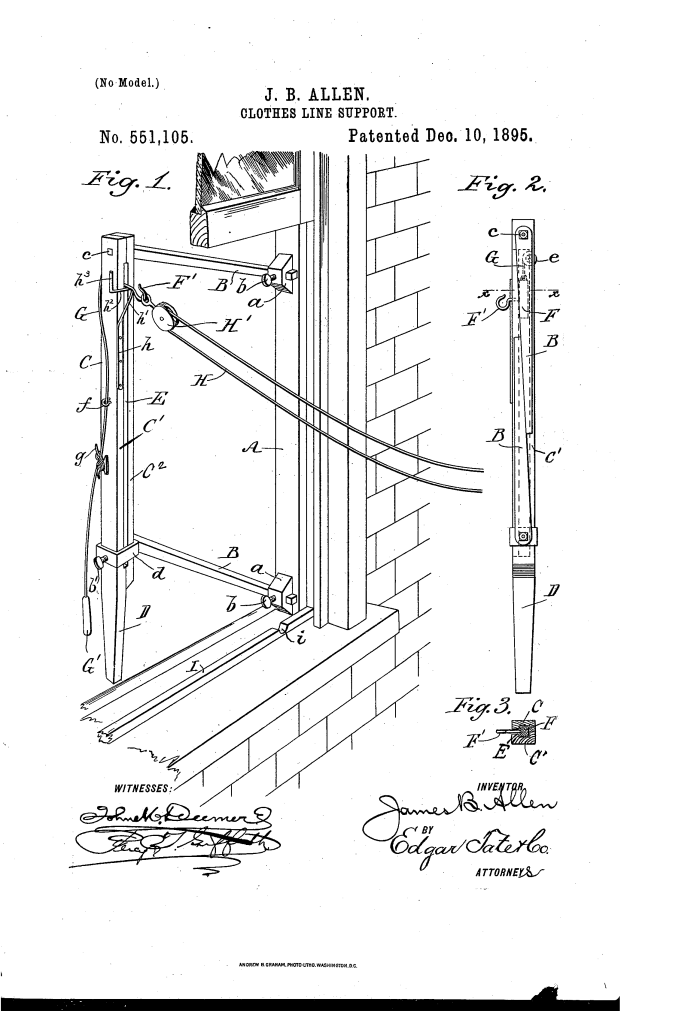
The patent by James B. Allen of Orange, New Jersey, describes a Clothes-Line Support designed to be easily attached to a window frame. Its main function is to allow the clothesline to be supported at a high level while clothes are being hung, and then immediately lowered so the clothes hang below the windowsill, enabling the window sash to be shut, especially in cold weather, without obstructing light or the view.
Invention and Mechanism
The support is a collapsible, vertically adjustable stand that uses a ratchet-like mechanism for quick lowering.
1. Main Structure and Mounting
- Post (C): The main support structure, formed in two vertical sections (main C′ and auxiliary C′′), both grooved or recessed to be sectionally U-shaped. The main portion’s lower end forms a tapered leg (D) that rests on the floor.
- Adjustable Rods (B): Two rods, pivotally secured near the top and bottom of the post (C).
- Mounting: The rods (B) fit into sockets (a) secured to the window frame (A) and are held in place by thumb-screws (b). The bottom rod is pivoted to a sleeve (d) secured to the post, allowing the post to rest on the floor regardless of window height.
- Portability: The rods (B) are tapered and can be folded snugly against the post (C) when detached from the window sockets (a).
2. Line Raising and Lowering
- Sliding Block (F): A block that slides vertically within the post (C).
- Clothes-Line Hook (F′): A hook projecting forward from the block (F) through a longitudinal slot (E) in the post. The endless clothes-line (H) is hung on this hook.
- Rope System (G): A rope or cord secured to the block (F), extending upward around a pulley (e) at the top of the post. The rope is secured by winding it upon a cleat (g).
- Function: Pulling the rope (G) raises the block (F) and the attached clothes-line.
- Window Protection: A strip of wood (I) with a notch (i) is placed on the sill to receive the clothesline (H), preventing the sash from holding the line partially open.
3. Locking and Quick-Release Mechanism
- Spring-Catch (h3): A plate (h) on the post has a spring-metal extension (h′) that projects obliquely across the slot (E) and bends back to form a horizontal portion (h2). The end is shaped as a handle (h3).
- Locking: When the block (F) is raised to the top, the hook (F′) forces the extension (h′) back until it passes, and the horizontal portion (h2) snaps back under the hook, preventing any downward movement.
- Lowering (Quick-Release): To lower the line, the user simply presses back on the handle (h3) to withdraw the catch from beneath the hook (F′). The block (F) and the line immediately fall (due to gravity and the weight of the clothes) to the low level of the window.
Historical Significance and the Inventor
James B. Allen’s 1895 patent addresses a common but persistent challenge in urban and suburban home life before the advent of clothes dryers.
- Urban Living and Hygiene: In the late 19th century, hanging clothes out of a window was a common practice, particularly in tenements and row houses lacking backyard space. The need for a simple, reliable clothesline system was universal.
- Balancing Function and Comfort: The core significance of the invention lies in its solution to the trade-off between clothes-hanging height and window function. Hanging clothes high was necessary for easy access, but it blocked light, obscured the view, and, most importantly in cold weather, prevented the window from being closed, leading to drafts and heat loss. Allen’s device provided an elegant, mechanical solution to have both: a high line for hanging and a low line for drying.
- Mechanical Simplicity: The use of a simple spring-catch and gravity for the quick-release mechanism made the device reliable, easy to manufacture, and intuitive to operate—hallmarks of successful domestic inventions.
Relation to Current Items
Allen’s clothesline support utilizes mechanical concepts that are found in various modern household and utility items:
- Quick-Release Locking Pins: The spring-catch system (where a component is pushed back by the load and snaps into a retaining position) is the same principle used in adjustable poles, extension ladders, and quick-release pins today, where fast locking and immediate release are required.
- Retractable/Folding Mechanisms: The ability to fold the support rods snugly against the main post is a principle essential for modern collapsible furniture, portable tripods, and foldable exercise equipment, prioritizing compact storage and easy transport.
- Window-Line Systems: While clothes dryers are common, retractable and pulley-based laundry line systems are still widely used, particularly
