

Clothes-Drier (1892)
U.S. Patent No. 4,76,416, granted on June 7, 1892, to George T. Sampson, introduces an innovative, space-saving domestic appliance designed to maximize home efficiency by utilizing the radiant heat of a kitchen stove to dry laundry. George T. Sampson, an inventor based in Dayton, Ohio, focused his design on structural adaptability, ensuring that the apparatus could be safely extended for use or folded completely out of the way when idle.
This invention solved a common 19th-century domestic dilemma: how to efficiently dry clothing indoors during inclement weather without cluttering the living space, creating fire hazards, or damaging the garments through direct contact with a hot stove.
The Innovation: The “Over-Stove Suspension” System
The core breakthrough of Sampson’s clothes-drier is its specialized, multi-tiered framing system that anchors directly to the floor behind a stove. By elevating the clothes over and around the heat source rather than resting them directly upon it, the design utilizes rising warm air currents to rapidly dry fabrics while keeping the top of the stove clear for cooking.
1. The Hinge and Button Mechanism
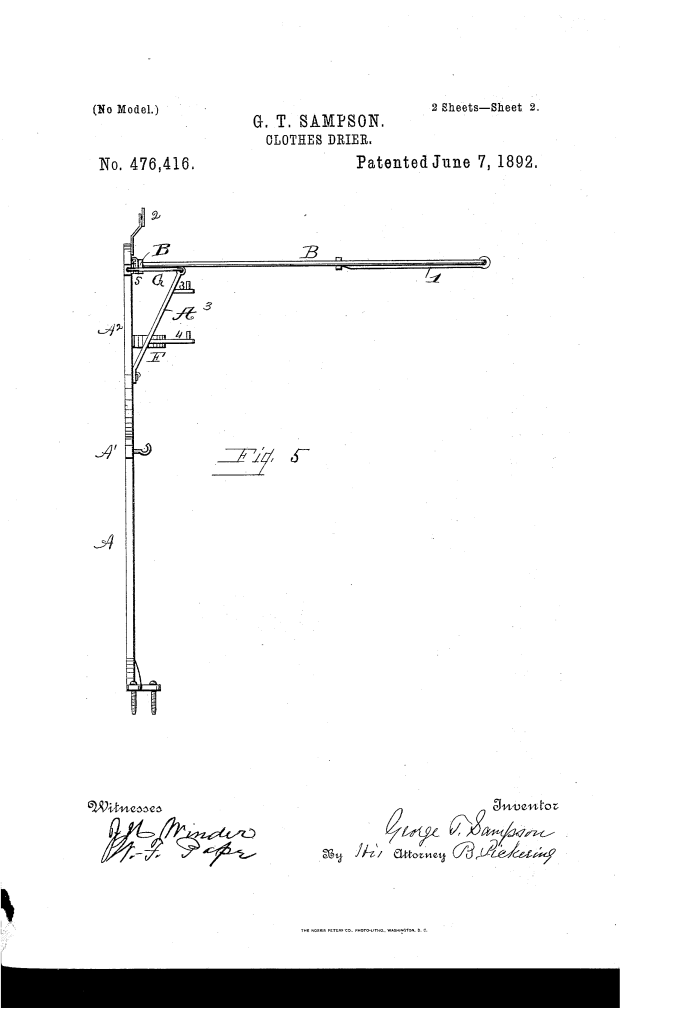
The primary drying frame (B) is connected to a heavy cast base frame via a set of sturdy hinges (5 5).
- When not in use, the frame stands perfectly vertical behind the stove, completely out of the way.
- To secure it in this storage position, the user engages a pivoted button (2) on the left arm of the frame.
- When turned down into a horizontal position for operation, the frame rests securely on a supporting wire (G) directly over the stove top.
2. The Stovepipe Clearance
Sampson cleverly accounted for existing kitchen layouts. The primary rectangular frame (B) features an open contour designed specifically so that a standard stovepipe (L) can pass backward through the frame without obstructing its movement or posing a fire risk.
Why This Design Excelled
- Space Efficiency: The entire apparatus folds flat against the wall or floor geometry behind the stove when cooking is the priority.
- Versatility: It combines rigid overhead drying with adjustable, swinging side brackets.
- Integrated Utility: The cast base frame (A) includes built-in lateral arms featuring a series of hooks, allowing homemakers to suspend cooking utensils simultaneously.
Key Structural Components
The drier operates as a modular, cooperative assembly of distinct frames and brackets:
| Component | Function |
| Cast Frame Base (A) | The heavy foundation secured to the floor with wood screws behind the stove; supports the entire weight of the drier. |
| Drying Frame (B) | The primary rectangular wire grid that hinges downward to sit horizontally over the stove top. |
| Extension Brackets (E) | Side-mounted wire frames suspended on pivots (3, 4) that can be extended, retracted, or swung toward and away from the stove at will. |
| Supplementary Frame (C) | A symmetrical, two-part semicircular frame that can be mounted on top of Frame B to double the drying capacity. |
| Oblong Pan (F) | An integrated receptacle attached to the main frame, acting as a catch-all or utility basin. |
How the Apparatus Functions
To accommodate different laundry loads, the user can transition the system through a strict sequence of adjustments:
| Step | Action | Utility Purpose |
| 1. Release | The chemist—or homemaker—turns the external button (2) to unlock the vertical frame. | Prepares the main unit for deployment. |
| 2. Lowering | Frame B is swung down to a horizontal position until it rests firmly on the supporting wire (G). | Places the main drying grid directly into the rising heat zone of the stove. |
| 3. Extension | The wire rods (8, 9) of the extension brackets (E) are pulled outward through cross-plates. | Expands horizontal hanging space for smaller garments away from the main top grid. |
| 4. Expansion | The supplementary frame (C) is unfolded, pinned via pin 6, and notched onto the outer wires of Frame B. | Creates a secondary, arched upper tier supported by floor legs (D) for heavy laundry loads. |
Historical and Scientific Impact
George T. Sampson’s clothes-drier represents a significant leap forward in the mechanical codification of everyday household labor during the late Industrial Era.
- Fire Prevention: By replacing makeshift wooden racks or clotheslines strung precariously close to open heat sources, this rigid, bolted iron-and-wire construction drastically reduced house fire risks.
- Sanitation and Speed: Utilizing the concentrated thermal updraft of a wood or coal stove meant clothes dried in a fraction of the time, preventing the mildew and sour odors common to slow indoor air-drying.
- Ergonomic Advance: The interlocking, collapsible nature of the supplementary frame—which used a spring-pin (7) and hinged joints to fold into a “comparatively small compass”—prefigured modern space-saving consumer appliances.
About the Inventor: George T. Sampson
George T. Sampson was an inventive mind working out of Dayton, Ohio, during a prolific era of American industrial design.
- Focus on Modernization: Living in an era where domestic chores required intense manual labor, Sampson focused on streamlining the home environment. His work targeted the optimization of the kitchen—the heart of the late-19th-century household.
- Mechanical Ingenuity: His ability to design complex, nested kinetic joints (such as the sliding wire plates on the extension brackets and the notched leg supports on the supplementary frame) demonstrated an advanced understanding of utility-driven mechanical engineering.
Summary of Claims
The patent explicitly claims:
- A clothes-drier comprising a cast frame anchored to the floor with lateral utensil hooks, upwardly extending arms, and a hinged drying frame held horizontally by a supporting wire or rod.
- An extension-bracket consisting of a frame with jointed, sliding wires (8, 9) and rigid cross-plates (10, 11) to allow seamless expansion and contraction.
- A collapsible, supplementary semicircular frame jointed at the top, featuring notched end-plates to rest securely on the wires of the lower frame, supported by adjustable, spring-pinned legs.
