

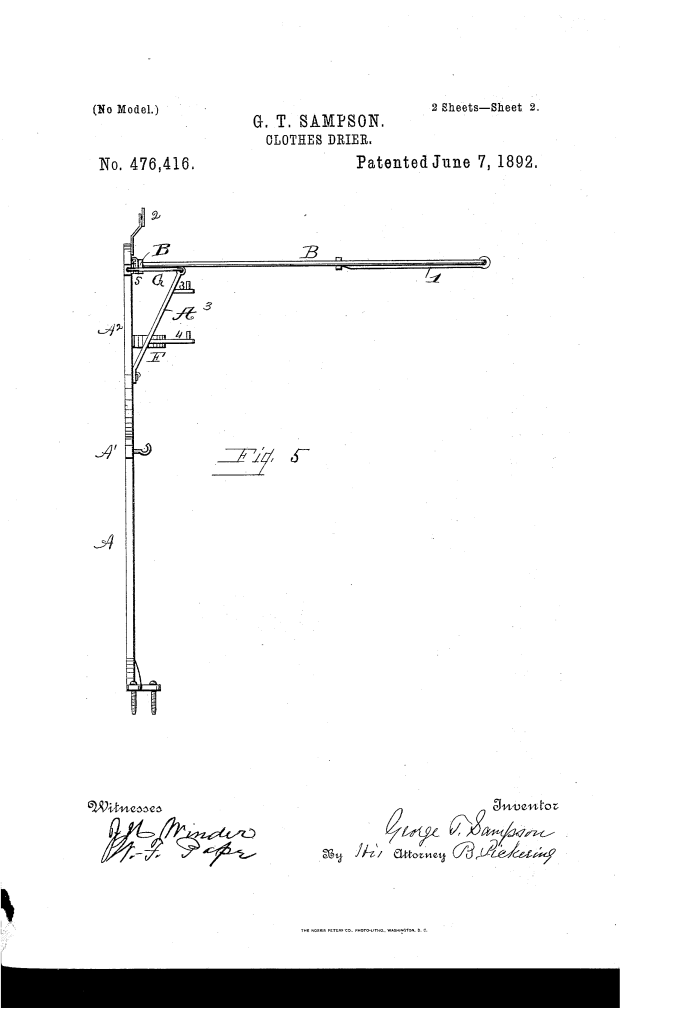
George T. Sampson’s patent for a Clothes-Drier, No. 476,416, describes a device designed to dry laundry using heat from a stove. Patented on June 7, 1892, the invention was a metal frame that could be mounted to the floor behind a stove.
The key features of the clothes-drier were:
- Hinged Frame: A primary drying frame, consisting of a series of wires, was hinged to the main frame. It could be swung up to a vertical position when not in use and lowered to a horizontal position directly over the stove to dry clothes.
- Telescoping Brackets: The main frame also included extension brackets that could be pulled out or retracted and swung to or from the stove to hang additional clothes.
- Supplementary Frame: A supplementary frame, composed of two symmetrical parts that could be folded together, could be attached to the main drying frame. This frame was shaped to go over a stovepipe and had its own legs that rested on the floor for additional support.
- Integrated Pan: An oblong pan was attached to the frame to serve as a receptacle for water or to collect drips.
Societal Impact and Legacy
Sampson’s invention was a practical response to a common problem of domestic life in the late 19th century, particularly in colder climates.
- Domestic Efficiency: Before clothes dryers, indoor drying in winter or on rainy days was a cumbersome process that involved hanging clothes in front of a fire or stove. Sampson’s invention provided a dedicated, efficient, and space-saving solution for this problem. It was part of a broader trend of inventions that aimed to simplify and mechanize household chores.
- Multi-functional Design: The design’s ability to be folded, extended, and stowed away was a major convenience for users, as it didn’t take up valuable floor space when not in use. This kind of ingenuity in creating multi-functional, space-saving devices was a hallmark of the era.
- The Inventor’s Legacy: The patent record for George T. Sampson does not contain information about his life beyond his residence in Dayton, Ohio. However, his work stands as an example of the thousands of inventors who created devices that, while not world-changing, made a direct and tangible improvement to the lives of people.
