
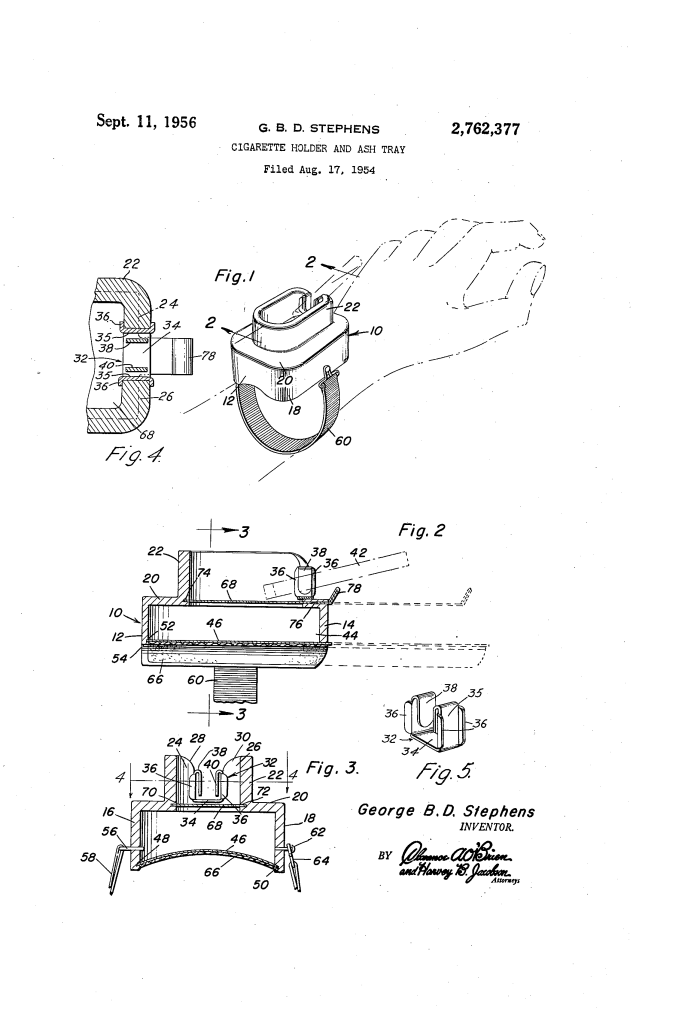
Cigarette Holder and Ash Tray (1956)
U.S. Patent No. 2,762,377, granted on September 11, 1956, to George B. D. Stephens, addresses a unique convenience and safety issue for mid-century smokers: how to enjoy a cigarette while working with one’s hands. Stephens, an inventor from Newport News, Virginia, developed a wearable receptacle that allows a smoker to safely park a cigarette and deposit ashes without needing a stationary table or risking a fire.
This invention solved the problem of “free-hand” smoking by creating a portable, wrist-mounted station that captures both ashes and stubs, ensuring that no annoying fumes or messy debris escape while the user is in motion.
The Core Design: The “Wrist-Mounted Receptacle”
The brilliance of the Stephens apparatus is its contoured, dual-plate system. It is designed to be worn like a wristwatch, using an adjustable strap to remain accessible at all times.
1. The Resilient Cigarette Clip (32)
The heart of the device is a U-shaped steel clip mounted on the top wall.
- Resilient Jaws: The clip features downturned extensions (38, 40) that act as spring-loaded jaws to grip a cigarette firmly.
- Angle Adjustment: The handle of the top cover can be engaged beneath the cigarette to prop it up at a specific angle, keeping the burning end away from the user’s hand.
2. The Dual-Plate Chamber (44)
The body of the device is a hollow metal box with sliding covers on both the top and bottom.
- Top Cover (68): A slidable plate that the user opens to flick ashes into the chamber and closes to trap fumes and debris.
- Bottom Cover (46): An arcuate (curved) plate that conforms to the shape of the user’s wrist. It slides out to allow the tray to be emptied.
How the Apparatus Functions
The device follows a practical sequence to ensure the safety and comfort of the wearer:
| Step | Action | Purpose |
| 1. Securing | The device is attached to the wrist using a resilient strap (60) and post member (62). | Keeps the tray stable and accessible while the user is working. |
| 2. Support | A cigarette is pressed into the resilient jaws of the metal clip. | Provides a “third hand” to hold the cigarette safely. |
| 3. Ashing | The user slides the top handle (78) to reveal the opening. | Allows ashes to fall directly into the internal chamber. |
| 4. Extinguishing | The cigarette is snubbed against the bottom plate. | The felt backing (66) insulates the heat, preventing burns to the skin. |
Technical Components
- Upstanding U-Wall (22): A raised wall on the top of the device that surrounds the ash opening, acting as a windguard and a mount for the cigarette clip.
- Felt Insulation (66): A soft, absorbent material attached to the underside of the bottom plate. It provides comfort against the skin and acts as a thermal barrier when putting out a cigarette.
- Sealing Grooves (70, 72): Precision-machined tracks that ensure the sliding plates stay “smoke-tight,” preventing ash from spilling even if the user moves their arm vigorously.
Historical and Practical Impact
George Stephens’s invention reflected the high-velocity lifestyle of the 1950s, where smoking was ubiquitous even in active work environments.
- Safety in Motion: It provided a “safe, clean receptacle” for stubs, which was a significant improvement over flicking ashes on the floor or leaving a lit cigarette on the edge of a desk.
- Ergonomics: By curving the bottom plate to match the human anatomy, Stephens ensured the device was comfortable for long-term wear.
- Industrial Utility: The patent suggests the device is ideal for people working in positions where a traditional ashtray is unavailable, such as mechanics or laborers.
About the Inventor: George B. D. Stephens
George B. D. Stephens was an inventor based in Newport News, Virginia. During an era of significant industrial activity in the coastal Virginia region, Stephens focused on practical “smoker’s accessories” that combined portability with mechanical simplicity. His design remains a fascinating example of mid-century wearable technology and personal utility.
Summary of Claims
The patent explicitly claims:
- A substantially U-shaped, resilient clip with downturned extensions for clamping a cigarette.
- A receptacle body with an arcuate bottom plate designed to fit the body of the user.
- A slidable top closure with an integrated operating handle that can also function as a support to angle the cigarette.
- The use of integral flanges on the clip to embrace the upstanding walls of the ash opening.
