
Improved Churning Apparatus (1891)
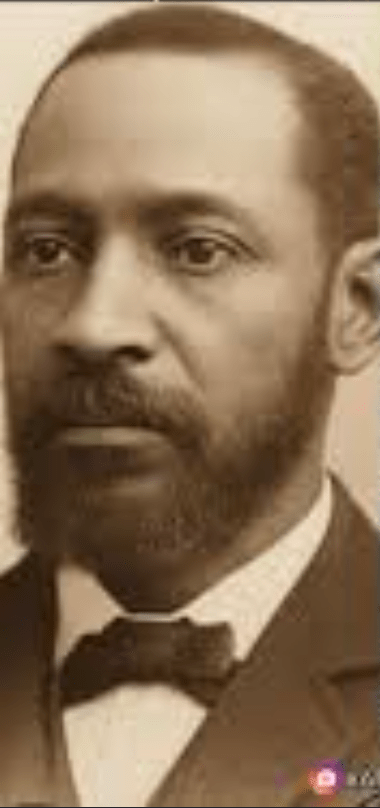
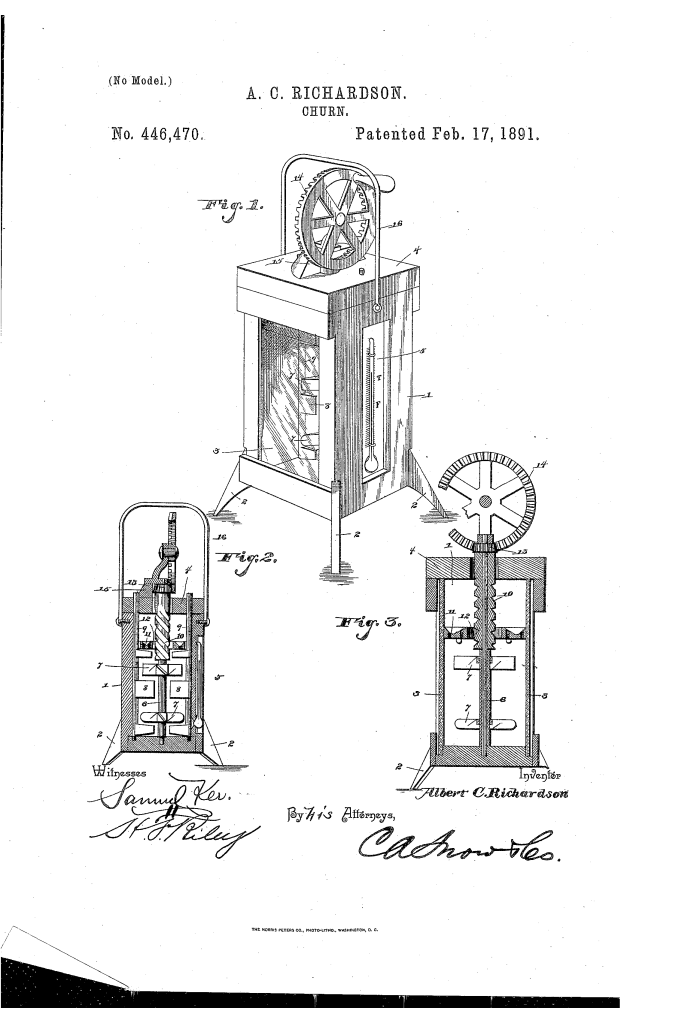
U.S. Patent No. 446,470, granted on February 17, 1891, to Albert C. Richardson, introduced a more efficient and user-friendly mechanical churn. Richardson, an African American inventor residing in South Frankfort, Michigan, sought to simplify the arduous task of butter making through a design that combined high-intensity agitation with an automated collection system.
At the time, butter making was a labor-intensive process that required precise timing and physical stamina. Richardson’s invention aimed to maximize the “yield” from the lacteal fluid (milk/cream) while providing the operator with better tools to monitor the chemical transformation from liquid to solid.
The Innovation: The “Screw-Conveyor” and Dual Agitation
The primary breakthrough of Richardson’s patent was the integration of a spiral conveyor directly onto the dasher shaft. In traditional churns, once the butter granules formed, they had to be manually skimmed or strained from the buttermilk. Richardson’s design automated the separation.
1. The Agitation System
The churn utilized a vertical shaft equipped with rotating dashers (7). These worked in tandem with stationary blades (S) mounted on adjustable rods. This “interlocking” blade system ensured that every ounce of fluid was thoroughly agitated, significantly speeding up the conversion process.
2. The Spiral Groove (10)
The upper portion of the dasher shaft featured a spiral groove acting as a screw conveyor. As the agitation thickened the fluid and butter formed, the rotation of the shaft naturally forced the solid butter upward along the spiral.
3. The Perforated Collection Plate (11)
At the top of the churn sat a flanged, perforated plate. The screw conveyor deposited the freshly formed butter onto this dish, allowing the liquid buttermilk to drain back through the perforations into the main body while the solids remained ready for removal.
Key Mechanical Components
The apparatus was designed for both efficiency and scientific monitoring:
| Component | Function |
| Spiral Dasher Shaft | Rotates to agitate the fluid and serves as a conveyor to lift butter to the top. |
| Adjustable Stationary Rods | Can be turned to different angles to change the resistance and flow of the fluid. |
| Thermometer | Allows the operator to monitor the exact temperature of the milk for optimal butter formation. |
| Glass Viewing Panes | Permits inspection of the “break” (when butter starts to form) without opening the cover. |
| Crank and Pinion Gear | A top-mounted handle and gear system that provides a mechanical advantage for easier turning. |
Operating the Richardson Churn
Richardson’s process was designed to be “simple and inexpensive,” following these steps:
- Inspection: The operator monitors the temperature via the built-in thermometer to ensure the cream is at the correct state for churning.
- Agitation: The handle is turned, spinning the central dashers against the stationary blades. The operator can adjust the angle of the stationary rods to increase or decrease the intensity.
- Observation: Through the glass windows, the operator watches for the formation of butter granules.
- Auto-Collection: As butter forms, the spiral groove carries it upward, depositing it onto the perforated plate for “convenient removal.”
About the Inventor: Albert C. Richardson
Albert C. Richardson was a versatile inventor whose work spanned multiple industries, from agriculture to personal care.
- Diverse Portfolio: Beyond the 1891 churn, Richardson is well-known for his 1894 patent for a casket lowering device, which was a significant improvement in funeral services, and an improved bottle design in 1899.
- Impact: Richardson was part of a wave of late 19th-century African American inventors who utilized the patent system to protect their intellectual property and contribute to the rapid industrialization of the United States.
- Legacy: His churn design was a precursor to more modern, automated dairy equipment, emphasizing the importance of temperature control and mechanical separation in food production.
Summary of Claims
The patent explicitly protects:
- The combination of a dasher-shaft with a series of blades and a spiral groove for conveying butter.
- The use of adjustable stationary rods journaled in the bottom and cover of the churn to vary the agitation.
- A perforated plate acting as a receptacle to receive and drain the butter delivered by the screw conveyor.
