

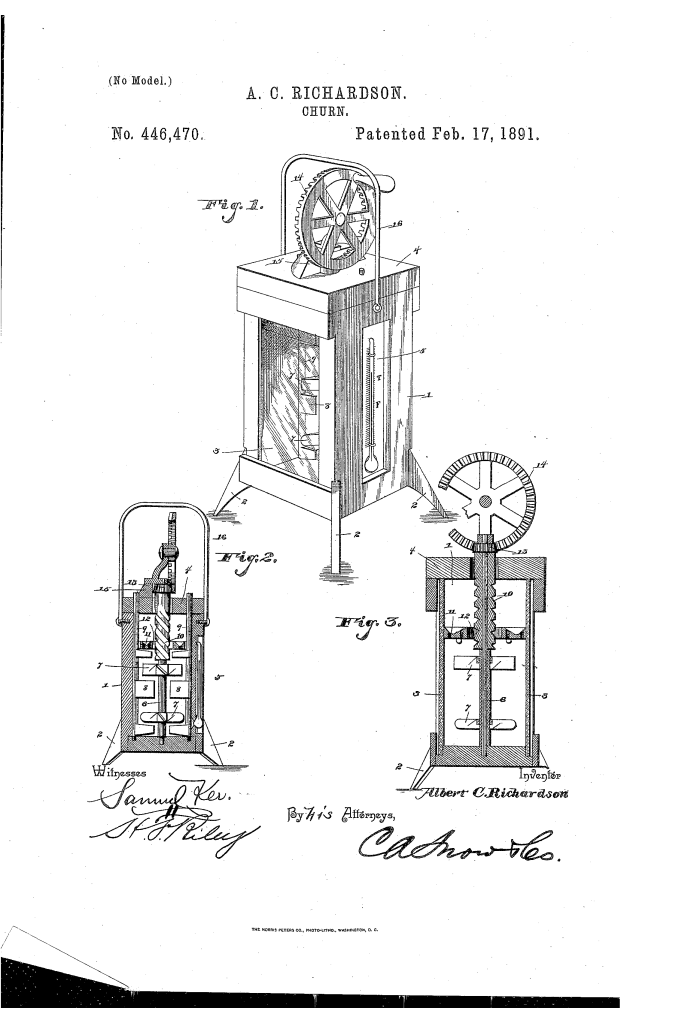
Churn – Patent No. 446,470
Inventor: Albert C. Richardson, of South Frankfort, Michigan.
Patent Number: 446,470
Date of Patent: February 17, 1891
Description: Albert C. Richardson’s patent for a “Churn” was a machine designed to make butter more efficiently. The invention included a rectangular churn body mounted on legs. Its key innovations were:
- Rotating and Stationary Dashers: A central vertical shaft with rotating blades worked in conjunction with stationary blades mounted on rods. This combination provided a “thorough and complete agitation” of the milk or cream, speeding up the churning process.
- Integrated Butter Conveyor: The upper portion of the rotating shaft had a spiral groove designed to act as a screw conveyor. As the butter formed and solidified, this spiral would automatically lift it upward and deposit it onto a perforated plate at the top of the churn.
- Temperature Control: The churn was equipped with a thermometer so the operator could monitor the temperature of the fluid, a key factor in successful churning.
- Visibility: Two sides of the churn were made of glass, allowing the operator to view the process without having to remove the cover.
Societal Impact
Richardson’s churn, while a small-scale invention, was part of a broader trend of mechanizing domestic and agricultural tasks in the late 19th century.
- Domestic Efficiency: Butter-making was a common, laborious chore for farm households. By automating and simplifying the process, Richardson’s churn saved significant time and effort. It was part of the ongoing push to make home life more efficient and to reduce the physical drudgery of daily tasks.
- Quality and Reliability: The addition of a thermometer and the improved agitation method provided a more consistent and reliable way to produce butter. This would have been a major benefit for farmers, who could produce a higher-quality product for personal use or for sale.
- The Inventor’s Legacy: The patent record for Albert C. Richardson does not provide further information about his life. However, his invention shows the kind of practical ingenuity that was applied to improving everyday tools during this period. These small innovations were a collective force in shaping the modern, convenience-oriented domestic and agricultural landscape.
