

Child’s Carriage: William H. Richardson (Patent No. 405,599)
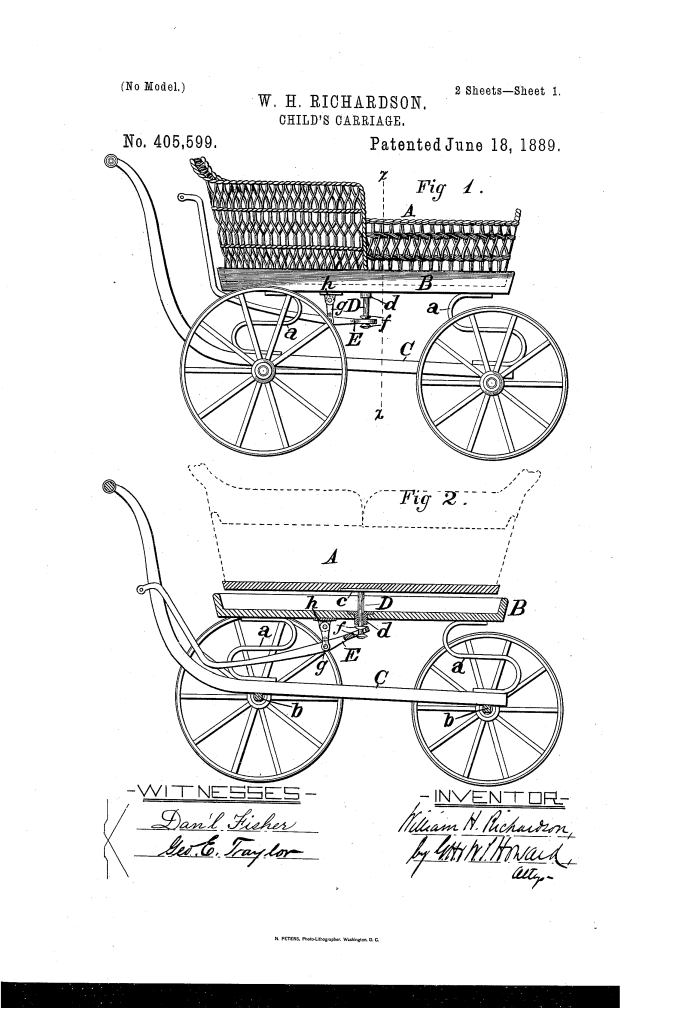
The patent by William H. Richardson of Baltimore, Maryland, describes a Child’s Carriage (Patent No. 405,599), granted on June 18, 1889. This invention is a reversible stroller mechanism that allows the carriage body to be rotated 360° on its chassis, enabling a child to face either the parent or the forward path without adjusting the wheels.
The “Why”
Before Richardson’s innovation, strollers were fixed-direction vehicles. If a parent wanted to shield a child from the sun or wind, or simply wanted to maintain eye contact, they had to turn the entire heavy carriage around and pull it backward—a clumsy and often unsafe maneuver. Richardson sought to solve this “pain point” by decoupling the carriage body from the running gear, allowing for a modular, adaptable orientation that prioritized both the child’s comfort and the caregiver’s convenience.
Inventor Section: Engineering Philosophy
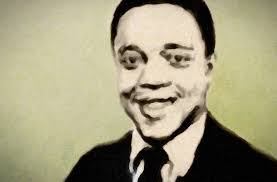
William H. Richardson was a prolific Black inventor whose work significantly impacted 19th-century urban transit and domestic life. His engineering philosophy was rooted in mechanical simplification for the end-user. Richardson understood that a reversible carriage needed to be operated quickly and with one hand. His design focuses on a centralized pivot point and a lever-action lift, emphasizing that true innovation should minimize physical strain through clever geometry.
Key Systems Section
The King-Bolt & Socket Assembly
- Modern Term: Centralized pivot spindle.
- The “King-bolt” (D) serves as both the vertical axis for rotation and the lifting rod. It passes through a “socket” (d) in the tray, acting as the single point of connection between the carriage body and the wheel frame.
The Floating Lever Lift
- Modern Term: Mechanical advantage linkage.
- To rotate the carriage, it must first clear the “flared edges” of the tray. Richardson utilized a lever (E) fulcrumed to a pivoted link (g). By pressing the lever, the attendant uses mechanical advantage to lift the entire wicker body vertically, clearing the locking edges of the tray so it can spin freely.
Self-Aligning Collars
- Modern Term: Spherical or rounded thrust bearings.
- To prevent the King-bolt from bending or jamming when the lever is pressed at an angle, Richardson added “round-faced collars” (f). These ensure that the upward force remains purely vertical (F_y), even as the lever moves through an arc, preventing “binding” in the socket.
Comparison Table: 19th Century Stroller Technology
| Feature | Standard Carriage (Pre-1889) | Richardson’s Innovation |
| Body Orientation | Fixed (Forward-facing only) | Reversible (360° Rotation) |
| Sun/Wind Protection | Requires turning the entire vehicle | Simply rotate the seat body |
| Locking Mechanism | None (Static) | Tray edges act as a gravity-fed lock |
| Maneuverability | Difficult in tight spaces | High; wheels remain stationary during reversal |
Significance
- Foundation of Modern Strollers: Most high-end modern strollers still utilize the “reversible seat” concept pioneered by Richardson.
- Axle Independence: By separating the seat from the “running gear,” Richardson paved the way for modular travel systems where seats can be swapped or adjusted.
- Safety Engineering: The “flared tray” design is an early example of a passive locking system—once the lever is released, gravity drops the body into the tray, securing it without the need for complex latches that could fail.
Technical Physics Note: The lever system utilizes the principle of moments:
F_1 \cdot L_1 = F_2 \cdot L_2
Where $F_1$ is the force applied by the nurse and $F_2$ is the weight of the carriage body. The link (g) allows the fulcrum to shift, ensuring the bolt (D) maintains a strictly vertical translation.
