
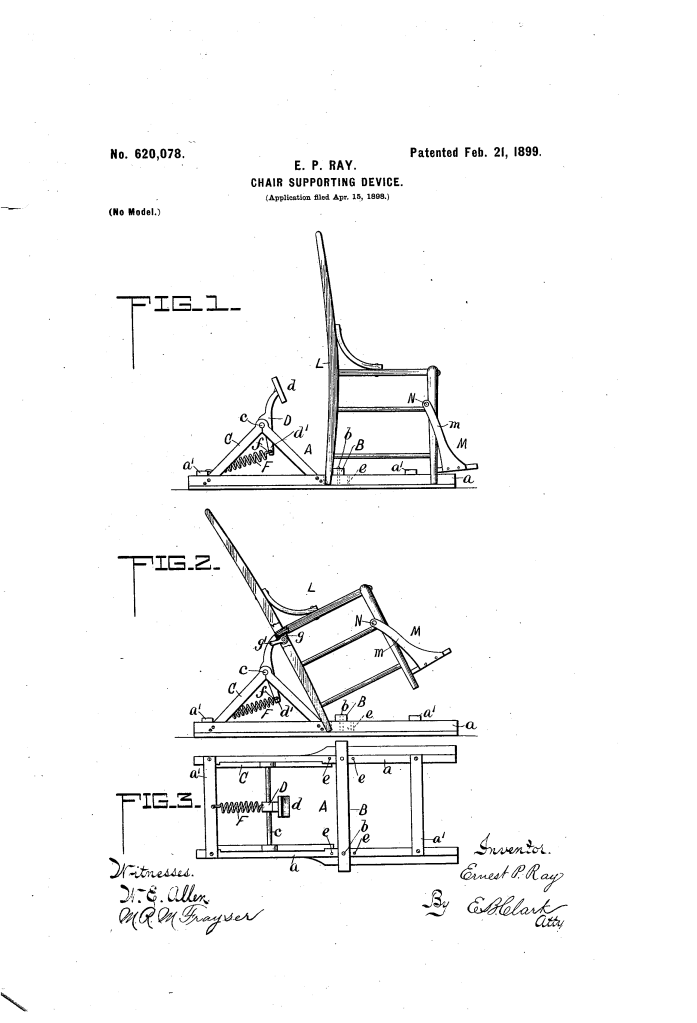
Chair-Supporting Device (Ernest P. Ray, No. 620,078)
The patent by Ernest P. Ray of Washington, D.C., describes a detached and portable Chair-Supporting Device (Patent No. 620,078, 1899) for tilted chairs. The object is to provide a portable frame with a yielding support for any ordinary chair in a tilted position, allowing the occupant to assume a comfortable reclining or partly-reclining posture on a lawn, veranda, or sea-beach.
Inventor Background: Ernest P. Ray
Ernest P. Ray was an inventor focused on improving domestic and outdoor leisure furniture. His invention addresses the problem of achieving comfortable, stable reclining with a standard, rigid chair, without having to lean it awkwardly against a fixed structure like a railing. The device is purely an accessory, maximizing the utility of existing furniture.
Invention and Mechanism
The device is a floor-based wooden frame that uses a centrally pivoted bar and a spring to provide controlled, cushioned rocking for a chair.
1. Supporting Frame
- Frame (A): A rectangular frame made of light wooden side bars ($a$) and cross-bars ($a’$).
- Portability: The frame is “comparatively light” so it can be readily moved from place to place (lawn, veranda, beach).
- Standards (C): A-shaped standards secured to the frame provide the pivot points for the support bar.
2. Chair Support and Cushioning (The Rocking Mechanism) (Key Innovation)
- Yielding Support-Bar (D): A transverse bar with a bearing block ($d’$) at its upper end for receiving the chair legs. It is pivotally supported near its middle by a pin ($c’$) passing through the standards (C).
- Spring (F): A spiral spring (F) connects the lower end of the support-bar (D) to the rear cross-bar ($a’$) of the frame.
- Function: The pivoted bar (D) and the spring (F) provide a yielding and resilient support. When the chair is attached, the occupant can enjoy a cushioned rocking motion because the spring works in both extension and compression.
3. Chair Attachment and Adjustment
- Chair Attachment: The rear of an ordinary chair (L) is attached to the upper end of the support-bar (D) via a pin ($g’$).
- Adjustable Stop-Bar (B): A transverse stop-bar extends across the front of the frame (A). It can be secured in different positions using pins ($b$) inserted into holes ($e$) in the side bars ($a$).
- Function: Adjusting the stop-bar (B) determines the degree of inclination of the chair relative to the support-bar (D).
Core Concepts Utilized Today
Ray’s chair support influenced subsequent leisure and ergonomic furniture by pioneering the concept of an external, spring-damped rocker base for standard seating.
- Spring-Damped Rocking Mechanism: The core innovation of using a centrally pivoted support bar (D) coupled with a base-anchored spring (F) to provide controlled, yielding, and resilient rocking motion influenced the design of:
- Patio and Leisure Rockers: Modern spring-action or glider chairs that use a controlled spring or hinge to achieve smooth rocking while remaining stable.
- Ergonomic Furniture: Specialized seating that incorporates shock absorbers or springs to provide micro-movement and damping, reducing muscle strain.
- Universal Retrofit Base: The design principle of creating a portable, detached accessory frame that adapts to and enhances the function of existing, standard furniture (any ordinary chair) influenced the design of various modular stands, furniture risers, and utility attachments that add new functions without requiring dedicated furniture.
- Adjustable Limit Stops: The simple, hole-and-pin method of using an adjustable stop-bar (B) to regulate the tilt angle of the object being supported is a foundational principle of adjustable fixtures, such as specialized wheelchair bases or adjustable bed frames.
