
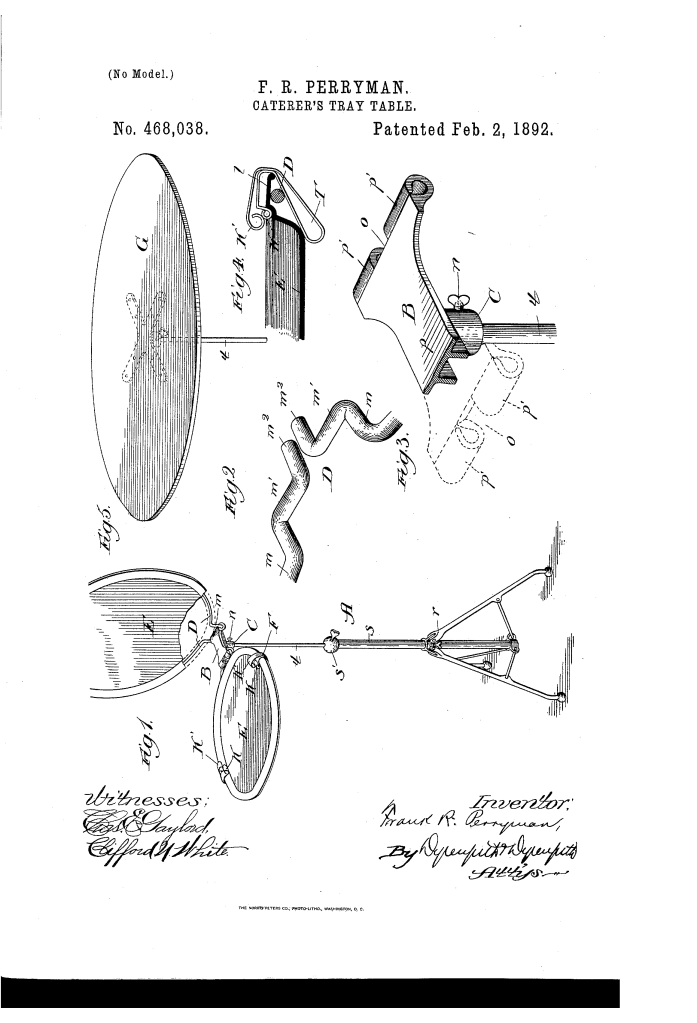
Caterer’s Tray-Table (1892)
U.S. Patent No. 468,038, granted on February 2, 1892, to Frank R. Perryman, introduces a portable, folding furniture solution designed to modernize formal food service. Perryman, a resident of Chicago, Illinois, sought to eliminate the awkwardness of 19th-century “lap dining” in private homes and social gatherings where stationary tables were unavailable or impractical.
Before this invention, guests at catered events were often forced to balance heavy plates on their laps or the narrow arms of chairs. Perryman’s tray-table provided a stable, adjustable, and retractable surface that could be positioned between two guests, elevating the comfort and sophistication of the catering experience.
The Innovation: The “Upward-Folding” Design
While many folding tables of the era featured leaves that hung downward when not in use, Perryman’s table utilized a unique vertically swinging mechanism.
The “Guest-First” Logic:
The tray supports were designed to swing upward into a vertical position rather than downward. This allowed the stand to remain in place while a guest took their seat. If the leaves hung down, they would interfere with the guest’s legs or require the entire stand to be moved and readjusted every time someone sat down or stood up.
The Core Design: The Ring and Hinge System
The apparatus is built around a central telescopic standard that supports two independent dining surfaces.
- The Hinge-Plate (B): A central body, typically made of brass or malleable iron, mounted to the top of the stand. It features specialized hinges with stops that allow the tray rings to stay perfectly level without extra bracing.
- The Supporting Rings (D): Rather than a solid wooden top, Perryman used metal rings with “angular converging ends.” These ends act as a lever; when the ring is horizontal, the points press against the underside of the hinge plate to prevent it from sagging.
- Frictional Resistance: The hinges were engineered with a tight fit, ensuring that when a tray was folded up, it would stay vertical through friction alone, rather than crashing back down.
Key Technical Components
The table is a modular system where every part can be adjusted or removed based on the event’s needs:
| Component | Function |
| Extensible Standard (A) | A telescopic rod with a set-screw that allows the height to be adjusted to the guest’s knee level. |
| Folding Legs (r) | A tripod base that provides stability but allows the entire unit to be collapsed for transport. |
| Tray-Supporting Rings (D) | Circular frames that hold the actual serving dishes or catering trays. |
| Spring Clamp (F) | A double-hooked metal clip that secures the tray to the ring. |
| The “Doily” Jaws (a, a) | Specialized edges on the clamp designed to grip a decorative doily or tablecloth, preventing it from slipping. |
Versatility in Use
Perryman designed the stand to be a multi-purpose tool for the catering industry:
- The Tray Support: In its primary form, the rings held large “caterer’s trays” (E) which could be brought from the kitchen and dropped directly into the rings.
- The Card Table (G): The entire hinge-and-ring assembly could be removed. In its place, a “spider” sleeve could be attached to support a solid wooden top for card games or social activities.
Historical and Social Impact
Frank R. Perryman’s invention reflects the Victorian era’s obsession with etiquette and the professionalization of the catering industry.
- Improved Guest Comfort: By placing the table at “a level very little above the knees of the user,” it allowed for a natural dining posture while seated in standard parlor chairs.
- Space Efficiency: In crowded Chicago apartments or townhomes, the ability to fold the table vertical meant more guests could fit into a room without the clutter of permanent furniture.
- Precision Service: The use of the Spring Clamp was a minor but vital innovation; it ensured that the “vessels” (dishes) wouldn’t slide off the rings if a guest accidentally bumped the table, a common hazard of early portable furniture.
About the Inventor: Frank R. Perryman
Frank R. Perryman was an inventor active in the late 19th century during Chicago’s rapid industrial and social growth. His work focused on the “service economy” of the time, refining the tools used by servers and caterers to provide seamless, “invisible” hospitality.
Summary of Claims
The patent explicitly protects:
- A caterer’s table featuring rings supported to swing in a vertical line on opposite sides of a hinge plate.
- The specific combination of a hinge-plate and tray-support that prevents the surface from falling below the horizontal line.
- The use of a spring clamp that simultaneously secures the tray to the ring and holds a doily in place.
- A removable hinge-plate system that allows the stand to be converted for different types of table surfaces.
