
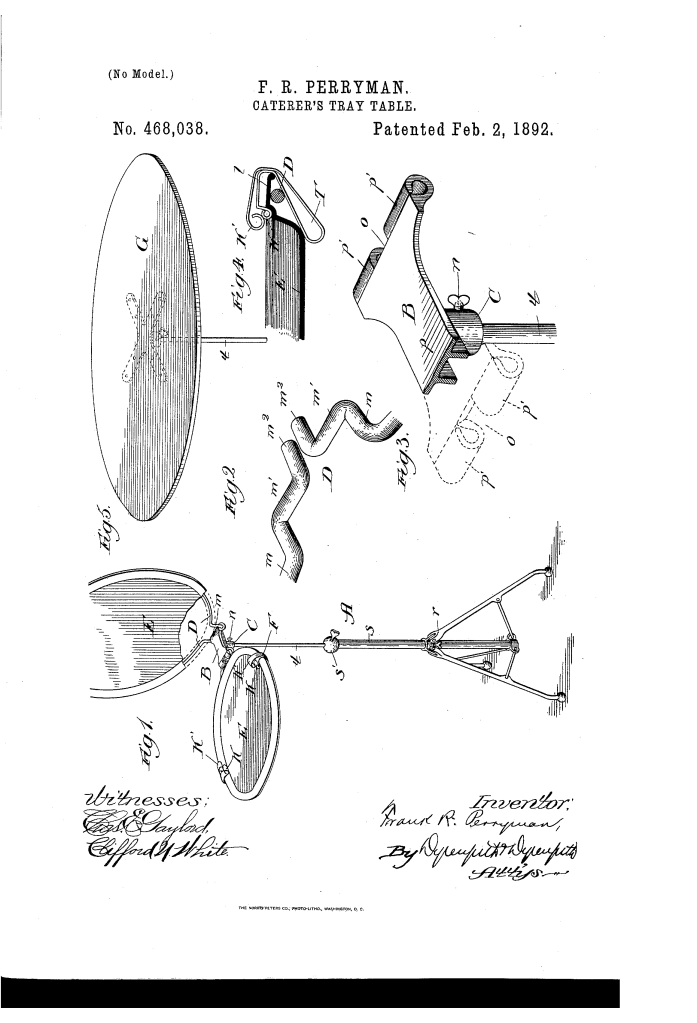
Frank R. Perryman’s patent for a “Caterer’s Tray-Table”, No. 468,038, describes a portable, folding table designed for use at events, particularly in places where stationary tables aren’t practical. Patented on February 2, 1892, the invention consisted of a single-post stand with foldable legs. The key innovations were the collapsible support rings for a serving tray. These rings could be swung from a horizontal position for use to a vertical position to get out of the way, and they were designed to be held in both positions by frictional resistance at the hinge.
Societal Impact and Legacy
Perryman’s invention was a small but significant contribution to the growing food service industry of the late 19th century.
- Improved Service and Convenience: Before such tables, guests at catering events in private homes had to balance their food on their laps or the arms of their chairs. This invention provided a stable, adjustable surface for guests to place their trays. Its folding design also meant it could be stored easily and wouldn’t get in the way of guests when they were not eating.
- The Rise of the Catering Industry: The late 1800s saw the growth of new businesses dedicated to providing services for social events. Perryman’s patent is an example of the kind of specialized equipment being developed to meet the needs of these burgeoning industries. It shows how inventors were looking for practical solutions to new commercial challenges.
- The Inventor’s Legacy: The patent record for Frank R. Perryman does not contain information about his life beyond his residence in Chicago. However, his invention showcases the kind of practical ingenuity that was applied to improving everyday services and conveniences during the Gilded Age.
