
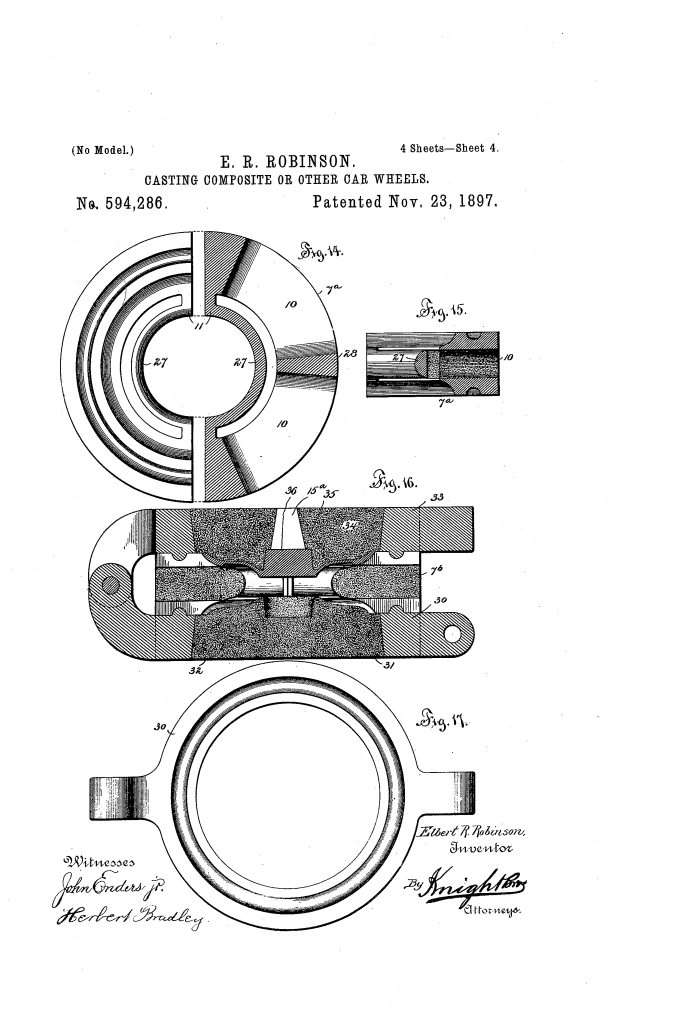
Casting Composite or Other Wheels (1897)
U.S. Patent No. 594,286, granted on November 23, 1897, to Elbert R. Robinson, describes a specialized mold and method for casting composite and grooved wheels—particularly iron and brass trolley wheels. Elbert R. Robinson, an prolific inventor based in Chicago, Illinois, focused on solving structural and manufacturing challenges in urban transportation components.
This specific invention solved a persistent problem in metallurgical casting: how to successfully fuse metals with vastly different properties (such as hard metals or high-conductivity alloys like brass and copper) into the iron body of a wheel, or cast internal fillings and bushings without requiring extensive post-casting machining.
The Innovation: The “Ventilated Ring and Sand-Core” System
Prior to Robinson’s design, casting a secondary metal filling or smooth grooved channel inside an iron wheel was prone to defects caused by trapped gas, uneven shrinkage, or poor bonding between distinct metal components.
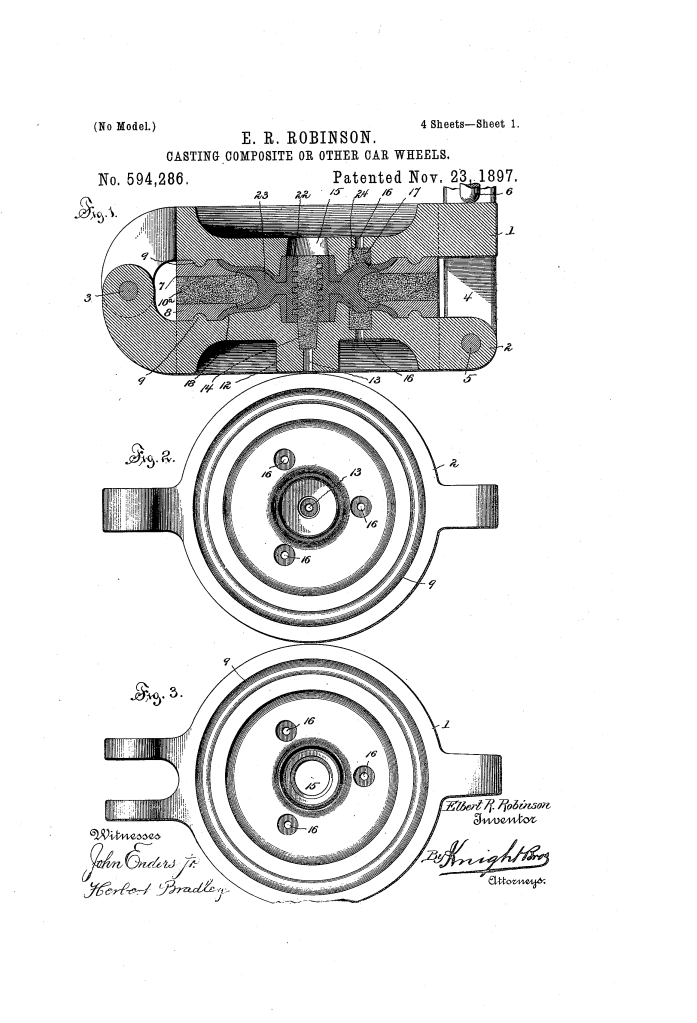
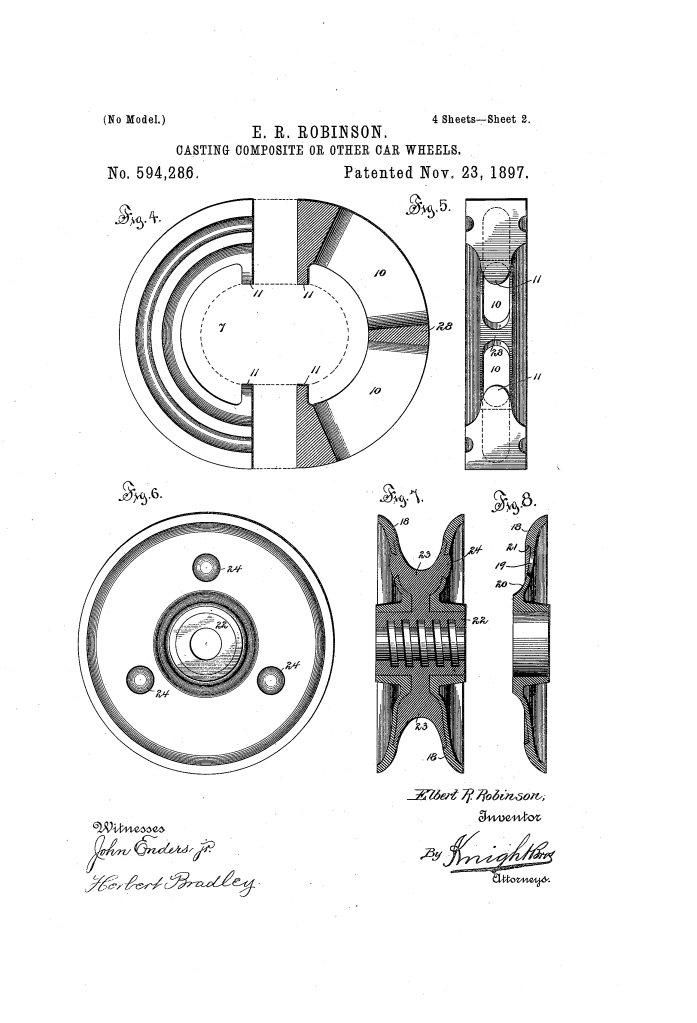
Robinson introduced a hinged, multi-part mold combined with a specialized, split metal ring (7) that holds a permeable sand filling (10). This allowed gases to vent naturally during pouring while locking two outer metal plates or disks (18) into a single, unified composite wheel via an integrated molten metal core.
Key Components of the Mold Design
The assembly uses a coordinated arrangement of mechanical and sand elements to shape and vent the casting:
| Component | Function |
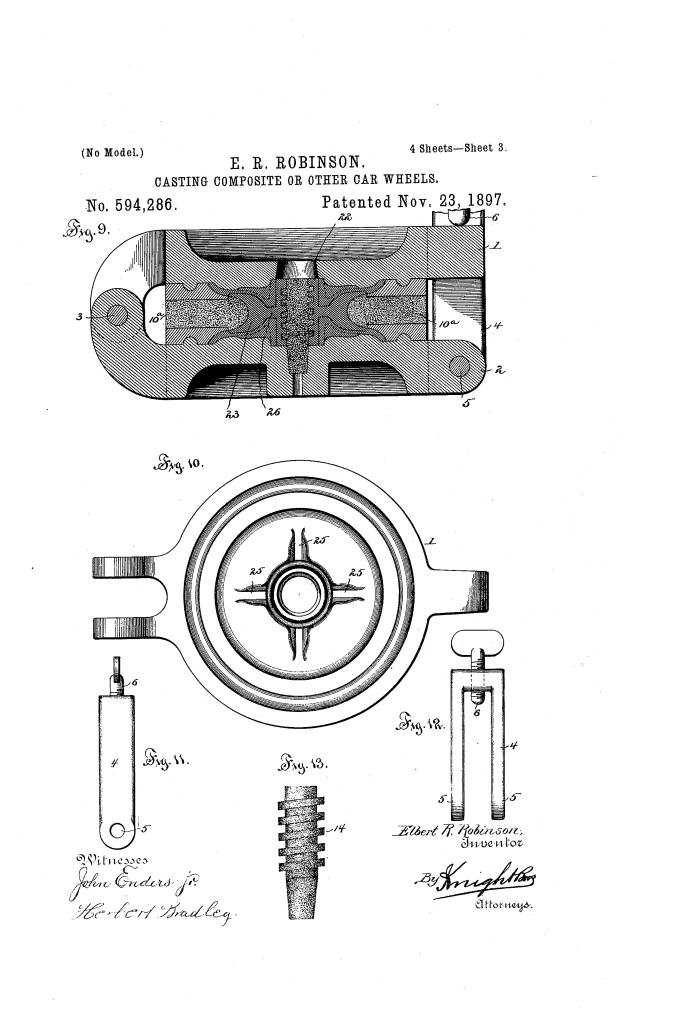
| Top and Bottom Flask (1, 2) | The outer hinged shell that secures the internal components under pressure via a link and screw clamp (4, 6). |
| Annular Split Ring (7, 8) | A two-part metal frame fitted between the mold halves that holds the sand filling and defines the wheel’s grooved outer perimeter. |
| Sand Filling (10) | Contained within cavity 10 of the ring by retaining lugs (11); forms the smooth inner groove while letting reaction gases escape. |
| Perforated Outer Disks (18) | Pre-formed side plates featuring countersunk holes (19) that allow molten metal to flow through, forming locking studs (24). |
| Sand Vent Plugs (17) | Sand-filled openings (16) built directly into the mold sections to vent gases and form clean-shaped heads on the locking studs. |
| Central Sand Core (14) | Inserted into the bottom boss (12) to form the precise axial bore and inner bushing (22) during the pour. |
How the Process Functions
The casting method operates through a systematic sequence to ensure proper alignment and gas evacuation:
| Step | Action | Manufacturing Purpose |
| 1. Mold Preparation | Sand plugs (17) are placed in vent holes (16); sand core (10) is packed into cavity 10 of the split ring frame (8). | Establishes pathways for gas escape and shapes the outer groove. |
| 2. Component Stacking | Lower disk (18) is set in the bottom mold (2); the split ring (7) and top disk (18) are positioned above it. | Aligns the pre-formed outer plates around the groove-shaping core. |
| 3. Sealing & Core Insertion | Central sand core (14) is inserted through the bottom opening (13); top mold (1) is closed and clamped shut via link (4). | Secures all internal elements tightly under mechanical pressure. |
| 4. Pouring & Locking | Molten metal is poured through opening 15, filling space between disks (23), forming bushing (22), and filling holes (19). | Mechanically locks the outer disks and inner filling together via solid studs (24). |
Historical and Scientific Impact
Elbert R. Robinson’s mold assembly significantly advanced high-volume foundry manufacturing for transit systems during the late 19th century.
Precision Casting: The technique produced finished wheels directly out of the mold, requiring little to no post-pour machining or finishing.
Gas Evacuation: By integrating permeable sand fillings directly into the rigid metal ring and mold vents, the design eliminated blowholes and casting weakness caused by trapped gas.
Versatility: The same fundamental mold design could be adapted for composite trolley wheels, solid single-metal wheels, spoked wheels (via spoke-grooves 25), or self-lubricating bushings with internal graphite grooves.
About the Inventor: Elbert R. Robinson
Elbert R. Robinson was an African American inventor who secured several patents in the late 19th century relating to railway technology and trolley equipment. Operating out of Chicago during a period of rapid industrialization, his work on composite metal casting contributed directly to the mechanical reliability of streetcars and urban rail networks.
Summary of Claims
The patent explicitly claims:
- The combination of hinged top and bottom mold sections with a split metal ring holding a internal filling space for casting grooved wheels.
- A mold structure utilizing outer side disks/flanges held in place by mold sections and structured around a split ring that forms an intermediate central space.
- A metal ring (7) designed for grooved wheel molds, featuring an internal radial cavity (10) and retaining lugs (11) to hold a gas-permeable sand filling.
- The integration of an axial sand core to cast an integral central bushing simultaneously with the intermediate wheel filling.
