

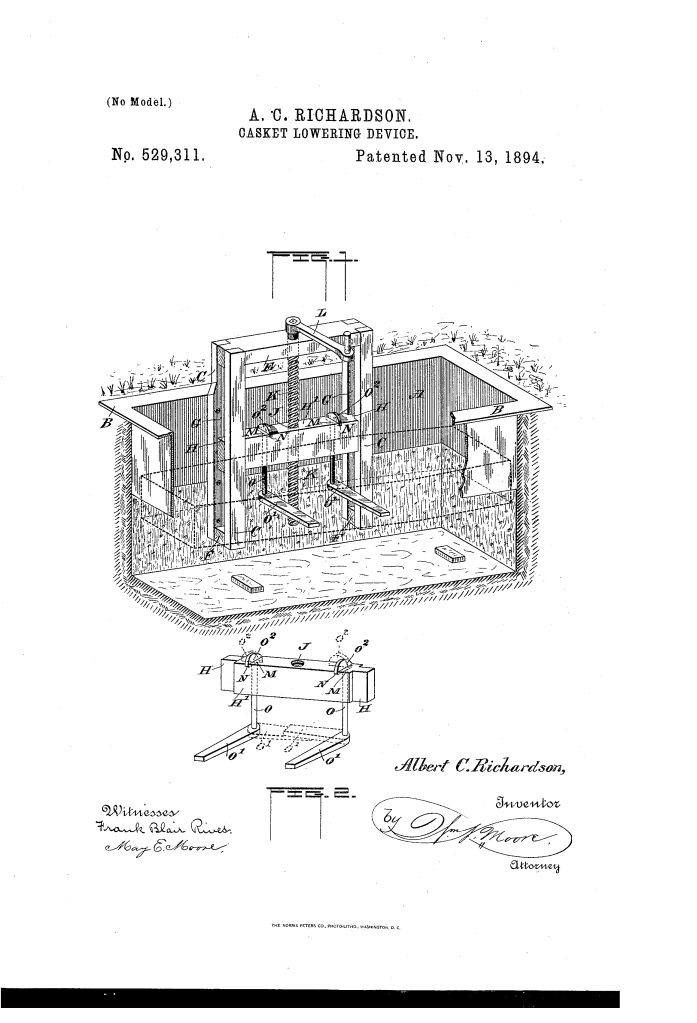
Casket-Lowering Device (1894)
U.S. Patent No. 529,311, granted on November 13, 1894, to Albert C. Richardson, addresses a profound and sensitive issue in late 19th-century undertaker practices: the unstable, undignified, and dangerous process of lowering a casket into a grave using manual ropes.
Traditionally, pallbearers or cemetery workers used fabric straps or ropes to lower a heavy coffin by hand. If a rope slipped or a worker lost their footing, the casket could drop, tilt violently, or rupture—an accident that caused immense emotional trauma to grieving families. Richardson, an inventor residing in South Frankfort, Michigan, engineered a mechanical solution that completely automated this process, ensuring a smooth, level descent while simultaneously protecting the structural integrity of the gravesite.
The Core Design: The Mechanical Guide and Shield System
The brilliance of the Richardson apparatus is its combination of structural earth support and a controlled, screw-driven descent. Instead of relying on human physical coordination, the system locks the casket into a rigid mechanical framework that operates from the safety of the surface.
1. The Casing Shield (A, B)
The foundation of the invention is a heavy, open rectangular shield or protector, preferably constructed of sheet metal.
- Collapse Prevention: It fits tightly inside the grave ditch, functioning as a retaining wall to keep loose dirt from caving in from the edges.
- Surface Anchor: A wide top rim or flange (B) rests flat on the surface of the ground, stabilizing the entire unit and preventing it from slipping downward under the weight of the casket.
2. The Traveling Screw and Follower Head (K, H’)
The lowering mechanism is mounted directly to a frame (C) on one side of the casing, consisting of vertical standards (D) that form precise guide tracks.
- The Crank Mechanism: A long, centrally threaded traveling screw (K) runs vertically through the frame and is operated from the top via an external hand crank or wheel (L).
- The Follower Head: Turning the crank moves a heavy follower head (H’) smoothly up or down along the vertical guide tracks, completely eliminating any sudden drops or tilting.
How the Apparatus Functions
The lowering process follows a strict mechanical sequence designed to maintain absolute decorum and safety at the gravesite:
| Step | Action | Practical Purpose |
| 1. Placement | The sheet metal shield is lowered into the grave ditch until the top flange rests securely on the grass. | Prevenst structural wall cave-ins and establishes a rigid, level foundation. |
| 2. Elevation | The operator turns the hand crank to drive the follower head to its highest position, level with the ground. | Positions the support infrastructure so pallbearers can easily transfer the casket. |
| 3. Loading | The casket is placed directly onto the rigid, horizontal metal receiving arms (O1) extended over the opening. | Takes the weight off human hands and centers the load over the deep grave. |
| 4. Descent | The operator slowly and uniformly turns the external hand crank, driving the traveling screw. | Smoothly lowers the casket into the vault at a perfectly steady, immutable pace. |
| 5. Disengagement | Once the casket is grounded, a tool hooks the upper rod extensions (O2) to unlock them from their notches, rotating the arms out of the way. | Allows the supporting arms to swing flush against the walls so the entire device can be lifted out cleanly. |
Technical Components
The system is built around a synergistic mechanical design where each specialized component ensures structural safety:
- Vertical Guide Tracks (G): Formed by wooden or metal blocks within the standards. They confine the lateral movement of the head, ensuring the casket cannot swing side-to-side or strike the walls of the grave.
- Supporting Rods (O): Vertical iron rods housed within the moving head. They bear the direct weight of the casket via the attached horizontal arms.
- Locking Enlargements (O2): Specialized flattened sections at the top of the rods that lock into matching notches (N) on the moving head. This safety feature prevents the support arms from spinning or swinging outward while carrying the heavy casket.
About the Inventor: Albert C. Richardson
Albert C. Richardson was a remarkably versatile and prolific African American inventor active during the late 19th century.
- Diverse Innovations: While his casket-lowering device solved a critical societal need for the funeral industry, Richardson did not limit his talents to a single field. He holds several significant patents of the era, including a specialized Insect Destroyer (1899) designed to chemically treat crops, and an improvement in the Churn (1891) that vastly accelerated the process of making butter.
- Impact & Legacy: Richardson’s work came during a golden age of independent black mechanics and inventors who revolutionized everyday industrial processes. His casket-lowering architecture laid the fundamental mechanical groundwork for the automated, motorized lowering systems used by modern cemeteries worldwide today.
Summary of Claims
The patent explicitly claims:
- The driving assembly: The combination of a guide frame, a moving head tracking within those guides, a traveling screw connected to the head, and weight-bearing rods with integrated locking enlargements to prevent accidental rotation.
- The integrated earth shield: The combination of a protective ground shield designed to line a grave ditch, coupled with a guide frame and a screw-driven lowering head.
- The safety lock mechanism: The structural combination of the grave casing, the guide frame, the moving head, and support rods equipped with horizontal arms at the bottom and locking flanged tops to stabilize the descent.
