
Cash Carrier – Patent No. 391,577
Inventor: Albert B. Blackburn, of Springfield, Ohio.
Patent Number: 391,577
Date of Patent: October 23, 1888
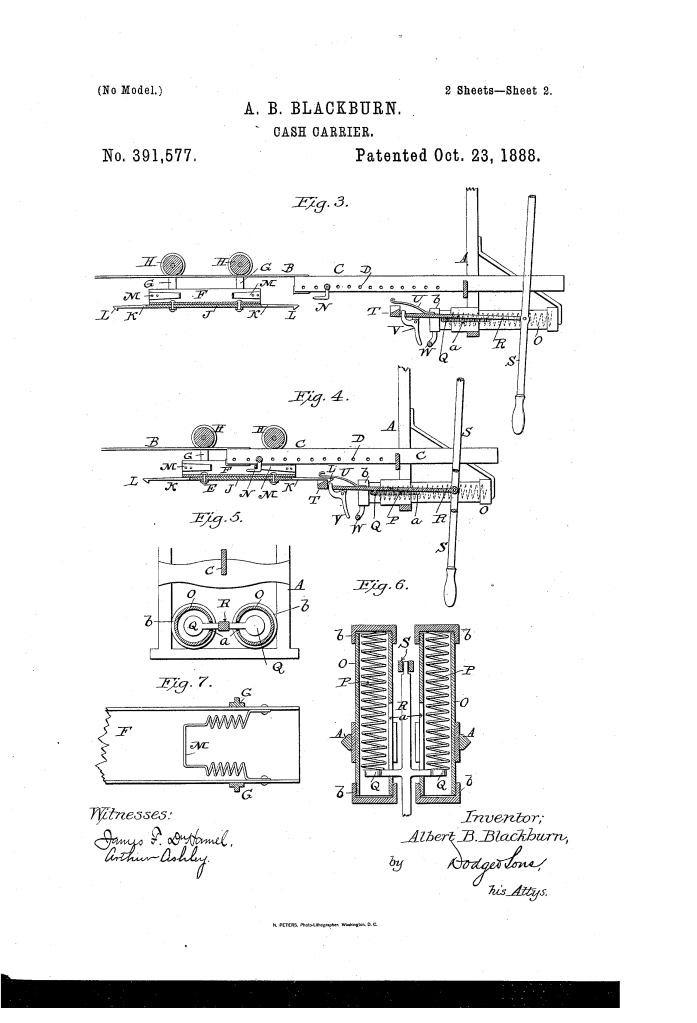
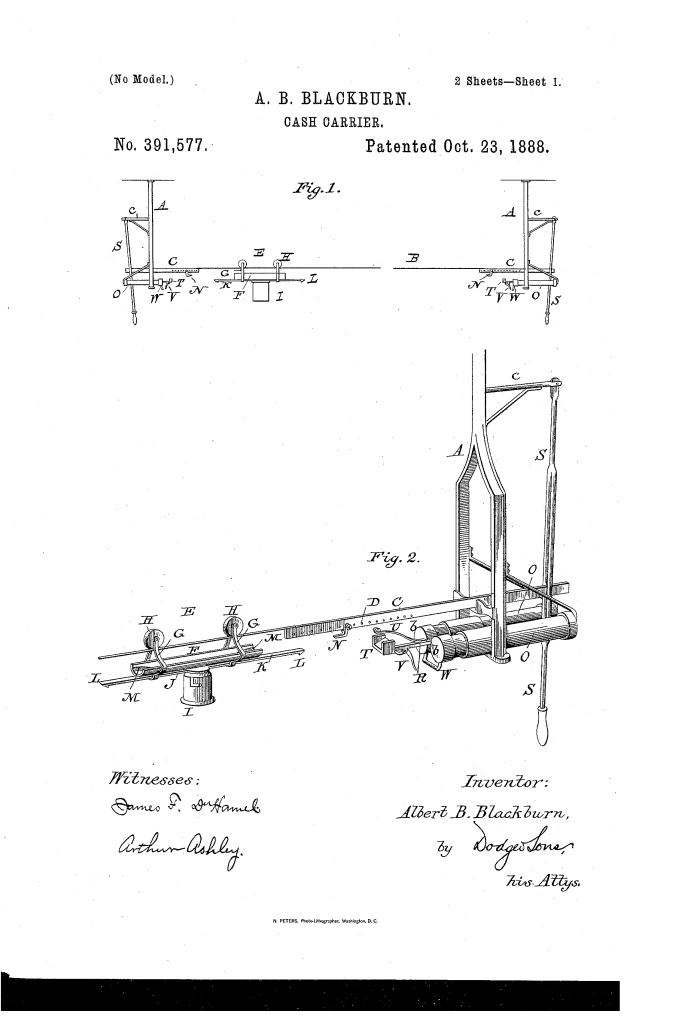
Description: Albert B. Blackburn’s patent for a “Cash Carrier” describes a specific type of wire-based system designed to transport cash and receipts from a sales counter to a central cashier’s station and back. The invention focused on improvements to the carriage that traveled along a fixed rail or wire. Blackburn’s design included a system of hooks, levers, and an elastic loop to ensure the carriage was launched with sufficient force and to create a buffer mechanism to prevent damage and noise upon arrival at the station.
The apparatus featured a carriage with hooks and elastic loops at both ends. It would engage with a fixed hook at the station, and once the transaction was complete, a release mechanism would launch it back to the sales counter. This design aimed to be both efficient and durable for repeated use in a retail environment.
Societal Impact of Cash Carrier Systems
Blackburn’s invention was part of a broader technological trend in the late 19th century that revolutionized retail. Cash carrier systems, often called “cash railways” or “rapid wire systems,” had a significant impact on retail and consumer experience.
- Increased Efficiency and Sales: Before these systems, a clerk would have to walk the money and sales slip to a central cashier and wait for change. This was time-consuming and took the clerk away from attending to customers. Cash carriers streamlined this process, allowing clerks to handle more customers and close sales faster, which was a major benefit for growing department stores.
- Reduced Theft and Improved Security: By centralizing the handling of all cash and receipts, these systems significantly reduced the opportunities for employee theft. The cash was securely transported to a single, supervised location, making it more difficult for clerks to pocket money. This provided store owners with greater control and financial security.
- An Evolving Retail Landscape: These systems contributed to the rise of the modern department store. Centralized cash handling was a key enabler for the massive, multi-department retail spaces that became common in urban areas. The systems themselves were a spectacle, often drawing crowds of spectators who were fascinated by the “novel exhibition” of money flying through the air.
- The Inventor’s Legacy: Albert B. Blackburn was an African American inventor who also held other patents, including for a railway signal and a spring seat for chairs. His cash carrier patent, and others like it from minority inventors, highlights the often overlooked contributions of black innovators to American industrial and technological progress. His work, alongside that of other inventors, collectively advanced the infrastructure of commerce and shaped the consumer experience for decades.
