
Car Park (1956)
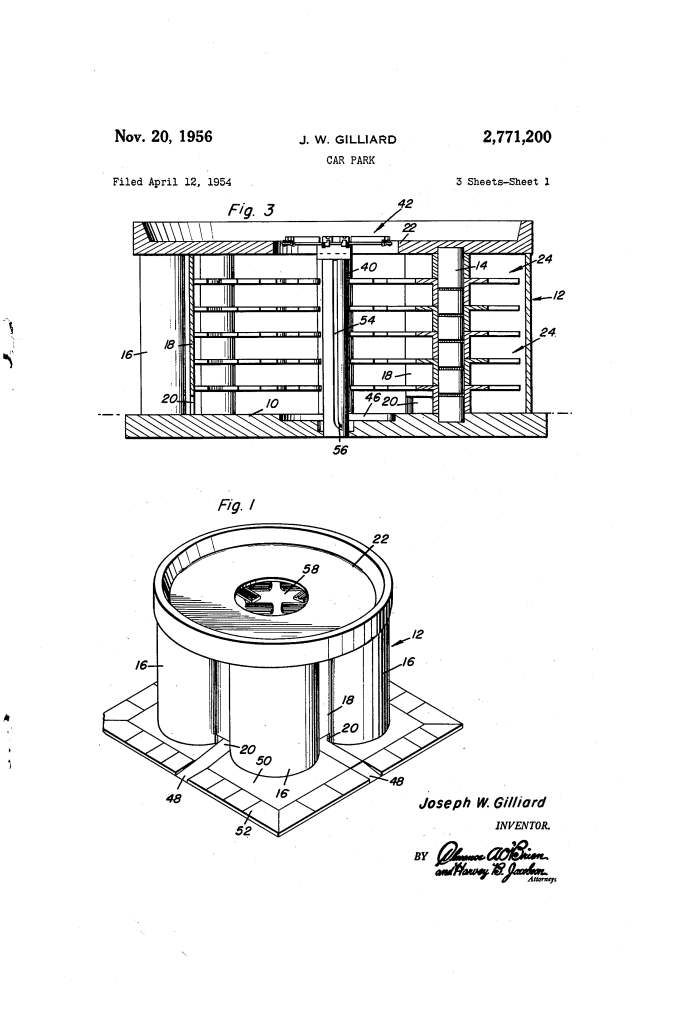
U.S. Patent No. 2,771,200, granted on November 20, 1956, to Joseph W. Gilliard, proposes an architectural and mechanical solution to the burgeoning traffic and parking crises of the mid-20th century. Gilliard, an inventor from Phoebus, Virginia, designed a high-capacity, automated parking structure that combines aesthetic appeal with a high-density “radially spaced” elevator system.
This invention addressed the limitations of traditional parking lots by utilizing vertical space and automated “carriage” transfers, allowing a maximum number of vehicles to be stored on a small urban footprint—ideally a single city block—without requiring drivers to navigate complex ramps.
The Innovation: The “Rotary-Column” System
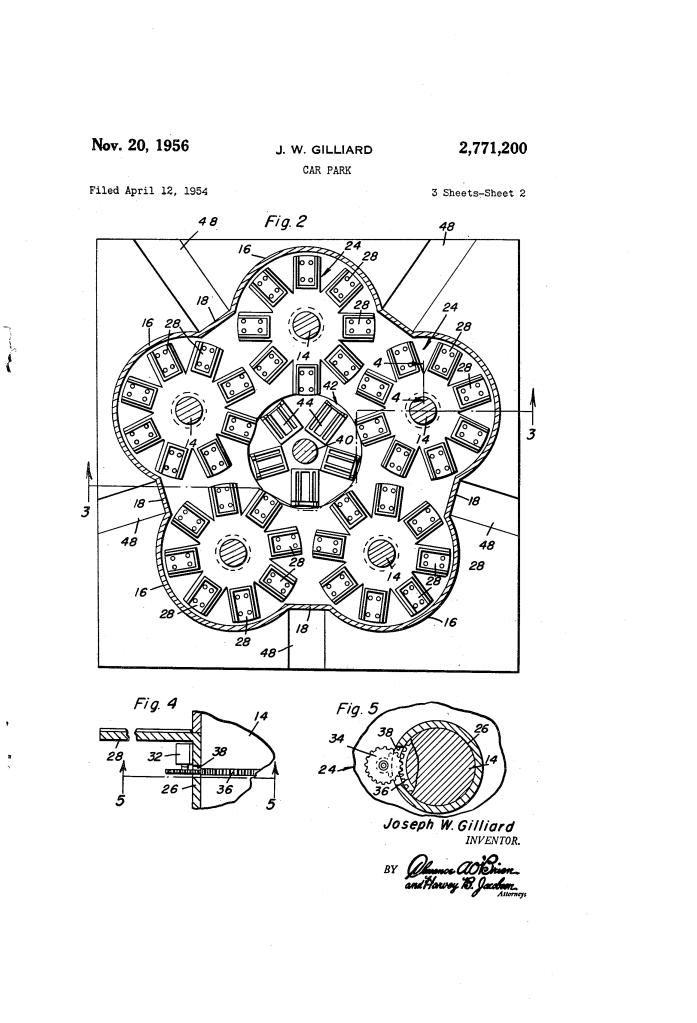
The defining feature of Gilliard’s design is the departure from fixed parking floors. Instead, the building uses a central elevator surrounded by five independent vertical columns that act as both structural supports for the roof and axes for rotating parking platforms.
1. The Stacked Parking Platforms (24)
Each supporting column (14) holds a vertical stack of independently rotatable platforms.
- Hub and Spoke: Each platform features a central hub (26) and load-receiving spokes (28) where the cars actually sit.
- Independent Rotation: Every individual platform is equipped with its own electric motor (32) and ring gear (36). This allows a specific car to be rotated into position for pickup without moving any other cars in the stack.
2. The Spiral-Aligning Elevator (42)
The central elevator assembly is designed for fluid transition between the street and the storage units.
- Automatic Alignment: The elevator mast (40) contains a spiral groove (54). As the elevator rises from the ground floor, this groove forces the platform to rotate, perfectly aligning the elevator spokes with the parking spokes by the time it reaches the desired level.
How the Apparatus Functions
The parking process is an automated sequence designed to minimize human error and maximize speed:
| Step | Action | Purpose |
| 1. Entry | A car drives through one of the doorways (20) onto the lowered elevator spokes (44). | Aligns with the street-level traffic flow. |
| 2. Ascent | The elevator rises; the spiral mast groove (56) rotates the elevator to face the storage columns. | Ensures the transfer bridge is perfectly aligned with the storage spokes. |
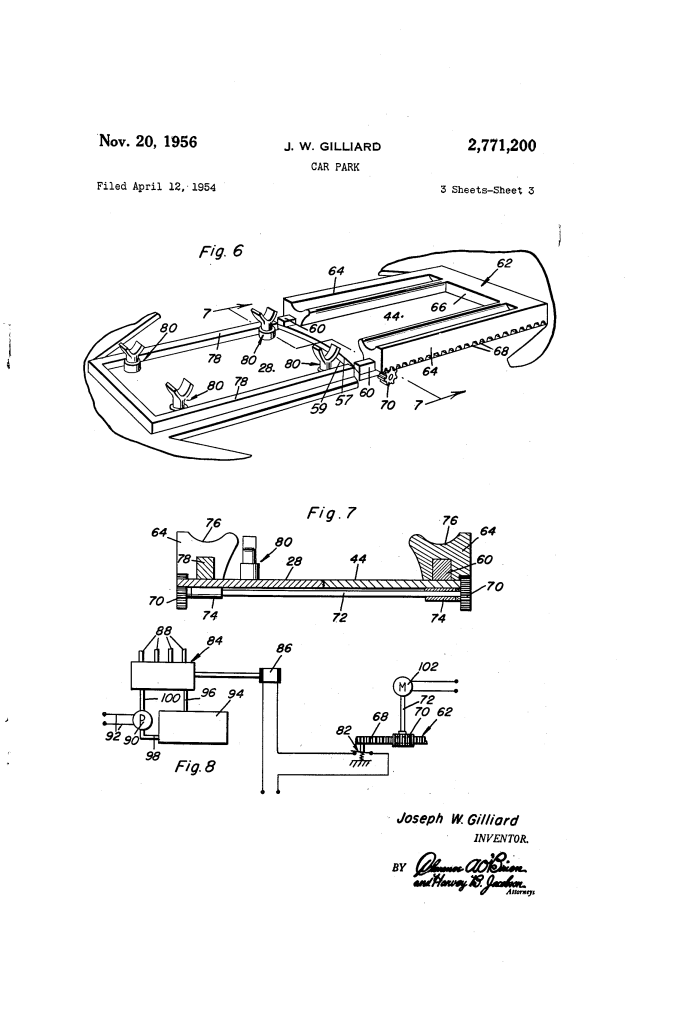
| 3. Transfer | A U-shaped carriage (62) on the elevator moves forward onto the parking spoke (28). | Bridges the gap between the elevator and the storage unit. |
| 4. Lift & Store | Hydraulic jacks (80) on the parking spoke lift the car off the carriage. | Allows the carriage to retract back to the elevator while the car remains safely “perched” on the spoke. |
Technical Components
- Convex/Concave Interlock (57, 59): The ends of the elevator spokes are concave to “nest” with the convex ends of the parking spokes, creating a continuous, gap-free bridge for the transfer carriage.
- Rack and Pinion Drive (68, 70): The transfer carriage uses a gear-driven rack system to move precisely between the elevator and the platforms.
- Hydraulic Coordination (Figure 8): A solenoid-actuated valve (84) and pump (90) system automates the jacks. When a carriage hits a limit switch (82), the jacks automatically engage to “take” the car from the carriage.
Architectural and Urban Impact
Joseph W. Gilliard envisioned his “Car Park” as a landmark structure rather than a mere utility building.
- Community Integration: The design includes a “skirt” area (50) between the sidewalk and the main wall intended for two-story business establishments, ensuring the building contributes to the local economy.
- Roof-Top Storage: The elevator can travel through a central opening (58) in the roof, allowing for additional long-term storage or “overflow” parking on the very top of the building.
- Traffic Flow: Because the building has five separate entrances positioned around a block, it can accept traffic from any direction, preventing the bottlenecks common at single-entrance garages.
About the Inventor: Joseph W. Gilliard
Joseph W. Gilliard was an innovator based in Phoebus, Virginia (now part of Hampton). Writing in 1954, Gilliard anticipated the “smart city” concepts of the future, recognizing that as urban populations grew, the only way to manage the influx of automobiles was through vertical, automated engineering. His work represents a significant contribution to the field of mechanical civil engineering and urban planning.
Summary of Claims
The patent explicitly claims:
- A building with circularly arranged supporting columns that rotatably receive vertically stacked parking platforms.
- An elevator platform with spokes that automatically rotates between street-alignment and column-alignment during ascent.
- An extensible vehicle supporting track (carriage) and a series of hydraulic jacks for the slip-free transfer of vehicles.
- A centrally disposed elevator mast with a spiral alignment groove to mechanically time the rotation of the elevator.
