
Car-Door-Actuating Mechanism (Walter N. McClellan, No. Re. 15,338)
The patent by Walter N. McClellan of Brooklyn, New York, describes an advanced Car-Door-Actuating Mechanism (Reissue Patent No. 15,338, 1922; originally No. 1,369,681, 1921). This invention is a comprehensive system for controlling passenger flow on railway cars and streetcars. McClellan’s primary objective was to improve safety and efficiency by centralizing door control, automating fare collection, and bridging the dangerous gap between the car and the station platform.
Inventor Background: Walter N. McClellan
Walter N. McClellan was an African American inventor who significantly contributed to the safety standards of New York’s burgeoning transit systems during the early 20th century. His work focused on the “human factor” of transit—preventing accidental falls and managing the chaos of boarding and alighting. This 1922 reissue reflects his iterative approach to engineering, adding layers of safety like “fenders” to protect passengers from moving doors.
Key Mechanical & Safety Systems
The mechanism integrates pneumatic power, mechanical linkages, and passenger-actuated barriers into a single “all-domain” control system.
1. The Centralized Pneumatic Control (17, 18, 19)
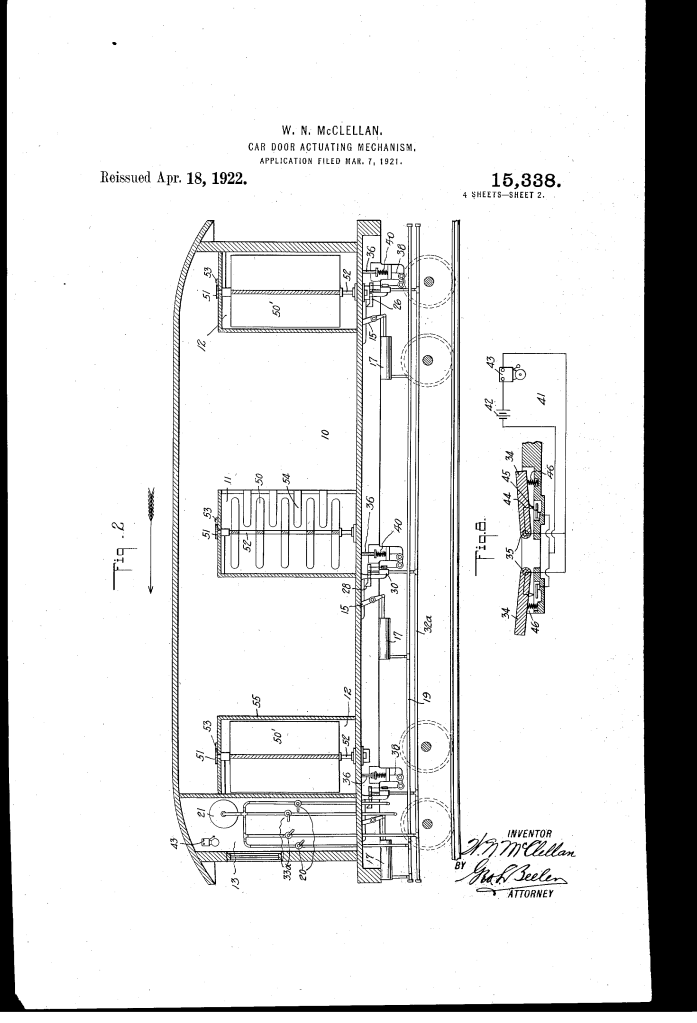
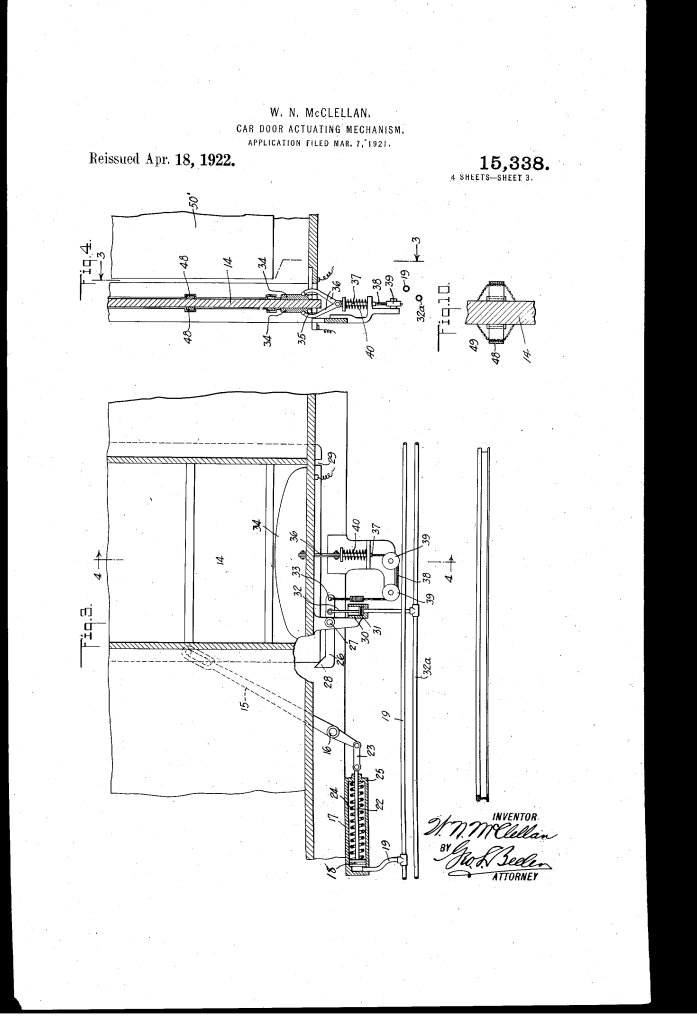
- The Cylinder and Piston: Each sliding door (14) is connected to a pneumatic cylinder (17).
- Operation: Compressed air from a reservoir (21) pushes the piston head (18) to open the door. A coiled compression spring (24) is used to close the door, ensuring that if air pressure is lost, the doors default to a closed position for safety.
- Master Control: All doors can be operated simultaneously by the motorman from a single cab (13), allowing for rapid response at stations with platforms on both sides.
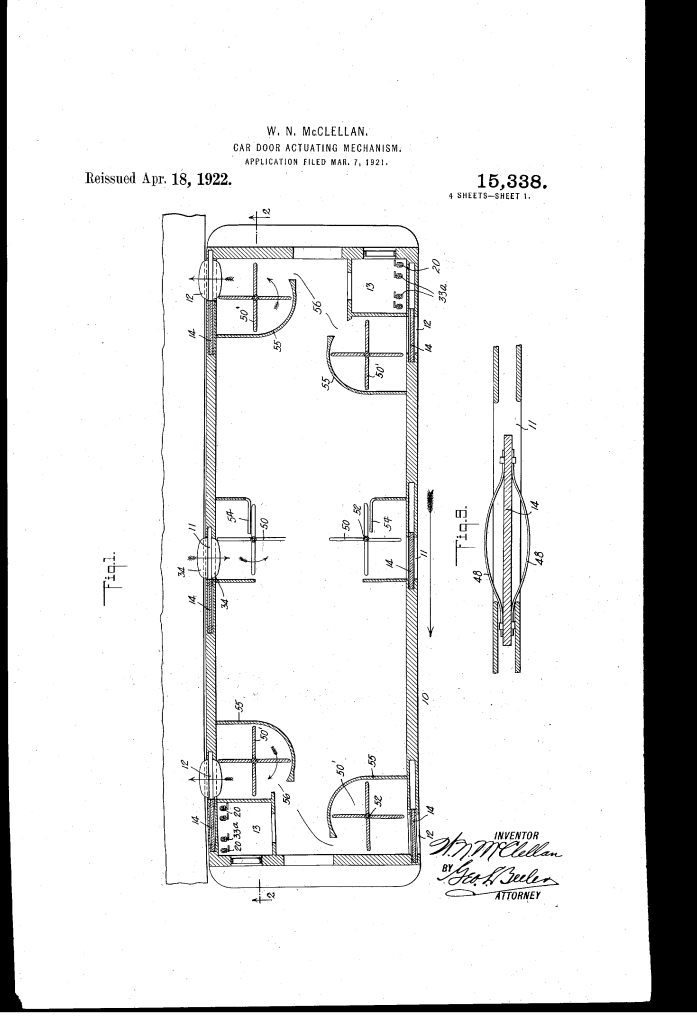
2. The Multi-Barrier Passenger Flow System (11, 12, 71)
To prevent fare evasion and control traffic, McClellan used a two-tier barrier system:
- Entrance/Exit Separation: Dedicated entrance (11) and exit (12) passages.
- Rotating Doors (Turnstiles): Inner rotating doors allow “free entry” but prevent exit through the same path.
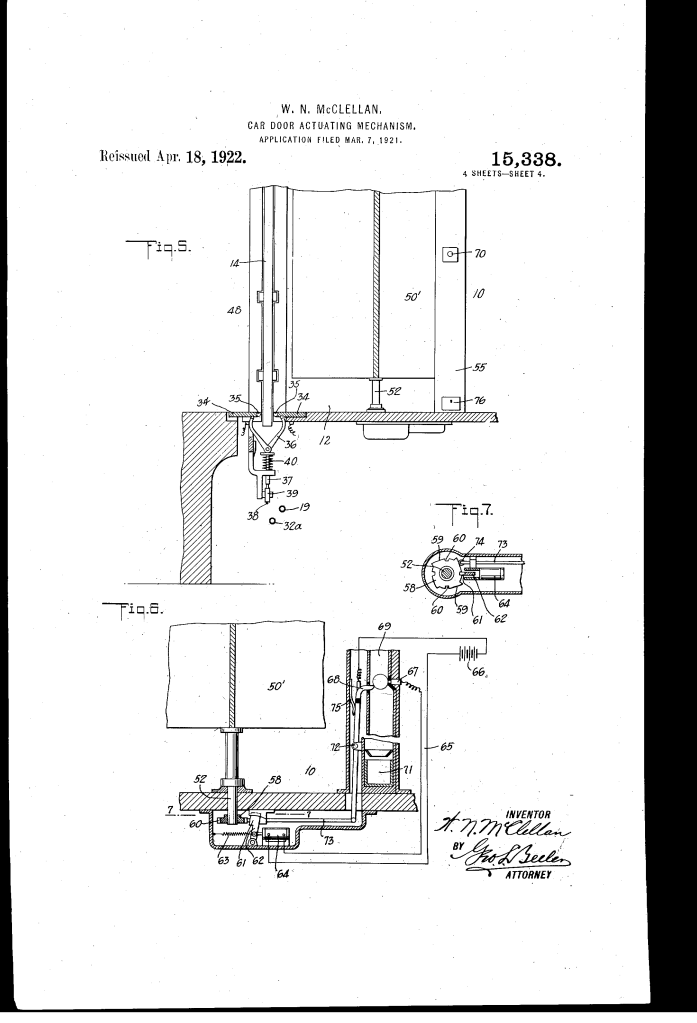
- Coin-Controlled Locking: The exit doors remain locked until a coin is deposited into the coin box (71), releasing the mechanical lock and allowing the passenger to depart.
3. The Platform Gap Bridge (Steps)
One of the most innovative features is the automatic bridging step (illustrated in Figs. 4 and 5 of the patent).
- Function: As the safety doors open, a set of steps or a “bridge” automatically extends to meet the station platform.
- Safety Logic: This eliminates the “gap” that frequently caused injuries in early subway and train travel.
4. Door Fenders and Signaling (Fig. 9, 10)
- Fenders: The doors are equipped with safety fenders (buffers) designed to “fend off” passengers who might be caught in the path of a closing door.
- Automatic Signaling: A sensor system (Fig. 8) notifies the motorman that the passages are clear, providing a “green light” to close the doors only when it is safe to do so.
Engineering Features and Problem Solving
| Feature | Hazard Addressed | McClellan’s Engineering Solution |
| Pneumatic Piston (18) | Manual labor/Slowness. | High-speed, simultaneous operation of all doors from one point. |
| Compression Spring (24) | Power failure/Drifting doors. | Provides “fail-safe” closing force even without air pressure. |
| Bridging Steps | Falls between car and platform. | Mechanically linked steps that extend/retract with door movement. |
| Rotating Turnstiles | Fare evasion/Crowd chaos. | Uni-directional movement and coin-actuated release. |
Significance to Transit Engineering
Walter N. McClellan’s invention was a precursor to the modern automated transit systems found in today’s subways and buses.
- The “One-Man” Operation: By centralizing the door and fare control, McClellan’s system allowed a single operator to manage a large car safely, reducing labor costs and human error.
- Safety First Philosophy: His inclusion of door fenders and gap-bridging steps pioneered the “Safe System” approach in transit, where the vehicle’s design proactively prevents passenger injury.
- Automated Fare Integration: The mechanical link between the fare box and the physical exit barrier is the foundational logic of modern turnstiles and electronic fare gates.
