
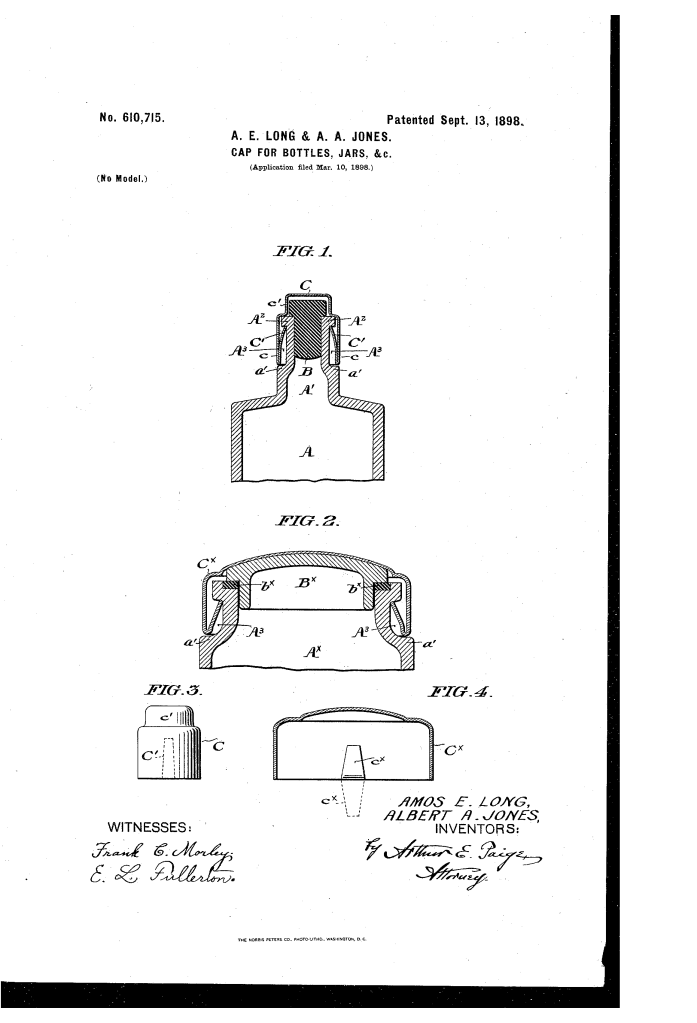
Cap for Bottles, Jars, &c. (1898)
U.S. Patent No. 610,715, granted on September 13, 1898, to Amos E. Long and Albert A. Jones, describes a tamper-evident closure for bottles and jars designed for single-use security. Long and Jones, inventors based in Philadelphia, Pennsylvania, developed a mechanical locking cap intended to indicate conclusively by its physical condition whether a container had been tampered with or opened.
This invention addressed a widespread late-19th-century commercial dilemma: preventing the fraudulent refilling, dilution, or unauthorized opening of bottled goods, medicines, and preserves without requiring complex, expensive external locking hardware.
The Innovation: The Integral Resilient Locking Tongue
While basic sheet-metal caps existed at the time, existing designs could often be pried off and replaced without visible signs of interference. Long and Jones solved this by engineering a cap body equipped with integral, flexible metal tongues configured to lock permanently into place upon initial seating.
Once pressed over the mouth of the vessel, the tongues automatically flex outward over the vessel’s rim and snap inward beneath a retaining shoulder. Because the locking tongues are seated within an inaccessible recess under the flange, the cap cannot be detached or lifted off without completely destroying or mutilating the sheet metal.
Key Structural Mechanics
The closure relies on three core mechanical interactions:
- Automatic Engagement: The flexible sheet-metal tongues yield during downward application, then spring under the lip without requiring secondary crimping tools.
- Tamper Evidence: The rigid geometry makes non-destructive removal physically impossible; opening the container requires visible destruction of the cap body.
- Dual-Shoulder Seating: The lower edge of the cap meets a matching lower glass shoulder, enclosing the locking mechanism completely to prevent external prying tools from reaching the internal tongues.
Technical Components
The assembly integrates directly with the molded contours of the container neck:
| Component | Function |
| Cap Body (C / C’) | The protective sheet-metal outer shell enclosing the stopper and the upper container rim. |
| Resilient Tongues (c) | Integral sheet-metal tabs struck up and bent inward from the cap rim that snap under the upper vessel lip. |
| Vessel Lip / Upper Shoulder (A2 / a’) | An annular projection on the vessel neck that acts as the physical catch for the free ends of the resilient tongues. |
| Annular Recess (A3) | The recessed channel molded into the container neck that houses the locked resilient tongues. |
| Lower Shoulder (a) | A base ledge on the container neck matching the diameter of the cap to support its bottom edge and block removal tools. |
| Stopper / Packing (B / B’, b) | The internal sealing element (cork or rigid stopper paired with a soft rubber packing ring) that ensures an airtight seal. |
How the Closure Functions
The locking and sealing sequence proceeds in four discrete operational stages:
- Primary Sealing: The vessel is charged, and the internal seal—either a standard cork (B) or a rigid stopper (B’) seated against a soft rubber gasket (b)—is inserted into the neck.
- Alignment: The stamped sheet-metal cap (C) is positioned directly over the vessel mouth and aligned with the neck contours.
- Snap-Locking: Downward pressure forces the resilient tongues (c) outward over the tapered vessel lip (A2 / a’) until they clear the edge and spring inward into the annular neck recess (A3).
- Terminal Enclosure: The free upper tips of the tongues brace firmly against the underside of the upper flange, while the continuous lower edge of the cap rests against the lower neck shoulder (a), preventing vertical displacement or tool access.
Historical and Industrial Impact
Long and Jones contributed to the rapid late-Victorian transition toward mass-manufactured, consumer-safe packaging.
- Fraud Prevention: The design provided merchant and consumer verification against adulterated liquor, compromised patent medicines, and spoiled food products.
- Manufacturing Efficiency: Because the locking tongues are struck up directly from the parent sheet metal of the cap skirt, the component could be stamped in high-volume production without separate fasteners, rivets, or complex multi-piece assemblies.
- Packaging Versatility: The mechanism functioned effectively across both standard beverage bottles using common corks and wide-mouth storage jars requiring airtight rubber gaskets.
About the Inventors: Amos E. Long & Albert A. Jones
Amos E. Long and Albert A. Jones were Philadelphia-based inventors operating during one of the most prolific eras of American industrial manufacturing. Developing hardware during Philadelphia’s tenure as the “Workshop of the World,” the partners focused on practical sheet-metal engineering and consumer product packaging. Their 1898 patent represents an early mechanical predecessor to modern tamper-evident beverage caps and safety seals.
Summary of Claims
The patent explicitly claims:
- A vessel closure combining a neck having a continuous recess (A3) with upper and lower annular shoulders.
- A sheet-metal cap provided at its continuous lower edge with integral, struck-up, and inwardly bent resilient tongues.
- A structural geometry where the free upper extremities of the tongues lock against the upper shoulder while the lower edge engages the lower shoulder to prevent non-destructive removal.
