
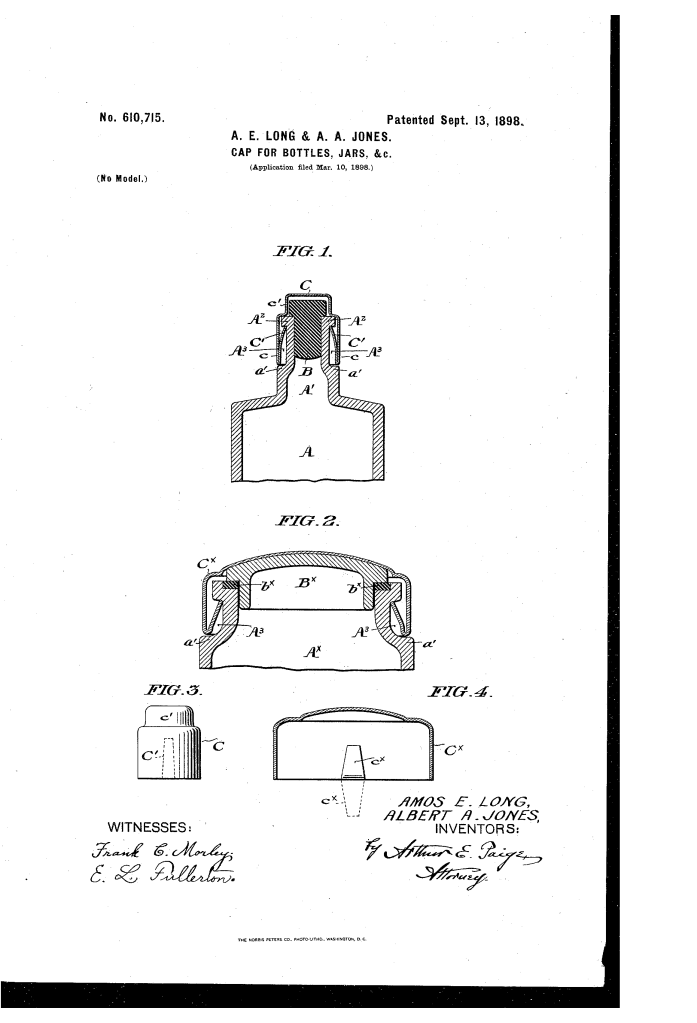
Cap for Bottles, Jars, &c. (Amos E. Long and Albert A. Jones, No. 610,715)
The patent by Amos E. Long and Albert A. Jones of Philadelphia, Pennsylvania, describes a closure for vessels called a Cap for Bottles, Jars, &c. (Patent No. 610,715, 1898). The invention is designed for vessels intended to be used but once, and its object is to provide a closure that indicates by its condition whether the vessel has been opened or not (tamper-evident).
Inventor Background: Amos E. Long and Albert A. Jones
Amos E. Long and Albert A. Jones were inventors working in Philadelphia, focusing on industrial packaging and sealing technology. Their invention addresses a critical commercial need of the late 19th century: ensuring the integrity of packaged goods (like medicines, beverages, or preserves) by making the opening process irreversible without physically destroying the seal.
Invention and Mechanism
The invention consists of a sheet-metal cap with integrated, automatically engaging spring tongues that permanently lock beneath a lip on the vessel’s neck.
1. Vessel and Sealing Area
- Vessel (A): A bottle or jar with a neck ($A’$) that is provided with a lateral flange or lip ($A^{2}$) and a continuous recess ($A^{3}$) below the lip.
- Stopper (B): A cork or other rigid stopper is inserted into the neck.
2. The Permanent Locking Cap (Key Innovation)
- Cap (C): A sheet-metal cap designed to enclose the cork and neck.
- Resilient Tongues ($c$): The cap (C) is provided with integral, struck-up, and inwardly-bent resilient sheet-metal tongues ($c$) along its lower edge.
- Automatic Engagement: When the cap is forced into position over the neck:
- The resilient tongues ($c$) are momentarily compressed.
- They automatically expand and engage beneath the flange or lip ($A^{2}$) on the vessel neck.
- Function: This action locks the cap onto the vessel permanently. The cap is designed not to be detachable except by mutilation (i.e., destroying the cap itself or the vessel), making the closure tamper-evident.
Concepts Influenced by This Invention
The Long and Jones cap influenced subsequent packaging and closure designs by pioneering irreversible, integral sheet-metal locking mechanisms for mass production.
- Tamper-Evident Closures (Irreversible Locks): The fundamental concept of a closure that uses integrated, resilient metal fingers to lock irreversibly beneath a vessel’s lip is a core principle in modern tamper-evident packaging. This influenced the design of various metal crowns (bottle caps), safety seals, and tear-off closures used widely today.
- Integral Spring Fastening: The method of forming the resilient spring-tongues ($c$) integrally with the cap body by stamping or striking the metal reinforced the engineering principle of minimizing parts and manufacturing complexity. This is crucial for high-speed, high-volume manufacturing processes like canning and bottling.
- One-Time Use Seals: The design contributed to the development of one-time-use seals that guarantee product integrity from the point of manufacture to the point of consumption, a necessary step in the evolution of standardized, safe retail goods.
