
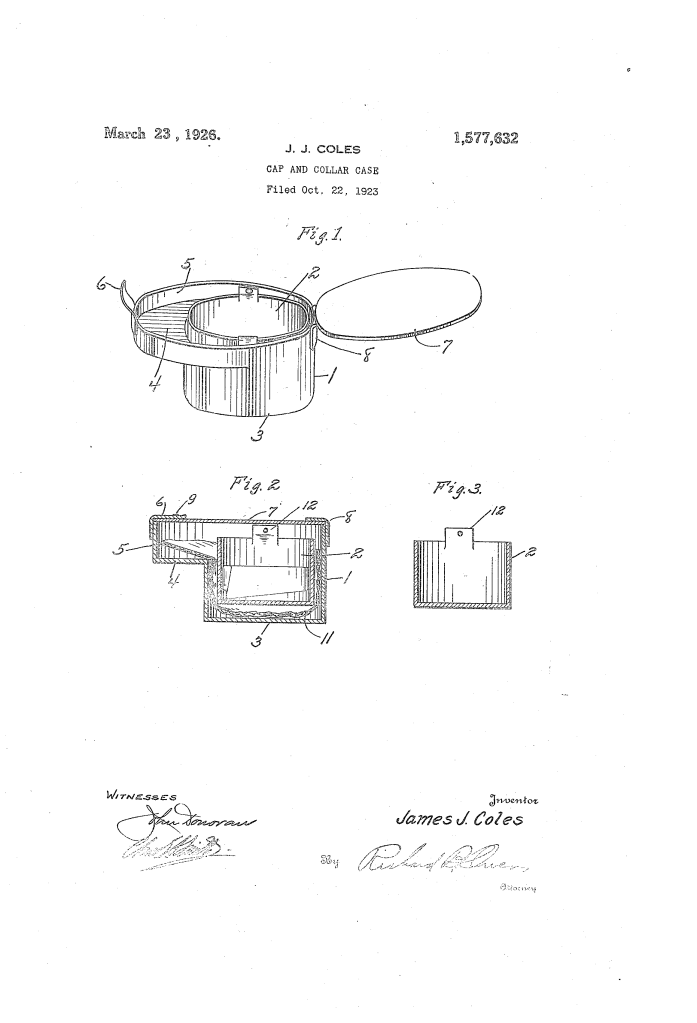
Cap and Collar Case (James J. Coles, No. 1,577,694)
The patent by James J. Coles of Los Angeles, California, describes a specialized Cap and Collar Case (Patent No. 1,577,694, 1926). This invention is a compact travel organizer designed to protect men’s formal accessories—specifically a peaked cap and stiff detachable collars—within a suitcase. Coles’s primary objective was to prevent the “crushing” of a cap’s crown and the “snapping” of its peak during transport. His innovation relies on a nested container architecture, where a smaller collar box fits perfectly inside the hollow crown of the cap, providing internal structural support while maximizing space.
Inventor Background: James J. Coles
James J. Coles was an African American inventor based in Los Angeles during the mid-1920s. His patent reflects the sartorial requirements of the “Roaring Twenties,” an era when detachable collars and sharp caps were standard attire for professional men. Traveling with these items was notoriously difficult, as they were easily ruined by the shifting contents of a trunk or suitcase. Coles’s design demonstrates a mastery of spatial efficiency and protective geometry, solving a specific daily frustration for the traveling public.
Key Mechanical & Structural Systems
The device is composed of two primary containers that interact to maintain the shape of the cargo.
1. The Outer Cap Case (1, 3, 4)
- Body Portion (3): A cylindrical or oval-shaped container designed to receive the crown of a cap (11).
- Tip Extension (4): A wide extension with a flange (5) that creates a dedicated compartment for the cap’s peak (or bill).
- Function: This protects the bill of the cap from being bent or broken, while the deep body prevents the crown from being flattened by other items in a suitcase.
2. The Inner Collar Case (2, 12) (Key Innovation)
- Nested Design: A smaller cylindrical container (2) sized to fit within the empty space of the cap’s crown.
- Removal Tabs (12): A pair of diametrically opposed tabs on the upper edge.
- Function: The collar case fits inside the cap after the cap is placed in the outer case. This “nesting” utilizes the dead space inside the cap to store multiple collars, while the rigid walls of the inner case act as an internal pillar to keep the cap’s crown from collapsing. The tabs (12) allow the user to easily lift the collar box out without disturbing the cap.
3. The Closure and Fastening System (7, 8, 9)
- Hinged Cover (7): A cover attached to the main body via a strap or hinge (8).
- Locking Tab (6): A tab that engages a button (9) on the flange of the extension.
- Function: The cover is designed to fit snugly over the continuous periphery of both the main body and the bill extension, sealing both compartments simultaneously.
Improvements Over Standard Luggage
| Feature | Standard Suitcase Packing | Coles’s Cap and Collar Case |
| Space Utilization | Caps and collar boxes take up separate space. | Nested architecture utilizes the empty crown of the cap. |
| Protection | High risk of cap bills breaking. | Dedicated tip compartment (4) ensures peak safety. |
| Structural Integrity | Soft items often crush the cap crown. | Inner case (2) acts as a rigid internal support. |
| Organization | Small collars get lost in large bags. | Collars are centralized and protected in a dedicated shell. |
Significance to Engineering and Design
James J. Coles’s travel case influenced the development of protective gear cases and modular travel organizers.
- Internal Bracing Logic: The concept of using one product (the collar box) to provide structural support for another (the cap) is a foundational principle in efficient packaging design.
- Integrated Closures: The design of a single cover that seals multiple complex shapes (the cylinder and the flat extension) is an early example of molded closure technology.
- Standardization for Travel: By creating a case specifically “adapted to be placed within a carrier such as a suit case,” Coles helped pioneer the “packing cube” philosophy of organization, where specialized sub-containers make larger luggage systems more efficient.
