
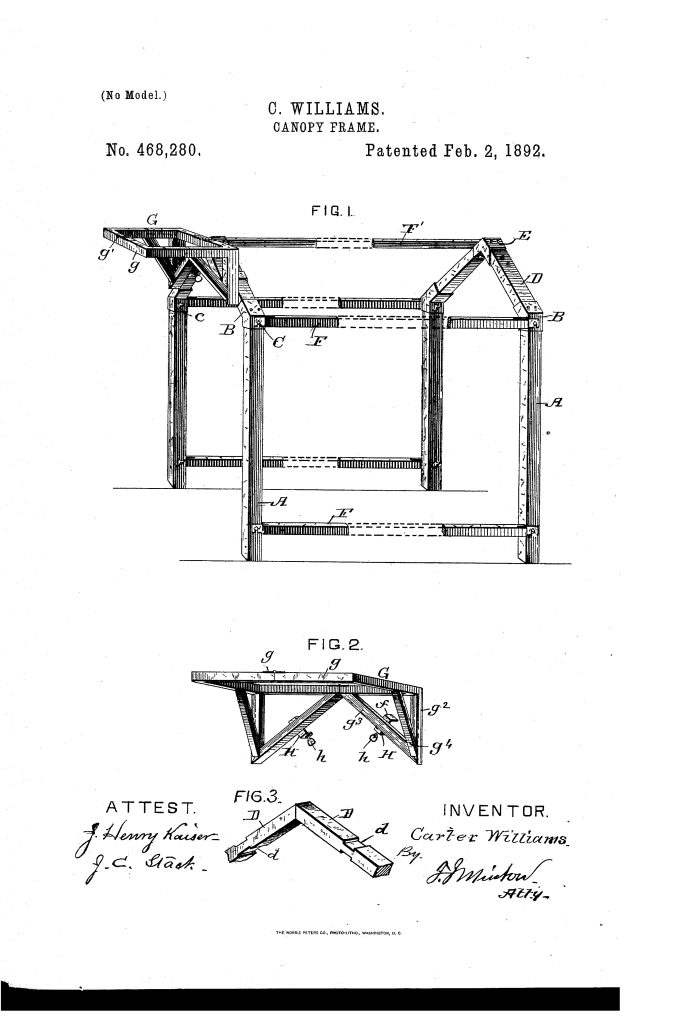
Canopy Frame (1892)
U.S. Patent No. 468,280, granted on February 2, 1892, to Carter Williams, describes a portable, modular canopy system designed for urban dwellings and venues. Carter Williams, a resident of Philadelphia, Pennsylvania, developed this frame to solve the logistical challenges of providing temporary shelter for guests and residents in a rapidly growing 19th-century city.
This invention addressed a common problem for upscale city life: providing a dry, sheltered passage from the curb of the sidewalk to a building’s entrance. Existing structures were often heavy, permanent, or difficult to store. Williams’ design focused on rapid deployment, modularity, and compact portability.
The Innovation: The “Quick-Fold” Modular Design
The brilliance of the Williams frame lies in its tool-less assembly and its ability to collapse into a single transportable package. Unlike traditional timber or heavy iron awnings, this system used a series of specialized “elbows” and thumb-screws to create a rigid structure that could be struck down in minutes.
1. The Universal Elbow System (B, E)
- The frame is held together by hollow elbows that receive the uprights and rafters.
- Instead of permanent pins or nails, Williams used headed bolts (C) and thumb-nuts (c).
- This allowed for “finger-tight” stability, meaning no heavy tools were required on-site.
2. The Hinged Extension Hood (G)
- The most distinct feature is the hood frame (g), which protected the area where people stepped out of carriages.
- The hood is longitudinally divided and hinged, allowing it to fold perfectly in half for storage.
- It utilizes a unique clamp and kerf system: the hood attaches to the rafters via clamps (H) that sit in pre-cut grooves (d) on the frame, ensuring it cannot slide or shift in the wind.
How the Frame Functions
The assembly process followed a logical sequence designed for speed and efficiency:
| Step | Action | Mechanical Purpose |
| 1. Primary Frame | Uprights (A) and rafters (D) are inserted into the hollow elbows. | Establishes the height and pitch of the walkway. |
| 2. Bracing | Side rails (F) and a ridge rail (F’) are notched onto the bolts. | Provides longitudinal stability and prevents the frame from swaying. |
| 3. Hood Attachment | The hinged hood (G) is clamped into the kerfs (d) of the front rafters. | Extends the shelter over the curb for vehicle passengers. |
| 4. Finishing | A canvas or fabric covering is draped over the completed skeleton. | Provides the actual weatherproofing for the guests. |
Key Technical Components
Williams utilized simple but effective mechanical locks to ensure the structure was both sturdy and temporary:
- Rectangular Uprights (A): The square cross-section prevented the poles from rotating inside the elbows, keeping the frame perfectly aligned.
- Metallic Plate Notches (f): The ends of the side rails featured notched plates that “hooked” onto the main bolts, locking the entire series of frames together.
- Foldable Bracing (g2, g3, g4): A complex system of diagonal and vertical braces supported the hood without adding excessive weight, allowing it to remain lightweight enough for one person to lift.
Performance: Modularity and Scale
Williams’ patent emphasizes that the frame was not limited to a single size:
- Infinite Length: By placing multiple frames end-to-end and connecting them with the ridge-rails, a canopy could extend from a short storefront or across a wide sidewalk to a grand estate entrance.
- The “One-Hood” Rule: Because of the modular design, a long canopy only required one hood at the curb-side, making the rest of the system highly economical.
- Storage: Once disconnected, the rafters, rails, and uprights could be “compactly bound together” and wrapped inside the canvas, forming a single package for easy transportation.
About the Inventor: Carter Williams
Carter Williams was a practical inventor working out of Philadelphia during the late Victorian era. His work reflects the “Gilded Age” necessity for formal social infrastructure—specifically the “carriage canopy”—which became a staple for theaters, hotels, and private mansions. Williams’ focus on the portability of the frame suggests he may have been solving a problem for rental businesses or “caterers” of the time who needed to provide temporary luxury accommodations for high-society events.
Summary of Claims
The patent explicitly claims:
- A canopy frame comprising uprights, rafters, and elbows secured by thumb-nuts for easy disconnection.
- A hinged hood that is longitudinally divided to fold over upon itself.
- The specific use of kerfs (grooves) in the top rafters and clamps on the hood to create a secure, non-slip attachment point.
- A modular bracing system that allows multiple units to co-operate to form a canopy of any desired length.
